Lofrans Tigres fail

The issue with a reliance on momentum or the monetum developed in a gust is that though the energy is transferred to the snubber - its transitory.

The gust develops, the yachts moves back, the catenary flattens and the snubber stretches - but the gust then dies and the yacht moves forward. If we recall Panope's video of the moving anchor - it is moving slowly and a transitory gust is not going to have much impact. The gust also needs to develop more tension in the rode than the previous gust - or the anchor will not move, at all (unless there is some other effect - like twitching). It is the same if the yacht reverses up - the combined potential energy of the flattening catenary and the stretching snubber increases and then becomes greater than the energy available from the engine - the yacht slows and stops and is then pulled forward by the release of the potential energy in the rode. Its transitory

Your bogged vehicle is not similar to our situations. The bogged vehicle will normally have its engine running, the pull out vehicle backs up and at some point applies the brakes and becomes a fixed point, or keeps reversing - the bogged vehicle then enjoys the transfer of energy to them, through the snatch strap and in addition runs forward in gear. If the pull vehicle is not held stationary nor continues to reveres, away from the bogged vehicle, the bogged vehicle will stay where it is.

To set an anchor needs a long steady pull, with increasing tension as the anchor dives, again think of the Penope videos, how long he 'sets' the anchors - yet they are still moving. You can only use a yacht as you do a pull out vehicle if you can hold the yacht stationary and allow the potential energy in the rode to impact the anchor - not possible - except for a few seconds.

The advantage of backing up slowly and straightening the catenary is that the engine will commonly be able to hold the yacht stationary. at 3:1. Unless you have deployed too much rode, or you carry too large linked chain and assuming you are not anchoring in 30m - then you can flatten the catenary and the engine can be run with the yacht stationary and you then do not have a transitory tension - it can be sustained. Not so with a snubber as it will continue to stretch and stretch - and then it and the catenary will pull the yacht forward. You could of course repetitively attack the anchor going back and forth - but the seabed will each time resist movement (it needs time) and as you increase the cyclical loading of the snubber - its life gets shorter.

An illustration of the time needed. Your anchor is well set, you are to leave, you shorten up the rode until it is vertical and then you sit and wait, and wait and wait - for the anchor to break out. The seabed does not react to a transitory tension - it needs time. This retrieval process is commonly advised - but the patience required is less than that to set an anchor as when you retreive you have a lever, the shank, acting on the fluke.


The final rule is one we all know - if something on a yacht is to go pear shaped it will happen at the most inconvenient time. Just read the article on the Med storm. Their Witchard hook was fine - until it wasn't . Ground tackle does not fail if you are pottering about - it fails when the wind is singing and the chop is concerning.


I too have been critical of the Panope tests and my comments, intended as being supportive, have been ignored and unanswered. However his moving anchor has been informative. A well known anchor maker suffered the same issue - they respond to their problems by removing the offending video. I, or course, never thought they would remove the vid - so did not save it.

Setting an anchor deeply and removing from a deep set demand both tension and time at tension, as Panope demonstrates and as you demonstrate to yourself every time you retrieve a deep set anchor. High tension might be wasted if it is transitory (think Panope) or your bow roller and windlass at retrieval.

Take care, stay safe

Jonathan.
There may be some major differences in how your light catamaran with small hp behaves compared to a heavy monohull with lots of HP and momentum.
I don't recognise the transitory aspect you mention. If we pull back hard but progressively on our anchor with the snubber attached we load up the anchor and it drives deeper in to the bottom. If we do that in a serious of jerks it will inch its way deeper. You seem to be assuming that a snubber has no elastic limit. It's basic physics. They do. Your snubbers may behave differently to mine. I don't use climbing rope. I use nylon three strand. It's exactly the same rope as I used to use in vehicle recovery. Known as KERR. Our 19t boat simply does not bounce at the end of a loaded snubber as you describe.

If I build revs slowly, we pull the snubber into its elastic limit. At this point it behaves like chain. Your experience sounds like your boat is not capable of doing this due to a different kind of rope and lack of engine/ prop power. For the avoidance of doubt, our 12m long snubber stretches such that we never feel and gusts or movement of the boat at anchor. I suspect it doesn't stretch in the way your climbing ropes do.
I have happened to be snorkeling around the anchor in a sand/broken coral seabed. I shouted to my wife that the anchor wasn't well set. I asked her to give the chain a pull. This is with the snubber set. The boat is moving backwards as I am snorkeling. My wife hasn't built the revs up slowly she just put the boat in reverse so the load came on the anchor as a snatch with boat momentum. I watched the anchor set deeper. It was only about three seconds of hard load but the anchor dug deeper. It was an unusually hard bottom. I asked her to do the same again and the anchor again inched deeper. I realised in that hard bottom it wasn't going to set any deeper so I left it at that.

We use a short length of dyneema as a back up to the snubber should it fail. This dyneema is permanently fixed to the clear on the windlass. It it simply tied through a link on the chain forward of the windlass. I have no concerns about anchor load being taken on the windlass case. The windlass weighs 55kg. Its mounted on M10 bolts through solid deck with 2" teak reinforcement and a s/s angle fixed below deck through the rear fixing bolts. It's super strong.

With regard to Panopes videos. Only certain anchors were still moving. Good anchors set quickly within their own length. Our experience of anchoring here in the Caribbean is that a nicely set anchor will often disappear completely if we have been anchored for a few days in gusty/ breezy conditions. This is happening with the snubber set. It's no different to power setting with the snubber set from what I can see. Even a short duration high pulling load on the anchor will have some movement effect. Lots of these will move an anchor deeper if the force is high enough until the anchor develops sufficient hold and depth to no longer move.

The only failure we have experienced other than a snubber failing a few years ago, is with the Terrible Wichard Hook. The pin sized. It's now bin material.
To recover a deeply set anchor we simply haul the chain tight until the chain is vertical and motor forward. It never fails to break out.

We are currently in Bonaire in the ABC islands of Venezuela. It's a marine park so first time we are not at anchor in many months. A quick anchor survey since everybody's anchors are on show. 20 Rocna, 2 Spade, 2 Mantus, 1 CQR, 1 Danforth, 5 Delta. All these boats are either European, Canadian or US flagged. Rocna seem to have cornered the market very successfully
 
Geem,

I think you have identified correctly that we have different, very different, yachts. I think you will also find that though ours is a catamaran it is relatively light, compared to your yacht, and that many of the forum members here also have lightweight yachts. The reasoning behind the lightweight yacht is very simple - that's what is available in the market, whether new or second hand. The option is a Bav, Jenny, Hanse or Benny and if you look at cats - the choice is from the same manufacturers but might include Catana et al.

Our yachts offer the same or similar accomodation to yours - but ours are lighter. The reason for their lightness we can ignore but one characteristic is that we all have small engines and because we are lighter we have smaller windlass, few of us will have windlass demanding securement with M10 bolts, 2" teak reinforcement and a s/s angle fixed below deck.

On use of climbing rope, Evan Starzinger, Evans Starzinger - Wikipediahttps://en.wikipedia.org › wiki › Evans_Starzinger, used 12/13mm dynamic climbing rope on his 47' aluminium Van De Stadt for his snubbers - its not an unusual choice. The reason for the choice is straight forward - the rope is constructed to optimise elasticity and it has an outer cover that is designed to be abrasion resistant.

Of course nylon has a finite elastic limit - the limit is an extension of 40% and most nylon rope, however it is constructed enjoys this elasticity. However to use the rope cautiously working with a 10% maximum elasticity seems prudent - but if you drive your yacht hard - you will easily exceed that 10% limit and if you make a habit of this practice - you will reduce the life of your snubber.

On using the windlass to secure the anchor - Maxwell/Vetus say:

quote:

Important: Maxwell windlasses must be used in conjunction with a chain stopper and/or alternative snubbing device to take the load off the windlass while laying at anchor. The chain stopper and alternative snubbing system should also be used to secure the anchor in the fully raised position while under way.

unquote

I don't think this cautionary note is unusual - many, most or all windlass makers say something similar.

A member here confirmed to be recently that he had queried of his windlass maker if he could use the horn cleat on the top of his windlass to secure his back up snubber. The reply was an emphatic 'No!' - which did leave he and I wondering what was its function.

We weigh 7t fully laden for a 3 month cruise and have the same windage as a 45' Bav, though it will weigh around 12/13t - the extra weight of the Bav is largely in the keel - the volume of the 2 yachts is more similar than dissimilar (which is why the windage is more similar than dissimilar).

The Maxwell RC 8-8 a fairly typical size of windlass (8mm 1000 watt) used by members here weighs 10kg vs your 55kg.. Ours is the same windlass, an RC 8-6, but with a 6mm, rather than the standard 8mm gypsy, We do not have a capstan. My recollection might be wrong but I'd say that the supplied bolts for securing the windlass to the yacht were M5.


My recommendations and comments are based on

Viewing yachts at boat shows with a specific focus on their ground tackle.

Our own experience and my testing programmes - focussed at ground tackle, building from our J24 to an X99 and then our current cat

Helping people locally on their ground tackle queries

Helping an increasing number of members here with their ground tackle queries.

I try to tailor my comments on what I perceive are the yachts people commonly sail so I make allowance for the simple fact we sail a catamaran and most members sail a monohull. I'm also conscious that many people do not sail a yacht of the size of a Bav 45.

Yes - your experiences are different to ours but airing the differences is valuable - there is no one right answer. At the end of the day it is upto the owner to make his decision based on information he gleans. It is very seldom I know the precise details of an owners yacht or how he uses it - I can only build on what the OP posts and what I know. I certainly do not think any of your practice is incorrect - it works for you. I do think your practice is incorrect for some of the members here - in the same way some of what I say is incorrect for members here. Neither of us can know who reads these posts and we cannot cater easily for the owner of a 18' yacht and a 50' yacht - in one sentence.

I might say that owners would do themselves a great favour if they were more quantitative with their thread (whatever the topic) and with the popularity of the mobile phone the absence of photos on threads is a complete mystery - people have expensive phones and do not use the camera - beggars belief. :)

On this cheerful note - I'm going to bed!. Unlike Concerto I cannot survive, unless on a long passage, on 6 hours of sleep!

Best regards

Jonathan
 
Geem,

I think you have identified correctly that we have different, very different, yachts. I think you will also find that though ours is a catamaran it is relatively light, compared to your yacht, and that many of the forum members here also have lightweight yachts. The reasoning behind the lightweight yacht is very simple - that's what is available in the market, whether new or second hand. The option is a Bav, Jenny, Hanse or Benny and if you look at cats - the choice is from the same manufacturers but might include Catana et al.

Our yachts offer the same or similar accomodation to yours - but ours are lighter. The reason for their lightness we can ignore but one characteristic is that we all have small engines and because we are lighter we have smaller windlass, few of us will have windlass demanding securement with M10 bolts, 2" teak reinforcement and a s/s angle fixed below deck.

On use of climbing rope, Evan Starzinger, Evans Starzinger - Wikipediahttps://en.wikipedia.org › wiki › Evans_Starzinger, used 12/13mm dynamic climbing rope on his 47' aluminium Van De Stadt for his snubbers - its not an unusual choice. The reason for the choice is straight forward - the rope is constructed to optimise elasticity and it has an outer cover that is designed to be abrasion resistant.

Of course nylon has a finite elastic limit - the limit is an extension of 40% and most nylon rope, however it is constructed enjoys this elasticity. However to use the rope cautiously working with a 10% maximum elasticity seems prudent - but if you drive your yacht hard - you will easily exceed that 10% limit and if you make a habit of this practice - you will reduce the life of your snubber.

On using the windlass to secure the anchor - Maxwell/Vetus say:

quote:

Important: Maxwell windlasses must be used in conjunction with a chain stopper and/or alternative snubbing device to take the load off the windlass while laying at anchor. The chain stopper and alternative snubbing system should also be used to secure the anchor in the fully raised position while under way.

unquote

I don't think this cautionary note is unusual - many, most or all windlass makers say something similar.

A member here confirmed to be recently that he had queried of his windlass maker if he could use the horn cleat on the top of his windlass to secure his back up snubber. The reply was an emphatic 'No!' - which did leave he and I wondering what was its function.

We weigh 7t fully laden for a 3 month cruise and have the same windage as a 45' Bav, though it will weigh around 12/13t - the extra weight of the Bav is largely in the keel - the volume of the 2 yachts is more similar than dissimilar (which is why the windage is more similar than dissimilar).

The Maxwell RC 8-8 a fairly typical size of windlass (8mm 1000 watt) used by members here weighs 10kg vs your 55kg.. Ours is the same windlass, an RC 8-6, but with a 6mm, rather than the standard 8mm gypsy, We do not have a capstan. My recollection might be wrong but I'd say that the supplied bolts for securing the windlass to the yacht were M5.


My recommendations and comments are based on

Viewing yachts at boat shows with a specific focus on their ground tackle.

Our own experience and my testing programmes - focussed at ground tackle, building from our J24 to an X99 and then our current cat

Helping people locally on their ground tackle queries

Helping an increasing number of members here with their ground tackle queries.

I try to tailor my comments on what I perceive are the yachts people commonly sail so I make allowance for the simple fact we sail a catamaran and most members sail a monohull. I'm also conscious that many people do not sail a yacht of the size of a Bav 45.

Yes - your experiences are different to ours but airing the differences is valuable - there is no one right answer. At the end of the day it is upto the owner to make his decision based on information he gleans. It is very seldom I know the precise details of an owners yacht or how he uses it - I can only build on what the OP posts and what I know. I certainly do not think any of your practice is incorrect - it works for you. I do think your practice is incorrect for some of the members here - in the same way some of what I say is incorrect for members here. Neither of us can know who reads these posts and we cannot cater easily for the owner of a 18' yacht and a 50' yacht - in one sentence.

I might say that owners would do themselves a great favour if they were more quantitative with their thread (whatever the topic) and with the popularity of the mobile phone the absence of photos on threads is a complete mystery - people have expensive phones and do not use the camera - beggars belief. :)

On this cheerful note - I'm going to bed!. Unlike Concerto I cannot survive, unless on a long passage, on 6 hours of sleep!

Best regards

Jonathan
Sailing around the Caribbean is quite different from sailing in UK coastal waters. Here boats are substantially bigger. Boats are rarely less than 40 ft. We have a large Hylas to our left, a Discovery 55 in front. There are several large Lagoon cats here. All of these boats are way heavier than us. The Discovery weighs 35t. Our boat is a lightweight among these boats. We have similar windlass power and motor power at our disposal. We see plenty of boats power setting with the snubber but not here. Anchoring is forbidden ?
 
Ok, so new windlass ordered to Tahiti, should arrive in 2 weeks (I'll believe it when I see it).

Changes to set up and future operation as follows:

1. I've made a dyneema strop with a chain-hook on it for power-setting and breaking free.
2. I'll keep the clutch cones and gypsy surfaces polished and greased
3. I'll Duralac all the fasteners I can find to make servicing easier in future.
4. The casing is corroded junk, but I should have a decent number of spares from the old one (I'm going to have to grind off the inner clutch cone though).
5. I'll be taking the chain right off the gypsy once the snubber is secured.
fine, although I feel it was an unnecessary expense!

Please REMOVE EACH AND EVERY s/s bolt (which means the 6 around the casing that support the "endcap" behind the gipsy iirc AND the 2 holding the stripper in place) and plaster them with duralac.
IMHO the two s/s M10 iirc bolts holding the s/s stripper onto the alloy casing are the main source of corrosion. My casing had a hole where the stripper mount was and gearcase oil was leaking out, I kid you not!
basically, anywhere you have s/s bolts screwed in the alloy casing, remove one by one and use duralac.

V.
 
I feel it was an unnecessary expense!

Known problems with current windlass, before I even try to get inside:
- deck mounting bolts seized into feet
- one of stripper bolts sheared in casing
- large amount of aluminium corroded away on stripper mounting
- clutch key bent
- shaft keyway bent
- outer clutch cone damaged by bent key (still useable)
- inner clutch cone bent by key, jammed on shaft, needs to be cut off. Inner clutch cone must be replaced.
- bearings and seals need replacing

As you know, in order to check the internals for other issues, I will have to remove the inner clutch cone, which, due to damage, will be a destructive process. This will leave me at anchor without a windlass (it currently limps on) while parts are ordered (2 weeks, minimum). Each separate import of parts is either subject to high import duty or a flat fee of 200USD for a customs broker (mandatory for tax-free status).

The boat was built 44 years ago and the original owner circumnavigated her. There are folders and folders full of receipts and manuals on the boat, but none for the windlass, so I suspect that the windlass is therefore original equipment and has had a long and hard life.
 
There may be some major differences in how your light catamaran with small hp behaves compared to a heavy monohull with lots of HP and momentum.
I don't recognise the transitory aspect you mention. If we pull back hard but progressively on our anchor with the snubber attached we load up the anchor and it drives deeper in to the bottom. If we do that in a serious of jerks it will inch its way deeper. You seem to be assuming that a snubber has no elastic limit. It's basic physics. They do. Your snubbers may behave differently to mine. I don't use climbing rope. I use nylon three strand. It's exactly the same rope as I used to use in vehicle recovery. Known as KERR. Our 19t boat simply does not bounce at the end of a loaded snubber as you describe.

If I build revs slowly, we pull the snubber into its elastic limit. At this point it behaves like chain. Your experience sounds like your boat is not capable of doing this due to a different kind of rope and lack of engine/ prop power. For the avoidance of doubt, our 12m long snubber stretches such that we never feel and gusts or movement of the boat at anchor. I suspect it doesn't stretch in the way your climbing ropes do.
I have happened to be snorkeling around the anchor in a sand/broken coral seabed. I shouted to my wife that the anchor wasn't well set. I asked her to give the chain a pull. This is with the snubber set. The boat is moving backwards as I am snorkeling. My wife hasn't built the revs up slowly she just put the boat in reverse so the load came on the anchor as a snatch with boat momentum. I watched the anchor set deeper. It was only about three seconds of hard load but the anchor dug deeper. It was an unusually hard bottom. I asked her to do the same again and the anchor again inched deeper. I realised in that hard bottom it wasn't going to set any deeper so I left it at that.

We use a short length of dyneema as a back up to the snubber should it fail. This dyneema is permanently fixed to the clear on the windlass. It it simply tied through a link on the chain forward of the windlass. I have no concerns about anchor load being taken on the windlass case. The windlass weighs 55kg. Its mounted on M10 bolts through solid deck with 2" teak reinforcement and a s/s angle fixed below deck through the rear fixing bolts. It's super strong.

With regard to Panopes videos. Only certain anchors were still moving. Good anchors set quickly within their own length. Our experience of anchoring here in the Caribbean is that a nicely set anchor will often disappear completely if we have been anchored for a few days in gusty/ breezy conditions. This is happening with the snubber set. It's no different to power setting with the snubber set from what I can see. Even a short duration high pulling load on the anchor will have some movement effect. Lots of these will move an anchor deeper if the force is high enough until the anchor develops sufficient hold and depth to no longer move.

The only failure we have experienced other than a snubber failing a few years ago, is with the Terrible Wichard Hook. The pin sized. It's now bin material.
To recover a deeply set anchor we simply haul the chain tight until the chain is vertical and motor forward. It never fails to break out.

We are currently in Bonaire in the ABC islands of Venezuela. It's a marine park so first time we are not at anchor in many months. A quick anchor survey since everybody's anchors are on show. 20 Rocna, 2 Spade, 2 Mantus, 1 CQR, 1 Danforth, 5 Delta. All these boats are either European, Canadian or US flagged. Rocna seem to have cornered the market very successfully

We spent 3 months in Bonaire last year. Saltpier was by far and away the best dive spot I went to - enjoy!
 
We spent 3 months in Bonaire last year. Saltpier was by far and away the best dive spot I went to - enjoy!
Yep, we have done that one. Quite different from the rest with the piles. I like the South side of Klien Bonaire myself. Mountainous underwater terrain. Bonaire is a great place to dive. Our fourth time here?
 
This is a video the illustrates some of the issues with using an (elastic) snubber


The anchor is deployed, it engages and tension is taken up in the all chain rode. A snubber is then attached. The clutch on the windlass is disengaged and the tension is applied by the snubber.

Simple stuff.

As revs are increased the snubber stretches further. What now happens is that the chain continuously slips, link by link, as the snubber stretches. If the chain is slowly deploying and the snubber stretching then the yacht is move backs wards - some of the power of the engine is driving the yacht backward - not further setting the anchor. In this case because the chain is kept relatively tight you can see that the yacht moves aft - if you are relying on a long snubber, all forward of the bow and have a decent lazy bight, you simply would not see the snubber stretching (even in the video you only know the snubber is stretching because the chain slowly deploys). Now you could check your GPS to see if you are moving - but the anchor will set more deeply, centimetre by centimetre - to be of value your GPS would need to be very accurate and you would need to move aft in a straight line, no veering.

Now if you have a beefy snubber - it might not stretch, most catamarans have a bridles that is far too beefy - good to manage veering but useless as a snubber.

Now if the chain had been secured with a chain lock or short, inelastic, strop (and the chain lock or strop took the tension) then the all the power of the engine would be directed at the anchor.

The snubber being used is thin and 3 ply - and elastic (you can see it stretching) - its a good snubber. I think that chain is a G70, so also thin, anchoring is less reliant on catenary. If there was a long lazy bight and the engine had more grunt the snubber would continue to stretch and stretch and (and the yacht move slowly back) then fail at 40% extension.


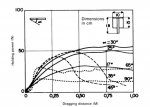
The video also, independently, illustrates why I would not recommend use of a Mantus. At the end of the video the anchor is described as well set. If you look at the shank of the anchor it is parallel with the seabed - so the shank is horizontal. Now if you take a drawing or picture of a Mantus and align the shank to be horizontal you will find that the fluke angle is 16 degrees to the horizontal. All other anchors have their flukes, when set, at 30 degrees (think Fortress) to the horizontal. A fluke at 16 degrees has half the hold of a fluke of the same sizes at 30 degrees. Because the fluke sets at 16 degrees it takes a longer distance to set. Viking fluke sets at 30 degrees, Fortress sets at 30 degrees, the fluke plate of Spade sets at 30 degrees, a Rocna fluke plate sets at 30 degrees and if you use your imagination an Excel fluke plate sets at 30 degrees.

An Inquiry into Anchor Angles - Practical Sailor


IMG_8682.jpeg


This is not a video I have doctored to prove some worthless point. The graphs is not something I have conjured and is a graph repeated by a number of other researchers, in eluding the US Navy - its all completely independent. I just added 2+2 and arrived at 4 - its not rocket science.

Jonathan
 
When considering purchase of a Mantus anchor.

If you take ballasted anchors, Delta, Excel, Spade, Rocna, Supreme they all have the shank/fluke interface, the crown, about 1/3rd forward of the heel of the fluke plate. Unballasted anchors, Brittany, Fortress, Bugel, Viking, Bruce, Viking and Danforth all have their crown at the heel. If you look at a genuine Bruce (and some copies) the crown is actually behind the heel - the shank protrudes behind the heel. Peter Bruce knew what he was doing.

The Mantus is an unballasted anchor - except it has its crown in the location of a ballasted anchor.

Its as if Mantus is a ballasted anchor - without the ballast.

A Bugel (and Viking) are welded fluke anchors (like a Fortress - welded) but because they are welded - with a roll bar to ensure self righting.

When the Danforth was introduced in the 1930s - they either had a lucky break or they knew that the centre of effort must be further aft. Delta has the crown in the correct location, it was introduced in the 1980s, Spade was introduced (along with Fortress) in the 1990s - it too has its crown in the right location.

Kg for kg a Mantus has a similar hold to a Delta, though Mantus might be more reliable (I'm not a Delta fan) and both kg for kg have half the hold of a Rocna or Spade.

Its interesting that a badly designed product should enjoy such feverish support - bordering on religious fervour. Its interesting to see the power of marketing Spade languishes but Mantus (in America) is the latest thing since sliced bread.

None of this is rocket science, none of this is unknown - the topic, crown location has been researched to death.

Suddenly hold is not important, in some quarters.


Apologies for the further thread drift - one thing led to another.....

Jonathan
 
In post 41 Geem mentioned that he uses KERR rope as a snubber and I had mentioned that I thought Marlow made such products (for the military). It appears Geem and I were on the same page - KERR rope is a development of Marlow and UK armed forces - to retreive bogged vehicles.

Sadly they are not going to be of much value to most of us as they are too big, the smallest, 24mm, we could use to lift our catamaran as long as the WLL is a 2:1 factor as the UTS is approx 12t. The UTS of 12mm nylon is about 2.5t Our 6mm chain has a UTS of 4.5t (I tested it) - so we are using a snubber of 10mm with about 25% of the strength of our chain, though as its a bridle we are using 2 snubbers).

K.E.R.R.

The only specification given is their ultimate strength and the size of vehicle for which they are suited (the smallest at 24mm is for a upto 3t weight (or that is my interpretation). They seem to be an anchor plait construction - from looking at the picture. I had some 14mm kernmantle made for a 50' cat - and I worry that we should have used 12mm (we are using 10mm on a 38' cat, having discarded 12mm as insufficiently elastic). So 24mm is pretty hefty.

However it is possible that KERR is a generic name for the product and Geem might know of smaller ropes made for the same application.

To confuse the issue slightly - in correspondence with Marlow the strength of the nylon product, 3 ply, anchor plait, KERR etc is better calculated by weight per metre - rather than diameter of the finished product. Kernmantle is a very tight construction but is not sold to a strength specification (and my idea of its strength maybe cautiously low - my specification is on the basis of how it stretches.).

Jonathan
 
Last edited:
This is a video the illustrates some of the issues with using an (elastic) snubber


The anchor is deployed, it engages and tension is taken up in the all chain rode. A snubber is then attached. The clutch on the windlass is disengaged and the tension is applied by the snubber.

Simple stuff.

As revs are increased the snubber stretches further. What now happens is that the chain continuously slips, link by link, as the snubber stretches. If the chain is slowly deploying and the snubber stretching then the yacht is move backs wards - some of the power of the engine is driving the yacht backward - not further setting the anchor. In this case because the chain is kept relatively tight you can see that the yacht moves aft - if you are relying on a long snubber, all forward of the bow and have a decent lazy bight, you simply would not see the snubber stretching (even in the video you only know the snubber is stretching because the chain slowly deploys). Now you could check your GPS to see if you are moving - but the anchor will set more deeply, centimetre by centimetre - to be of value your GPS would need to be very accurate and you would need to move aft in a straight line, no veering.

Now if you have a beefy snubber - it might not stretch, most catamarans have a bridles that is far too beefy - good to manage veering but useless as a snubber.

Now if the chain had been secured with a chain lock or short, inelastic, strop (and the chain lock or strop took the tension) then the all the power of the engine would be directed at the anchor.

The snubber being used is thin and 3 ply - and elastic (you can see it stretching) - its a good snubber. I think that chain is a G70, so also thin, anchoring is less reliant on catenary. If there was a long lazy bight and the engine had more grunt the snubber would continue to stretch and stretch and (and the yacht move slowly back) then fail at 40% extension.


The video also, independently, illustrates why I would not recommend use of a Mantus. At the end of the video the anchor is described as well set. If you look at the shank of the anchor it is parallel with the seabed - so the shank is horizontal. Now if you take a drawing or picture of a Mantus and align the shank to be horizontal you will find that the fluke angle is 16 degrees to the horizontal. All other anchors have their flukes, when set, at 30 degrees (think Fortress) to the horizontal. A fluke at 16 degrees has half the hold of a fluke of the same sizes at 30 degrees. Because the fluke sets at 16 degrees it takes a longer distance to set. Viking fluke sets at 30 degrees, Fortress sets at 30 degrees, the fluke plate of Spade sets at 30 degrees, a Rocna fluke plate sets at 30 degrees and if you use your imagination an Excel fluke plate sets at 30 degrees.

An Inquiry into Anchor Angles - Practical Sailor


View attachment 136349


This is not a video I have doctored to prove some worthless point. The graphs is not something I have conjured and is a graph repeated by a number of other researchers, in eluding the US Navy - its all completely independent. I just added 2+2 and arrived at 4 - its not rocket science.

Jonathan
I fail to see the problem in the Mantus setting video. It's pretty well identical to how we set our anchor. The boat stops stretching the snubber but is still applying engine horse power. At this point, when there is no more snubber stretch, all engine hp is being passed to the anchor in exactly the same way as if you did not have a snubber and we're using chain. They obtained a nice anchor set as we would expect.
 
The key is the chain.

The engine is running flat chat, the snubber is under tension - but its the yacht that is moving, backwards (away for the anchor). If the yacht is moving backwards then the anchor is not setting as deeply as it could. The fight is between anchor/seabed and engine - the seabed is winning as its the yacht that is moving - in retreat. Except in this case of the video - the snubber is stretching and the yacht still retreats. So - the engine is doing its work and all its efforts are focussed at stretching the snubber and driving the yacht aft. And there was me thinking power setting was all about securing the anchor.....

We want ALL the effort directed at setting the anchor more deeply. We want the anchor and yacht to move together - same distance apart. If the distance is increasing between yacht and anchor (the chain is deploying) then......

Or don't bother thrashing the engine and stretching the snubber - deploy the anchor on chain, decide the scope you find suitable for your anchor, gently back up and slowly straighten the catenary increasing the revs gently (no thrashing) set the anchor so you are comfortable it has engaged - and go have a beer :). If your anchor regularly does not set 'by itself' (it drags) after a a managed power set buy a modern anchor, Spade, Knox, Rocna etc (and enjoy a beer).

If you have a 30hgp engine the tension you can develop in your rode when power setting, flat chat, is about 300kg. A 15kg modern has the potential to set were the wind to increase sufficiently :) to set it, without your intervention, to 2,000kg.

A little trick seldom mentioned - with the engine in reverse - lean over the bow and simply using your fingers - touch the chain rode. If its set - the chain will be stable, if the anchor is still moving through the seabed - you will feel it. If the anchor is dragging over the seabed - you will know. Just practice - you will learn very quickly good and bad. The chain, without a snubber, is a magnificant transmitter of movment - but a snubber will dampen any movement (that's why you have a snubber at all :) )

Jonathan
 
The key is the chain.

The engine is running flat chat, the snubber is under tension - but its the yacht that is moving, backwards (away for the anchor). If the yacht is moving backwards then the anchor is not setting as deeply as it could. The fight is between anchor/seabed and engine - the seabed is winning as its the yacht that is moving - in retreat. Except in this case of the video - the snubber is stretching and the yacht still retreats. So - the engine is doing its work and all its efforts are focussed at stretching the snubber and driving the yacht aft. And there was me thinking power setting was all about securing the anchor.....

We want ALL the effort directed at setting the anchor more deeply. We want the anchor and yacht to move together - same distance apart. If the distance is increasing between yacht and anchor (the chain is deploying) then......

Or don't bother thrashing the engine and stretching the snubber - deploy the anchor on chain, decide the scope you find suitable for your anchor, gently back up and slowly straighten the catenary increasing the revs gently (no thrashing) set the anchor so you are comfortable it has engaged - and go have a beer :). If your anchor regularly does not set 'by itself' (it drags) after a a managed power set buy a modern anchor, Spade, Knox, Rocna etc (and enjoy a beer).

If you have a 30hgp engine the tension you can develop in your rode when power setting, flat chat, is about 300kg. A 15kg modern has the potential to set were the wind to increase sufficiently :) to set it, without your intervention, to 2,000kg.

A little trick seldom mentioned - with the engine in reverse - lean over the bow and simply using your fingers - touch the chain rode. If its set - the chain will be stable, if the anchor is still moving through the seabed - you will feel it. If the anchor is dragging over the seabed - you will know. Just practice - you will learn very quickly good and bad. The chain, without a snubber, is a magnificant transmitter of movment - but a snubber will dampen any movement (that's why you have a snubber at all :) )

Jonathan
Jonathan, there is fundamental physics issue here. You are assuming that the snubber will stretch for ever. It doesn't do that. Once the snubber stops stretching all the force of reversing goes into the anchor. We are talking of a few seconds at most on my boat until the snubber is stretched. The snubber stretches no more and the anchor sets as if you are setting on an all chain rode. Go back to your 2kg weights. One hanging on a snubber, one on chain. Both weights exert 2kg. When hanging with a 2kg weight in steady state you have no idea that one rode is stretchy until you remove the weight but they both exert 2kg load on the rode. If you add another kg to the two rodes the one with the elastic snubber will likely stretch a little further but it will still have exactly the same 3kg load tension as the chain rode. The engine hp determines the tension in the rode not the material the rode is made of
 
Jonathan, there is fundamental physics issue here. You are assuming that the snubber will stretch for ever. It doesn't do that. Once the snubber stops stretching all the force of reversing goes into the anchor. We are talking of a few seconds at most on my boat until the snubber is stretched. The snubber stretches no more and the anchor sets as if you are setting on an all chain rode. Go back to your 2kg weights. One hanging on a snubber, one on chain. Both weights exert 2kg. When hanging with a 2kg weight in steady state you have no idea that one rode is stretchy until you remove the weight but they both exert 2kg load on the rode. If you add another kg to the two rodes the one with the elastic snubber will likely stretch a little further but it will still have exactly the same 3kg load tension as the chain rode. The engine hp determines the tension in the rode not the material the rode is made of
Exactly.
This is the point I explained to Neeves, but he misunderstands.
If the stretchy snubber is already stretched, and you are motoring the anchor in, then zero engine horsepower, (or none of the yacht's static bollard pull to be precise) , is being used to maintain that stretch.
All the pull goes to the chain/anchor combination.
This is different to eg, holding out a weight at arm's length, which does actually burn metabolic calories.
 
Last edited:
You both are ignoring the fact that the yacht moves aft. If the tension in the rode, snubber and chain, was kept stable - the yacht would have reversed until the snubber reached its elastic limit at that tension - which would increasingly reduce the life of the snubber. You both appear to treat a snubber as being unaffected by stressing it, unnecessarily.

I understand perfectly that the power of the engine is transferred in full and directly to the anchor (once the snubber has reached its elastic limit at that tension) , what ever the link is between yacht and anchor.

Nylon stretches almost linearly to its ultimate elasticity of about 40%. In order to stretch to that 40% failure would need increasing revs (and a big engine or thin rope). At 40% elasticity the rope will fail - its UTS. When you use a snubber you will not stretch anywhere near 40% and it will have potential elasticity available. I'd suggest considering a 4:1 safety factor - which means you should be working with a 10% limit of elasticity. Consequently the idea there is an ultimate elasticity beyond which nylon will not stretch is irrelevant - unless you are using to destruction.

The point of the video is that the yacht moves aft and the distance increases between yacht and anchor. This means that some of the extra power being generated by the engine is further stretching the snubber and driving the yacht aft - and this power necessary to further stretch the snubber and drive the yacht further from the anchor would be better directed, exclusively, at more deeply setting the anchor. As the snubber has used little of its potential elasticity increasing revs will simply further stretch the snubber and increase the length of chain slipping through the clutch. The answer is to lock the clutch. If you lock the clutch the snubber will be unable to stretch further and the power of the engine will be directed directly at the anchor. But you could do this in the first place by forgetting the snubber and simply using the chain (which is what everyone used to do, and many still do, - no snubber, all chain rode).

I fail to understand the need to use the snubber, at all, when setting other than as a chain lock. If you gently reverse up, straighten the catenary and slowly increase revs all of the tension in the chain is directed at the chain. There is no need to stretch the snubber and reduce its life and the tension developed in the chain is instantly imposed on the anchor - there is no time lag as the snubber stretches, no holding the snubber - stressed - during the time, minutes not seconds, required for the anchor to dive more deeply.


So explain exactly why the use of a snubber makes power setting an anchor more effective.


Jonathan
 
Last edited:
Nylon stretches almost linearly to its ultimate elasticity of about 40%. In order to stretch to that 40% failure would need increasing revs (and a big engine or thin rope). At 40% elasticity the rope will fail - its UTS. When you use a snubber you will not stretch anywhere near 40% and it will have potential elasticity available. I'd suggest considering a 4:1 safety factor - which means you should be working with a 10% limit of elasticity. Consequently the idea there is an ultimate elasticity beyond which nylon will not stretch is irrelevant - unless you are using to destruction.

The point of the video is that the yacht moves aft and the distance increases between yacht and anchor. This means that some of the extra power being generated by the engine is further stretching the snubber and driving the yacht aft - and this power necessary to further stretch the snubber and drive the yacht further from the anchor would be better directed, exclusively, at more deeply setting the anchor. As the snubber has used little of its potential elasticity increasing revs will simply further stretch the snubber and increase the length of chain slipping through the clutch. The answer is to lock the clutch. If you lock the clutch the snubber will be unable to stretch further and the power of the engine will be directed directly at the anchor. But you could do this in the first place by forgetting the snubber and simply using the chain (which is what everyone used to do, and many still do, - no snubber, all chain rode).

I fail to understand the need to use the snubber, at all, other than as a chain lock. If you gently reverse up, straighten the catenary and slowly increase revs all of the tension in the chain is directed at the chain. There is no need to stretch the snubber and reduce its life and the tension developed in the chain is instantly imposed on the anchor - there is no time lag as the snubber stretches, no holding the snubber - stressed - during the time, minutes not seconds, required for the anchor to dive more deeply.


So explain exactly why the use of a snubber makes power setting an anchor more effective.


Jonathan
Stretch of the snubber is irrelevant. You seem to be assuming that because the snubber stretches then the power of the engine doesn't manifest itself in a pull on the anchor. That simply isn't the case. Don't get hung up on snubber stretch. The anchor doesn't know your using one. It will still see the same HP pulling on it in a steady state as it would as if you are using all chain.
The reason to use the snubber is simple. It takes the load off the windlass. Once you have set the anchor on the snubber you are done. Just connect the back up strop and go for a swim.
You seem to be assuming that we would weaken our snubber by pulling with the engine but the steady state load is tiny compared to the load imposed in a huge gust when a slack chain and snubber could create a massive momentum load as 19t of boat heads back at say one knot. We would never get anywhere near that kind of snatch load on the snubber using an engine. The biggest snatch loads we ever see are on mooring lines in a harbour with swell. Those loads are truly huge on our boat.
We never get anywhere near those loads on our snubber unless a big squall hits hard and fast and that all about monentum
 
Ok, so new windlass ordered to Tahiti, should arrive in 2 weeks (I'll believe it when I see it).

Changes to set up and future operation as follows:

1. I've made a dyneema strop with a chain-hook on it for power-setting and breaking free.
2. I'll keep the clutch cones and gypsy surfaces polished and greased
3. I'll Duralac all the fasteners I can find to make servicing easier in future.
4. The casing is corroded junk, but I should have a decent number of spares from the old one (I'm going to have to grind off the inner clutch cone though).
5. I'll be taking the chain right off the gypsy once the snubber is secured.
I don't know if the Tigres is the same but my Cayman has a thick rubber gasket to be placed between the windlass and the deck, the gasket has a sort of brim all around which accumulates water to eventually corrode the casing, when I replace my windlass I will not use that thing again, perhaps rubber washers under the mounting bolts but nothing else.
I think I would also coat the underside of the casing with something like Duralac or Lanocote.
 
I don't know if the Tigres is the same but my Cayman has a thick rubber gasket to be placed between the windlass and the deck, the gasket has a sort of brim all around which accumulates water to eventually corrode the casing, when I replace my windlass I will not use that thing again, perhaps rubber washers under the mounting bolts but nothing else.
I think I would also coat the underside of the casing with something like Duralac or Lanocote.

I'm in the process of mounting a new Tigres.
Lofrans supply a CD with the mounting template, designed to be printed out on paper, and used for drilling the holes through deck.
I took it to a specialist signwriter/graphics firm, who do vinyl wraps and stickers, for van signwriting etc.
I told them what it was for, and they cut the template out of some UV-proof, waterproof, electrically insulating, vinyl-type stuff. About 2mm thick. £12.00.

I will put that between the windlass and the hardwood pad, it will hopefully slow corrosion.
I think rubber would allow too much movement, I want everything rigid, not cushioned. That lip on the supplied rubber gasket sounds like built-in obselescence!
 
Just thinking of it, maybe even cutting out only the four bolts gaskets? After all the more the casing remains in free air the better. IIRC the bottom of the casing has a hole where the three cables pass through, maybe isolate that hole and keep most of the aluminium without contact with the deck?
They are good windlasses it's a pity that not enough attention has been paid to such relevant details.

I'm in the process of mounting a new Tigres.
Lofrans supply a CD with the mounting template, designed to be printed out on paper, and used for drilling the holes through deck.
I took it to a specialist signwriter/graphics firm, who do vinyl wraps and stickers, for van signwriting etc.
I told them what it was for, and they cut the template out of some UV-proof, waterproof, electrically insulating, vinyl-type stuff. About 2mm thick. £12.00.

I will put that between the windlass and the hardwood pad, it will hopefully slow corrosion.
I think rubber would allow too much movement, I want everything rigid, not cushioned. That lip on the supplied rubber gasket sounds like built-in obselescence!
 
Top