Lofrans Tigres fail

Just thinking of it, maybe even cutting out only the four bolts gaskets? After all the more the casing remains in free air the better. IIRC the bottom of the casing has a hole where the three cables pass through, maybe isolate that hole and keep most of the aluminium without contact with the deck?
They are good windlasses it's a pity that not enough attention has been paid to such relevant details.

I was also pondering, that free air under the windlass sounds good as well, I did think about it. Maybe even mounting on thick spacers or short pillars.

(The sealing problems would be very awkward for me though, my deck structure is tricky.
My deck is glassfibre over marine ply, over Sikaflex, over the original laid pine planks and I have to be very careful about water, specially rain, getting in there and percolating sideways, with inevitable hard-to-trace leaks and rot. )

Yes they seem to be good winches, and the benefit of choosing the most popular make, with all its known faults, is the amount of advance warning and long-term woes available to read about online!
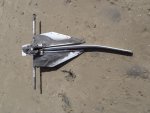
 
Well, today the windlass limped on to lift the 60m of 10mm chain we have had deployed for the last week or so. When we anchored later on, I dropped the spare anchor instead of the 25kgRocna/all-chain we now have out the Fortress-fx23 with 10m of chain and 50m of 3 ply nylon rode - my thinking being that worn bearings are likely to be on the chain-gypsy side rather than the rope gypsy side and that it should be feasible to retrieve without a windlass at all, if necessary.

In 2 years of living aboard, this is the first time we've slept with the fortress out...
 
The fortress held just fine, and I managed to retrieve it *by hand* this morning. I'd heard some horror stories about retrieving fortresses, so I wasn't sure it would be possible.

The Fortress instructions for retrieval are to drive up to the anchor, pulling in the rode until it's vertical, pull as tight as you can and cleat it off, then wait, if it doesn't break free, reverse to break it out. The reversing bit seems counter-intuitive, but it worked like a charm!
 
The fortress held just fine, and I managed to retrieve it *by hand* this morning. I'd heard some horror stories about retrieving fortresses, so I wasn't sure it would be possible.

The Fortress instructions for retrieval are to drive up to the anchor, pulling in the rode until it's vertical, pull as tight as you can and cleat it off, then wait, if it doesn't break free, reverse to break it out. The reversing bit seems counter-intuitive, but it worked like a charm!

The trick is - be patient for any anchor that is difficult to retreive. As long as it is 'only' seabed that is holding the anchor then the seabed will eventually give up the fight. If you are aggressive, specifically with a Fortress or aluminium Spade then there is a chance to bend the shank or in the case of the Fortress the shank and/orflukes. Fortress may have a magnificent no questions asked warranty for life - but its not much use if you are 250nm from Tahiti.

Fortress have a misplaced reputation for tripping easily, in a change of tide/wind. You have probably found that a well set Fortress sets well and with a long rode (not one vertically above) is safe. I suspect the danger is that people oversize their choice of Fortress, then cannot set it deeply and in a change of tide the rode gets under the protruding stock - and the anchor trips. The answer it the correct size of Fortress, or one size down.

Jonathan
 
The fortress held just fine, and I managed to retrieve it *by hand* this morning. I'd heard some horror stories about retrieving fortresses, so I wasn't sure it would be possible.

The Fortress instructions for retrieval are to drive up to the anchor, pulling in the rode until it's vertical, pull as tight as you can and cleat it off, then wait, if it doesn't break free, reverse to break it out. The reversing bit seems counter-intuitive, but it worked like a charm!

This is what happens when you lack the patience. The anchor was set with a 500kg tension and then retrieved 'backwards' with a snatch load. Obviously the 'backwards' was slightly off centre - though I'm not sure that getting orientation exactly right would have changed the outcome

Fortress marine grade aluminium.jpeg

Thank goodness for Fortress' no questions asked warranty. I did try to bend the shank straight, without real success. I don't know the tension applied to break the anchor out, the display is too wquick but in another test the winch operator, on a commercial research vessel, suggested that the break out tensions were 'similar' to the set tensions (or hold)


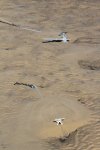
This is the problem with having an anchor that is too big, and in this case may be the reason why Fortress have the reputation for tripping easily. The protruding anchor is a FX37, the buried anchor is a FX 23 - both have been 'set' to the same tension, under water.

IMG_9838 2.jpeg

The problem of self tripping is not restricted to Fortress. Many anchors have protuberances that appear to be perfectly designed to catch the rode in a change of wind or tide, Rocna, Spade, Mantus, Viking and an Excel, below

As an aside - the idea that anchor slice into the seabed like a knife in butter needs some modification. Note the amount of seabed that has been moved in the photo above. The Excel below shows the same seabed excavation - fluke anchors plough the same way as do convex anchors. :). As tension is applied the fluke does bury - but the anchor is moving forward (anchors set in their own shank length) and the seabed is being heaped up. The deeper you anchor 'dives' the more resistance there will be to movement (modification) of the seabed - power setting also needs patience - a short sharp burst of engine power is probably inadequate - a long sustained increase in engine power and holding at whatever you choose as maximum revs - would be more effective.
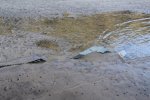
I have lots of pictures of anchors set - underwater, and still underwater. I don't normally see (and I have checked) these signs of excavation. I wonder if normally, because there is time between setting and taking a picture of a set anchor that this excavated sand might normally be 'smoothed out' by wave and current action - particularly as having been excavated it will be soft.

It might dispel the idea that convex anchors are not to be recommended as they are simply ploughing (omitting to note that other anchors 'simply plough'. :)

IMG_9752 2.jpeg

I have not intentionally set the Excel shallow - I just set it without thinking too much. The near heel of the anchor would neatly 'take' the rode with a change of tide and if new tension applied correctly (or incorrectly if you were to actually rely on the anchor) it would trip the anchor.

Oversizing your anchor beyond the recommendation of the anchor maker may have downsides.

Jonathan
 
Last edited:
The new windlass finally arrived in Tahiti. As it was tge same as the old one, the swap was easy. I tried to take as many parts as I could from tge old one as spares for the new one. I managed to get the old motor out, but even after using pry-bars to get the inner chain gipsy clutch off, it was impossible to remove the rope drum - I presume the steel key had corroded with the aluminium drum. No amount of heat, pry bars, cold chiselling or whacking with a mallet would get the drum off, so I'm very glad I decided to order a new one a month ago!
 
The new windlass finally arrived in Tahiti. As it was tge same as the old one, the swap was easy. I tried to take as many parts as I could from tge old one as spares for the new one. I managed to get the old motor out, but even after using pry-bars to get the inner chain gipsy clutch off, it was impossible to remove the rope drum - I presume the steel key had corroded with the aluminium drum. No amount of heat, pry bars, cold chiselling or whacking with a mallet would get the drum off, so I'm very glad I decided to order a new one a month ago!

removing the rope drum was v.hard I remember. Eventually succeeded using a heavy duty custom construction with 30x30x3mm angles, drilled, placed between rope drum and body and scew them against a centrally place cross section with a bolt where the shaft was. Rather complex, lots of swearing does help (as always...)

Now that its new, I'd remove stripper bolts and cover them with duralac or something similar. Same for the allen tappers that hold the enclosure, or any other ss bolt on ali tbh!

V
 
removing the rope drum was v.hard I remember. Eventually succeeded using a heavy duty custom construction with 30x30x3mm angles, drilled, placed between rope drum and body and scew them against a centrally place cross section with a bolt where the shaft was. Rather complex, lots of swearing does help (as always...)

Now that its new, I'd remove stripper bolts and cover them with duralac or something similar. Same for the allen tappers that hold the enclosure, or any other ss bolt on ali tbh!

V
Yep, I removed all the new allen bolts, the 2 on the stripper, the one on the end of the drum and the one on the gipsy lock and tefgelled them all (no duralac here).
 
Yep, I removed all the new allen bolts, the 2 on the stripper, the one on the end of the drum and the one on the gipsy lock and tefgelled them all (no duralac here).

I'm guessing you have bolted the motor to 'something', bit of reinforcement - with stainless bolts and you have tefgelled these bolts also.

The other thing to do is to coat the new motor with something to protect it against corrosion. The motor casings are commonly mild steel. If you were in the UK I'd suggest the gunk they use to seal cars against corrosion caused by the spreading of salt in the winter - but I cannot think it will be easy to find in Tahiti :(. This is only a bit of a stop gap as the motors have air holes, for cooling and they can then corrode from the inside - but every little helps. (and don't block the air holes - as they are there for cooling).

Jonathan
 
I'm guessing you have bolted the motor to 'something', bit of reinforcement - with stainless bolts and you have tefgelled these bolts also.

The other thing to do is to coat the new motor with something to protect it against corrosion. The motor casings are commonly mild steel. If you were in the UK I'd suggest the gunk they use to seal cars against corrosion caused by the spreading of salt in the winter - but I cannot think it will be easy to find in Tahiti :(. This is only a bit of a stop gap as the motors have air holes, for cooling and they can then corrode from the inside - but every little helps. (and don't block the air holes - as they are there for cooling).

Jonathan

On the Tigres, the motor is inside the casing and protected by a seal, bolted to the gearbox. The old motor was spotless despite the chain gipsy clutch and the rope drum being internally corroded & damaged beyond repair.
 
Top