Lofrans Cayman windlass Gypsy size

Cheeky Girl

Well-Known Member
Joined
23 Feb 2004
Messages
298
Location
Stirling, Scotland
Visit site
Hi
I have a Lofrans Cayman windlass. I replaced all the chain with 10mm ISO chain as the sseemed to fit the windlass the best.

When raising the chain all is well but on lowering it the chain seems to jump out :cry:

Does this mean the gypsy is the wrong size and should be a 10mm DIN one?

So how do I find which gypsy the windlass is fitted with.

Thanks for any help
Graham
 
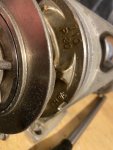
We have 10mm ISO chain on a Lofrans windlass. The gypsy has P.30 stamped on it, which I think corresponds to the inside link measurement of 30mm for ISO. DIN has a link measurement of 28mm. Conveniently, it's currently sitting on my workbench at home... hence the photo. Sorry for the poor focus!

IMG_2496.jpeg

Edited to fix my confusion between ISO and DIN!
 
Last edited:
We have 10mm DIN chain on a Lofrans windlass. The gypsy has P.30 stamped on it, which I think corresponds to the inside link measurement of 30mm for DIN. ISO has a link measurement of 28mm. Conveniently, it's currently sitting on my workbench at home... hence the photo. Sorry for the poor focus!

View attachment 98529
It's the other way around, ISO has 30mm pitch :)
Chain 10mm ISO DIN.pdf
 
Hi
I have a Lofrans Cayman windlass. I replaced all the chain with 10mm ISO chain as the sseemed to fit the windlass the best.

When raising the chain all is well but on lowering it the chain seems to jump out :cry:

Does this mean the gypsy is the wrong size and should be a 10mm DIN one?

So how do I find which gypsy the windlass is fitted with.

Thanks for any help
Graham
What was the previous chain? Did you compare a length of the old with a length of the new?

Richard
 
Also check if your chain is doing at least a 90° turn around the gypsy. Otherwise there aren't enough links engaged and it can jump under sudden tension (like when the anchor is in freefall or you're trying to pull a deep set Rocna out of the mud). Someone on the Bavaria forums had this problem and solved it by installing an additional roller that guides the chain around the gypsy just slightly further.
 
Also check if your chain is doing at least a 90° turn around the gypsy. Otherwise there aren't enough links engaged and it can jump under sudden tension (like when the anchor is in freefall or you're trying to pull a deep set Rocna out of the mud). Someone on the Bavaria forums had this problem and solved it by installing an additional roller that guides the chain around the gypsy just slightly further.

I found this wasn't enough when we were supplied with the wrong chain. It really needs a full wrap to show up the difference if the gypsy is well used.
 
As far as I am aware every gypsy for every windlass has the chain size stamped, engraved or cast into the gypsy. If you are lucky the mark will be obvious, some are between the plates and you need to take the gypsy off to find the mark. Gypsy removal is relatively easy and painless. I think all windlass are distributed, to a great or lessor extent, internationally and windlass makers thus need to stock a range of gypsies to cater for the different markets. In Europe it is relatively easy all chains are made to the same, or identical standard (varying only by chain, wire, size) except for 10mm metric chain that is made to 2 standards. In America (and markets serviced by American chain makers) there is a bewildering range of link size standards: BBB, G30, G43 which are all different. G43 and G70 Imperial are the same size of link. There is some overlap, as the image from Shuggy shows as the gypsy is, apparently, compatible with both a Metric and Imperial size.

Somewhere on your gypsy will be a part number, it might also be on the documentation for the windlass, the part number will define what the specification is of the appropriate chain. Ask the windlass maker - they sometimes have spread sheets on their websites with the cross section of gypsies they stock.

Most of the big chain makers for example Peerless and CMP make the complete cross section of chain sizes and link sizes and sometimes you can buy imperial chain in metric markets and vice versa. Suppliers to America of chain all mark their chain with a simple code, say 'P' for Peerless and a number say 7 (hence P7 for a G70 grade from Peerless). Peerless and Campbell (who use 'C' for Campbell) also mark their chain with country of origin, USA. Maggi chain was marked A4 or A7 for Aqua G40 or Aqua G70. Sometimes every link isa marked, sometimes its every few links. CMP do seem to mark their chains well. Chinese chains tend not to be marked, at all - hopefully that will change. Lofrans have entered the chain market, their chains are marked (but I forget how :( ). PWB (now owned by Kito who also own Peerless) and Serafini (both in Australia) use PWB and S to mark their chains

As Roberto indicates one way to confirm the size of your gypsy is to buy lengths of chain and wrap them round the gypsy. Commonly chandlers will charge for the length of chain needed and its easier (or better) to take the gypsy off and take it to the chandler. Some chandlers actual can mount your gypsy on a simple rig and run the length of chain you want to buy through the gypsy.

If you want to change your chain size - you will need a new gypsy. Gypsies are expensive (part of the cost being the need to keep stock for the bewildering number of chain sizes). It is better to think deeply about the chain you want when you buy a new yacht - or wait till you need to replace the windlass. We downsized from 8mm metric to 6mm metric and replaced the, 20 year old, windlass (and have not regretted it).

Modern gypsies, or some of them, are now designed to accept mixed rodes - so will retrieve chain and rope of the appropriate size. This does not work if you downsize link size but use a stronger chain, so downsize from 10mm G30 to 8mm G70 as the appropriate rope (of the correct strength) is too big for a 8mm gypsy. In our case, where we downsized from 8mm G30 to a 'G70' quality 6mm we use only chain - so its not an issue.

I think Vyv (Cox) on his website defines metric link sizes and specifications for strength. There is similar information on Rocna's website, CMP's Titan website and the NACM (in America) have all the imperial chain sizes and strength specifications on their website. Vyv's website is possibly the most informative, for metric chain, as he also includes actual tests conducted on chain - all the information may also be included in his book. Practical Sailor, US, has had a series of articles on chain, both Imperial and Metric - use their search engine.

Jonathan
 
Top