Lithium batteries - are they worth it?

I wonder how memory effect can be avoided on banks that charge only with solar panels which are unable to maintain constant output from one hand and have a low charge rate also. From alternator or shore power, the current is big and steady at bulk, while reduces at the absorption phase and the charge stops at the desired level. For example, if the battery solar-charged to 60% during the day and charge stopped at sunset, we would have a partial charge which is supposed to harm the battery due to memory effect. Additionally, another problem, with solar panels, is that only a voltage termination can take place which is not a precise method for SoC, because the current is already small from the beginning bulk stage let's say at 0.05 C ( 100w solar giving 5 amps on a 100ah battery) Any thoughts?

From my reading so far (but not from practical experience) memory effect in LFP batteries is still a bit of an unknown. I've read people arguing about whether it exists at all. Some user reports suggest that - just as you say - consistent undercharging to 60 to 70% SOC can result in loss of capacity so making some effort to getting to full charge (but not holding it there on float) from time to time would be useful.
 
Last edited:
LiFePO4 is so compelling. The charging efficiency and tolerance of partial recharging especially.
Is there some kind of compromise solution where you run a small Li bank alongside a Pb one? I fancy an electric outboard for my yet to be built nesting dinghy... A smallish (say 80Ah) Li battery for this could be hooked up to the yacht to provide additional capacity. Just wondering how best to configure this with B2B charger etc- I'd rather be cycling the Li battery than the main bank given their relative lifespans.

A Sterling Battery to Battery charger would be very good for this since the custom settings allow you to control the length of time for absorption as well as the target voltage. (As said above long absorption times are what can kill LFP.) You have to opt for float but choosing about 13.2 volts for this effectively gives no float at all. They are still on clearance at about half-price last time I looked.
 
They are but the Victron Orion Smart would be a much nicer unit to work with. The caveats being it's more expensive and only 30 amps instead of 60. The Sterling is fiddly, and whilst it does have custom settings, it's not precise. You can only go up on 0.2v intervals. I think once mine is repaired I will get rid of it.
 
How about this idea... Get a Li bank that is big enough to just about last a day at minimal consumption. Supplement with a big cheap LA bank (could also be the engine start bank). In normal use, only use the Li bank, but dip in to the other bank when you have to. Prioritise the LA bank for charging- I'm assuming an abundance of solar given how cheap it is- ensure this always gets back to 100%.
This should greatly reduce the initial outlay on the Li bank, whilst retaining most of the advantages.
I'm assuming that depth of discharge has minimal impact on the lifespan of a Li, unlike LA.
 
I wonder how memory effect can be avoided on banks that charge only with solar panels which are unable to maintain constant output from one hand and have a low charge rate also. From alternator or shore power, the current is big and steady at bulk, while reduces at the absorption phase and the charge stops at the desired level. For example, if the battery solar-charged to 60% during the day and charge stopped at sunset, we would have a partial charge which is supposed to harm the battery due to memory effect. Additionally, another problem, with solar panels, is that only a voltage termination can take place which is not a precise method for SoC, because the current is already small from the beginning bulk stage let's say at 0.05 C ( 100w solar giving 5 amps on a 100ah battery) Any thoughts?

I dont think there is a memory effect with Lithium batteries. Those who seem to know about them suggest it's OK, (even good), to use them between 20% and 90% SOC. If there were a memory effect, 90% would become full, and capacity would deplete quite quickly over time. I dont think that happens.
 
I dont think there is a memory effect with Lithium batteries. Those who seem to know about them suggest it's OK, (even good), to use them between 20% and 90% SOC. If there were a memory effect, 90% would become full, and capacity would deplete quite quickly over time. I dont think that happens.

That seems a very reasonable argument. Some serious people are predicting that using LFP through a very conservative range of states of charge could give several decades of life. That seems unlikely if memory effect was a thing.
 
So far, the battery university website states that there is no memory effect on Li-ion batteries, but a later research from Toyota Research Laboratories found that there is a memory effect

1)"Similar to a mechanical device that wears out faster with heavy use, the depth of discharge (DoD) determines the cycle count of the battery. The smaller the discharge (low DoD), the longer the battery will last. If at all possible, avoid full discharges and charge the battery more often between uses. Partial discharge on Li-ion is fine. There is no memory and the battery does not need periodic full discharge cycles to prolong life. The exception may be a periodic calibration of the fuel gauge on a smart battery or intelligent device. "

2)
Frequently
asked question
Lead acid
(Sealed, flooded)
Nickel-based
(NiCd and NiMH)
Lithium-ion
(Li-ion, polymer)
How should I prepare a new battery?
Battery comes fully charged. Apply a topping* charge.​
Charge 14–16h. Priming may be needed to format​
Apply a topping charge before use. No priming needed
Can I damage
a battery with incorrect use?
Always store battery fully charged.​
Battery is robust. New pack will improve with use.​
Keep partially charged. Low charge can turn off protection circuit​
Do I need to apply a full charge?
Fully charge every few weeks or months. Continuous low charge causes sulfation.​
Partial charge is fine​
Partial charge better than a full charge
Can I disrupt the charge cycle?
Partial charge causes no harm when applying periodic fully saturated charges.​
Repeat charges can cause heat buildup​
Partial charge
causes no harm​
Should I use up
all battery energy before charging?
No, deep discharge wears battery down. Charge more often​
Apply scheduled discharges only to prevent memory​
Deep discharge wears the battery down​
Do I have to worry about “memory”?
No, there is no memory​
Discharge NiCd every 1–3 months​
No memory

3)
Battery care
Lead acid: Flooded, sealed, gel, AGMNickel-based:
NiCd, NiMH
Lithium-ion: Cobalt, manganese, NMC
Best way
to charge
Apply saturated charge to prevent sulfation; can remain on charge with correct float voltage.Avoid getting battery too hot on charge. Do not leave battery in charger for more than a few days Subject to memory.Partial and random charge is fine; does not need full charge; lower voltage limit preferred; keep battery cool.

And here is the article that explains the memory effect
Memory effect now also found in lithium-ion batteries


"Scientists at the Paul Scherrer Institute PSI, together with colleagues from the Toyota Research Laboratories in Japan have now, however discovered that a widely-used type of lithium-ion battery has a memory effect. This discovery is of particularly high relevance for advances towards using lithium-ion batteries in the electric vehicle market"
 
We live in Sweden, so boating for us has been mostly during April/may until oktober. We spend weekends and all summer vacation on our boat.
I have always had pretty big battery banks, AGM, Gel.
Two years ago I was pretty fed up with always beeing short of electricity. Running genset to charge.
So I got 180Ah cells built my own 360 Ah bank.

Last summer we changed boat (batterybank followed me). I installed the bank in our new boat (40 ft sailboat). It had one solarpanel of 45W already installed.. We spent one week at an ancor, two fridges, heater used occasionaly, two kids using ipads, no saving of electricity. After one week we had used 50% of our bank.
I agree lifepo4 is not mainstream yet - but it is worth the effort and money to have a solution that just works.

I have not read all the posts so I dont know if this is discussed yet:
A lead acid battery drops in voltage when under load. A lithium battery stay the same all the time - if you want to draw 300W out of a battery that is consistent 13V you get less amphour than if you pull 300W out of a battery that drops to 11,8-12,2 volt. That makes a huge difference in the long run.
 
We live in Sweden, so boating for us has been mostly during April/may until oktober. We spend weekends and all summer vacation on our boat.
I have always had pretty big battery banks, AGM, Gel.
Two years ago I was pretty fed up with always beeing short of electricity. Running genset to charge.
So I got 180Ah cells built my own 360 Ah bank.

Last summer we changed boat (batterybank followed me). I installed the bank in our new boat (40 ft sailboat). It had one solarpanel of 45W already installed.. We spent one week at an ancor, two fridges, heater used occasionaly, two kids using ipads, no saving of electricity. After one week we had used 50% of our bank.
I agree lifepo4 is not mainstream yet - but it is worth the effort and money to have a solution that just works.

I have not read all the posts so I dont know if this is discussed yet:
A lead acid battery drops in voltage when under load. A lithium battery stay the same all the time - if you want to draw 300W out of a battery that is consistent 13V you get less amphour than if you pull 300W out of a battery that drops to 11,8-12,2 volt. That makes a huge difference in the long run.
Do you charge them with solar and shore power only or you use your alternator also? If you do what is your alternator setup?
 
I dont have a shorepower charger that works - will get one next week, just to have it when we are at a dock especcialy during the colder seasons - so we can charge and have hotwater without starting the main engine.

I charge my batteries with my large solarpanel of 45w, I will also install a 85W panel. These will not provide the amount of power needed for the boat, but it helps. If we order an arc for the bach of the boat we will install as big panels as we can fit, even this will not besufficient to charge the whole boat.

IMPORTANT! If you have solar/wind, make shure that you have the right type of controller, otherwise you might burn your batteries. I have Victron MPPT that you with BT connection can change the settings to the right battery type. Dont stick with your old ones - sell them and get the right ones, cheaper than to exchange the batteries.

My set up is two banks.

1 - Engine, AGM battery.
2 - domestic, Lifepo4
Battery separator between these.

I charge with my existing alternator, in my mind the lifepo bank will cut the power when full - then the alternator can still charge the start battery. "I have a friend that built a 1 bank system - it works like a charm that too - charging with existing alternators"
The important thing when charging lifepo batteries is that since you pull what the alternator can give - it gets very warm, do Not charge batteries when idle - this will burn the alternator. When reving the engine the alternator cools itself.

To my domestic battery system i have:

Victron MPPT controller: SmartSolar MPPT 75/10, 75/15, 100/15 & 100/20 - Victron Energy
PICO battery monitoring: PICO+ BATTERY MONITOR
123 Smart BMS on the batteries to even them out: Shop GWL | BMS123 Smart Gen3 - Complete Set (4 cells) with Bluetooth 4.0
Low voltage disconnect/ Battery protect: BatteryProtect - Victron Energy
Cyrix relay: Cyrix Battery Combiners - Victron Energy
Standard battyer separator from when the boat was built. I have not find any need to change this yet.

A DC/DC charger can be a very good piece to install - this will protect your alternator from burning, this will also lower the powrt to the lifepo batteris.
DC-DC converters - Victron Energy here is some information about DC to DC converters.

In Sweden there are companies selling lifeposystems that are fairly simple - it works for them and apparently their customers. However most of these systems are built with smaller banks. up to 80Ah. Which in my world is to small for a partly live aboard boat. Smaller systems means less forces on alternators and so on.
 
I dont have a shorepower charger that works - will get one next week, just to have it when we are at a dock especcialy during the colder seasons - so we can charge and have hotwater without starting the main engine.

I charge my batteries with my large solarpanel of 45w, I will also install a 85W panel. These will not provide the amount of power needed for the boat, but it helps. If we order an arc for the bach of the boat we will install as big panels as we can fit, even this will not besufficient to charge the whole boat.

IMPORTANT! If you have solar/wind, make shure that you have the right type of controller, otherwise you might burn your batteries. I have Victron MPPT that you with BT connection can change the settings to the right battery type. Dont stick with your old ones - sell them and get the right ones, cheaper than to exchange the batteries.

My set up is two banks.

1 - Engine, AGM battery.
2 - domestic, Lifepo4
Battery separator between these.

I charge with my existing alternator, in my mind the lifepo bank will cut the power when full - then the alternator can still charge the start battery. "I have a friend that built a 1 bank system - it works like a charm that too - charging with existing alternators"
The important thing when charging lifepo batteries is that since you pull what the alternator can give - it gets very warm, do Not charge batteries when idle - this will burn the alternator. When reving the engine the alternator cools itself.

To my domestic battery system i have:

Victron MPPT controller: SmartSolar MPPT 75/10, 75/15, 100/15 & 100/20 - Victron Energy
PICO battery monitoring: PICO+ BATTERY MONITOR
123 Smart BMS on the batteries to even them out: Shop GWL | BMS123 Smart Gen3 - Complete Set (4 cells) with Bluetooth 4.0
Low voltage disconnect/ Battery protect: BatteryProtect - Victron Energy
Cyrix relay: Cyrix Battery Combiners - Victron Energy
Standard battyer separator from when the boat was built. I have not find any need to change this yet.

A DC/DC charger can be a very good piece to install - this will protect your alternator from burning, this will also lower the powrt to the lifepo batteris.
DC-DC converters - Victron Energy here is some information about DC to DC converters.

In Sweden there are companies selling lifeposystems that are fairly simple - it works for them and apparently their customers. However most of these systems are built with smaller banks. up to 80Ah. Which in my world is to small for a partly live aboard boat. Smaller systems means less forces on alternators and so on.

Thanks for posting. Are you happy with your BMS123 Smart? I have read some reports (on the previous version) that the cells on the ends can get out of balance. What 'battery combiner' are you using?
 
Last edited:
Hi,

I have read alot of positive about BMS123, thats why I chose it - if cells go out of balance - you can balance them your self. Just charge them and emty them and charge them - measure and so on.
There are several diffrent types of bms - important is that you select the one you feel confident in, and if you bild your own system - you can always exchange parts over time.

Im Using the Ctrix from Victron, it seem to work good for me.
 
For the most part it does, if we have been at ancore for some time and make short moves, starting the engine using the windlass then it might not get sufficient charge, but that is not something we do often. I have not yet got into lack of power in my start battery yet.. :)
 
For the most part it does, if we have been at ancore for some time and make short moves, starting the engine using the windlass then it might not get sufficient charge, but that is not something we do often. I have not yet got into lack of power in my start battery yet.. :)
Thanks for sharing. Good to know that the alternator can handle the current at high revs. Do you have a large alternator? If I was changing to lithium, i was thinking of adding an extra blower for the alternator. Finally i went with 2x100 lead acid to be sure i wont get into lithium adventures during the summer!
 
batteri1.jpg
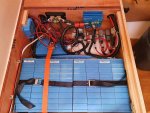
Here is my installation. I have not redone the original electric wiring or moved anything, thats why it is not a perfect installation. 8 pcs 180 Ah cells. combined to 2 batteries. There are some the say that building it an one battery is better.
Top left: One of the solar controllers.
Below that is a small inverter 220V
Ontop of that is my Pico shunt.
Top right is the low volt cut of.
This installation fitted with 3 mm of clearence and removal of some things in the oroginal batterybox.
 
View attachment 90421
Here is my installation. I have not redone the original electric wiring or moved anything, thats why it is not a perfect installation. 8 pcs 180 Ah cells. combined to 2 batteries. There are some the say that building it an one battery is better.
Top left: One of the solar controllers.
Below that is a small inverter 220V
Ontop of that is my Pico shunt.
Top right is the low volt cut of.
This installation fitted with 3 mm of clearence and removal of some things in the oroginal batterybox.

@Rikarde What is the batter cell models you have? Any links. Also is there a BMS there and where is it?
 
Top