LiFePo Query

I get a bit tired of saying this, but lithium does not have to be expensive. If it was, I wouldn't have chosen it. The idea that it might be 'a significant proportion of the boat's value' is only true if you massively over-spec a system on a very cheap (<£5k) boat.

I was nearly scared away from choosing lithium, but I'm very glad that I took the plunge. When I dug in to it all, it turned out that I didn't need every bell and whistle, and I could put together a system for less than I had budgeted for deep cycle lead acid batteries.
 
I am very conscious of the costs involved with a new Lithium installation and suspect many are going to conduct the initial research and then back away - on an oldish yacht (not sure how old) the Lithium costs are going to become a large part of the yacht costs - and they may back away. Any way of cutting the costs, which means ignoring the thought that the only colour is blue (aka 'Victron everything'), must be worth exploring and not rejecting out of hand.

Assuming the lithium battery bank is a retrofit then it does seem a complete waste of money to dump the charging and control of the old Lead. It presumably currently works and the prompt to consider the installation of a Lithium bank is because the lead is old and needs replaced. Lead batteries are cheap - simply replace the Lead commensurate with what is needed, windlass, engine start, bow thruster (I had not realised the number of people with bow thrusters) and simply replace the domestic demands. I note that people are using Lithium for high demand components, engine start, bow thruster etc - but I have no take on that. My understanding is you do need to invest as you might want a B2B charger, battery monitor + shunt, etc and you may need to change or add to your solar charging control.

It is likely that the old electrics were 12v - I don't know what the issues are with having a 12v lead and a 24v Lithium (one of the recommendations if you received_1474814383373522.jpegreceived_1020684705818974.jpeg investing in Lithium is to go 24v).

The big issue might be space, where to locate the extra kit. Hopefully your old battery bank can be reduced in size and the Lithium bank take up no more room than the retired old Lead units.

If its a new yacht - different story - but if its a new yacht the commissioning team should be doing the electrics, not you as owner.

Jonathan
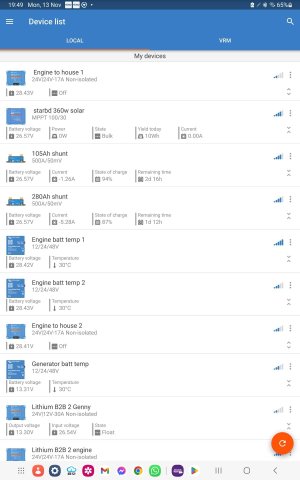
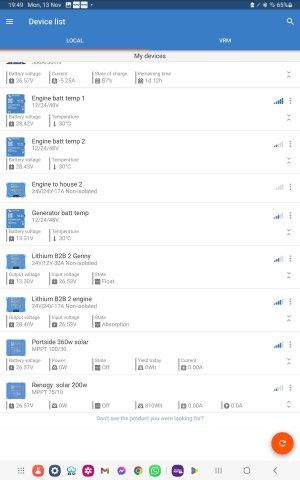
I couldn't fit all my blue box Bluetooth connections on one page so you get two.
You can do Lithium simply as if you still had a lead bank and take little benefit of the lithium other than longer life of your battery bank or you can embrace Lithiums full advantages, as we do. We use so little propane for cooking compared to pre lithum. The main use is the gas oven. We use the diesel generator far less now. I did a quick calc based on our liveaboard lifestyle, and the savings on propane and diesel will mean the lithium battery installation will pay for itself in 7 years. It wasn't even a consideration when installing lithium but it is an added bonus.
We use our pressure cooker a lot as its saves a lot of energy. It's works very efficiently hand in hand with our 2kw induction hob.received_1474814383373522.jpegreceived_1020684705818974.jpeg
 
Last edited:
Thanks Geem

Impressive. I'm not knocking 'energy in blue' - just its the Rolls Royce end of the scale and thus not for everyone (and possibly discourages some) - and it would be nice to think there are reliable options (maybe without some of the bells and whistles).


You would save a little bit more 'energy' (though it might be too insignificant to register) if you replaced the pressure cooker with a Thermal cooker. This would also make the galley a bit cooler (maybe less warm, where you are).

Thermos Thermal Cooker Review - Practical Sailor

Some of the heat of your pressure cooker will warm the galley (great in the UK in winter) but a thermal cooker retains that heat - and uses it.

Jonathan
 
Thanks Geem

Impressive. I'm not knocking 'energy in blue' - just its the Rolls Royce end of the scale and thus not for everyone (and possibly discourages some) - and it would be nice to think there are reliable options (maybe without some of the bells and whistles).


You would save a little bit more 'energy' (though it might be too insignificant to register) if you replaced the pressure cooker with a Thermal cooker. This would also make the galley a bit cooler (maybe less warm, where you are).

Thermos Thermal Cooker Review - Practical Sailor

Some of the heat of your pressure cooker will warm the galley (great in the UK in winter) but a thermal cooker retains that heat - and uses it.

Jonathan
Its not an issue. If its very hot, we plug the induction hob in, in the cockpit. The pressure cooker on an induction hob makes negligible heat compared to using gas. So much of the gas heat bypasses the pan. You don't notice until you use an induction hob
 
The capacity of a battery is generally rated and labelled at the 1C Rate (1C current), this means a fully charged battery with a capacity of 10Ah should be able to provide 10 Amps for one hour.
Lead acid isn't, it's usually a 20 hour rating, and the stated capacity can't be reached with lead in one hour as the amps very quickly fade despite initially high output.
 
I get a bit tired of saying this, but lithium does not have to be expensive. If it was, I wouldn't have chosen it. The idea that it might be 'a significant proportion of the boat's value' is only true if you massively over-spec a system on a very cheap (<£5k) boat.

I was nearly scared away from choosing lithium, but I'm very glad that I took the plunge. When I dug in to it all, it turned out that I didn't need every bell and whistle, and I could put together a system for less than I had budgeted for deep cycle lead acid batteries.
The standard recommendation is 'Victron everything'. Occasionally another manufacturer is mentioned but that is exceptional. Victron is not cheap but as you suggest there are other ways of building and managing a Lithium investment - which based on your experience need not be expensive and are both adequate and safe. People like you are the exception and even though no-one argues with your experience - they still recommend 'Victron Everything',

Everyone who is considering making their own investment is doing so in a yacht already equiped with Lead - and the cacophony of recommendation is to focus attention on Victron. Not expensive - its relative - but a new Lithium power system for domestic battery bank is probably the largest investment an owner would ever make in their already owned yacht, more than a new suite of sails (and most cruisers would not buy a new suite of sails (too expensive) - but make do.

Jonathan
 
a new Lithium power system for domestic battery bank is probably the largest investment an owner would ever make in their already owned yacht, more than a new suite of sails
Nope. My initial system cost about £1400 total. That's for battery, inverter, MPPTs, solar panels, cabling, fuse, isolator.
The lithium battery was £407 out of that.
If I had built the same system but using lead acid, it would have been either the same price (cheap leisure batteries) or considerably more (if using AGM or deep cycle).

Compare that to some of the other expenditure on the boat:
- new sails £4000
- new furler £3000
- new standing rigging (DIY) £1500

And a new engine blows all of the above out of the water.
 
Nope. My initial system cost about £1400 total. That's for battery, inverter, MPPTs, solar panels, cabling, fuse, isolator.
The lithium battery was £407 out of that.
If I had built the same system but using lead acid, it would have been either the same price (cheap leisure batteries) or considerably more (if using AGM or deep cycle).

Compare that to some of the other expenditure on the boat:
- new sails £4000
- new furler £3000
- new standing rigging (DIY) £1500

And a new engine blows all of the above out of the water.
Maybe a misunderstanding - I was suggesting that following the Victron Everything universal recommendation would be more expensive than (yes - excepting a new engine) anything else - you picked and chose, not 'Victron everything'.

Jonathan
 
The standard recommendation is 'Victron everything'. Occasionally another manufacturer is mentioned but that is exceptional. Victron is not cheap but as you suggest there are other ways of building and managing a Lithium investment - which based on your experience need not be expensive and are both adequate and safe. People like you are the exception and even though no-one argues with your experience - they still recommend 'Victron Everything',

Everyone who is considering making their own investment is doing so in a yacht already equiped with Lead - and the cacophony of recommendation is to focus attention on Victron. Not expensive - its relative - but a new Lithium power system for domestic battery bank is probably the largest investment an owner would ever make in their already owned yacht, more than a new suite of sails (and most cruisers would not buy a new suite of sails (too expensive) - but make do.

Jonathan
My investment in lithium stands me at less than £3k. That is lithium batteries and ancillaries. I already had lots of Victron kit prior to lithium because it works and when it doesnt, it has a 5 yesr warranty.
A new main and genoa a couple of years ago were over £7k. A new toerail cost me over £6k supply only. A new paint job was £13k. Lithium is not such a big investment in the scale of things
 
It might be interesting to look at the details of Kelpie's Stg1,400 system and Geem's Stg3,000.

Kelpie's new sails at Stg4,000 is as big a decision to install as Geem's Stg 3,000 cost for lithium. Coming from a racing background I'd prioritise the new sails but having promoted (?) ourselves to cruising then the Stg 3,000 looks enticing.

To us - without the detail - Kelpie's Stg 1,400 Lithium looks a no brainer

Priorities change.

Josephine who was the owner of 'JoXephine of Hong Kong' which was CHS champion for 2 consecutive years in local club racing might have supported a new set of sails THEN - NOW induction hobs and more fresh water is the new priority. Other people have different constraints and some have pockets with a finite depth (they are interested but have seen Victron prices).

Our, cheep and cheerful 200amp Lithium battery mon cost Stg 32 the Victron 'equivalent' costs, here in OZ, STG 150 (500 amp). Yes ... I know - no Blue Tooth, and 500 vs 200 amp. But they both measurer the same 'thing' (maybe questionable accuracy) and the cheep and cheerful data is similar (accuracy unknown on either) to the 25 year old Xantrex unit on 'Josepheline'.

Our cheep and cheerful mon is widely condemned - based on no input (other than it is not coloured blue (Victron's colour).

Extrapolate this simplistic cost differential, and worry about the absence of Blue tooth - now wonder at the the implications to Lithium - where the recommendation is 'Victron everything'.

Again I'm not knocking Victron, we had a totally reliable Inverter charger that was trouble free for almost 25 years and excellent after sales service. I suspect there are as good inverter chargers (but we have no experience) and excellent after sales service is totally unnecessary if there are no issues.

So if Victron can make trouble free electronic components - is there no-one else?

Jonathan

We were given access for a fortnight to a top of the range Mercedes SUV. It had all the bells and whistles (in fact so may bells and whistles I was in constant fear of what the sound of a real emergency might be). The electronics were seriously impressive. Do we really need a boot lid that opens if you wiggle your foot? do we need wipers that react to rain? - we have done without for decades - and obviously did not know what we were missing.

I know ... I'm a dinosaur, that's also a Luddite. :)

Jonathan
 
Last edited:
It might be interesting to look at the details of Kelpie's Stg1,400 system and Geem's Stg3,000.

Kelpie's new sails at Stg4,000 is as big a decision to install as Geem's Stg 3,000 cost for lithium.
Jonathan


You are picking the wrong bits to suit your argument. My sails cost £7k not £4k. We are a bigger boat so sails cost more. Our batteries are bigger than Kelpies so is cost more. Will all due respect to Kelpie, our battery system is more complex. We have a diesel genset that can charge at 115A at 24v.
We have a pair of DC to DC chargers to charge the lithiuim batteries when motoring and we have another couple to charge the engine battery whilst at anchor and the AGM generator battery. There is £1k worth of Victron kit there. My batteries have a capacity of 385Ah at 24v so 770Ah at 12v and we can use a whole lot more of the capacity compared to lead acid.
Lots of cruisers here in the Caribbean used to buy lifeline AGM batteries. They were crazy expensive. For the same capacity as we have in lithium, they would spend a lot more.
A quick look at Budget Marine catalogue. Lifeline 225Ah AGMS are $1223US each. You would need four of them to give you the same useful capacity as my lithium. So circa £4k. My lithium is way cheaper, when you consider that I already had 3 Victron MPPTS, 2 Victron DC/C chargers, 2 Victron battery balancers in my previous lead battery set up.
All but one battery balancer are incorporated into the new system. I only needed to buy two DC/DC chargers and two Victron smart shunts. So on top of the cost of cells and 2 BMS, i had $700 US in blue box costs.
Class T fuses are expensive and the mods I did to our 43 year old electrical system were something I needed to do anyway so cost went up as I replaced and improved stuff.
In pure battery costs lithium batteries are lower than true deep cycle batteries for the same useful capacity if you build them yourself. If you can build them yourself, you can build the equivalent of a top quality expensive lithium battery from one of the major players. Drop in lithium with no Bluetooth BMS shouldn't be on a boat, so no point in comparing their prices.
 
Neeves- who is knocking your cheap battery monitor? I've got one and it appears to work perfectly.

A few costs from my system, vs the blue box alternative:
Battery- 280Ah £400-£450 depending on exact spec. A 200Ah Victron battery is more like £2000. Various drop in options are anywhere between these two extremes.
MPPTs- I've got 40A Epever, £120, Victron do 30A (£200+) or 50A (£270).
Inverter- my Epever cost £375 for 3kw, the Victron I replaced it with is only 2.4kw and cost about £900.

I am a big fan of Victron. I wish I'd had the budget to spec their stuff. It's undeniably good quality and extremely user friendly. When my first inverter died, it was a no brainer to replace it with a Victron. Easier to justify when buying one component, rather than building a complete system from scratch.
Equally, though, I know people who have bought £200 3kw Chinese inverters and get on just fine with them. I was tempted to go that route but I've come to enjoy electric cooking so much that I didn't want to risk another failure.
If I'd just been part time cruising in home waters I probably would have chosen the cheapest inverter with decent reviews on Amazon, because failure wouldn't have been a big deal.
 
I am not sure why there is an mistaken view that lots of new equipment, blue boxes or otherwise, will always be needed when switching to lithium.

Most good quality equipment (unless very old) such as battery chargers, solar controllers, alternator controllers, battery monitors etc that were purchased for a lead acid system are just as suitable for lithium batteries.

This future proofing is one reason why it is usually worth purchasing good quality equipment with a wide range of user adjustable settings.

If you do not already have an existing smart alternator regulator, some extra equipment may be needed to protect the alternator when switching to lithium, but don’t assume you will need to scrap all equipment and start from scratch, as seems to be suggested in some posts. In most cases existing chargers, solar controllers, alternator controllers, battery monitors etc will be fine with only some minor adjustments.
 
I am not sure why there is an mistaken view that lots of new equipment, blue boxes or otherwise, will always be needed when switching to lithium.

Most good quality equipment (unless very old) such as battery chargers, solar controllers, alternator controllers, battery monitors etc that were purchased for a lead acid system are just as suitable for lithium batteries.

This future proofing is one reason why it is usually worth purchasing good quality equipment with a wide range of user adjustable settings.

If you do not already have an existing smart alternator regulator, some extra equipment may be needed to protect the alternator when switching to lithium, but don’t assume you will need to scrap all equipment and start from scratch, as seems to be suggested in some posts. In most cases existing chargers, solar controllers, alternator controllers, battery monitors etc will be fine with only some minor adjustments.


It all comes down to BMS ......

Li can be serviced by common gear - IF its connected via good BMS to correct and support Li setups.
 
Most good quality equipment (unless very old) such as battery chargers, solar controllers, alternator controllers, battery monitors etc that were purchased for a lead acid system are just as suitable for lithium batteries
Even a lot of relatively recent battery chargers will murder your lithium in no time at all if they don't have lithium specific settings or the ability to change things like voltage. Certainly the one that came with my boat, a Nemo 25 as fitted by Jeanneau in 1999 wasn't suitable. The CTech I fitted to my old boat wouldn't have been suitable either, despite being "modern" and "smart".
 
Even a lot of relatively recent battery chargers will murder your lithium in no time at all if they don't have lithium specific settings or the ability to change things like voltage. Certainly the one that came with my boat, a Nemo 25 as fitted by Jeanneau in 1999 wasn't suitable. The CTech I fitted to my old boat wouldn't have been suitable either, despite being "modern" and "smart".
You often don’t have much choice over what equipment the boatbuilder fits, so you have my sympathies, although 1999 is now 24 years ago o_O. However, when purchasing your own equipment I strongly advocate always buying charge sources (mains chargers, solar controllers, alternator regulators DC to DC chargers etc) with parameters that are fully user adjustable.

You don’t need a "lithium" setting if you can adjust all the charging parameters. Even a charger that was produced long before lithium batteries were available will still work perfectly with this chemistry providing these adjustments are available.

This user adjustability is also much better than a single "lithium" setting. Different marine lithium batteries require slightly different settings (based primarily on cut in point for balancing), and circumstances such as long term storage require settings not available on many chargers.

There is also still some significant debate about the ideal settings for lithium batteries. User adjustable settings allow the values to be tweaked as we learn in the long term how to best charge these batteries. Finally, there is the the possibility of other lithium chemistries (such as LTO) taking over the market (LTO and other lithium chemistries require different charging voltages). Even completely different battery types may become available in the near future. The rapid uptake of electric cars has accelerated battery development.

User adjustability does not add much to the price of charge sources, but buying equipment with this versatility means it is largely future proof and unlikely to need changing. This can save a lot of money and installation heartache down the line.
 
Neeves- who is knocking your cheap battery monitor? I've got one and it appears to work perfectly.


I am a big fan of Victron. I wish I'd had the budget to spec their stuff. It's undeniably good quality and extremely user friendly. When my first inverter died, it was a no brainer to replace it with a Victron.

I'll leave the first question unanswered.

Except to say our cheap and cheerful shunt and monitor does what we want - though we might not actually know what we want or need - until we do :(. But a middle road would be the NASA Clipper shunt and battery mon - not cheap as chips but, from memory, half the price of one from Victron.

But do we see mention of the NASA unit........ ?

The nub of my series of posts is the second paragraph above, specifically the second sentence.


We are not impecunious but some are and some who are less flush desire the Lithium option. But if you read through the posts 'Victron Everything' is the standard response - and immediately half those that want to consider Lithium look at the prices of 'Lithium Everything' and stick with Lead. I fear that I'm inadequate, because I don't have a lithium background, in ignoring those with a smaller disposable income.

I have this desire and hope(d) others might have a similar desire and move the various threads on Lithium to be more inclusive.

I'm not knock Victron I second the idea that if your wallet is big enough 'go Victron'. I'm not nocking those that have invested in Victron, wise focus on which to invest. The others are currently left out in the cold. One big advantage of Victron is that you can go to one source and buy everything you need - it probably comes in one big, blue, cardboard box :). Open the box, plug everything in - off you go! Sourcing all the bits and pieces from a variety of sources is more difficult but - we, on PBO, are not helping as, in general, we do not offer the options to Victron.

I'm also not knocking those who have Victron kit and who have taken the time to define their installations - without them newbies would have no-where to start.

Jonathan
 
Top