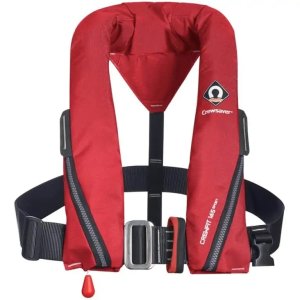
Life jackets

Hi All
Does anyone know much about this make of life jacket and are they ok,don't want to spend the earth but also need a decent one that will do the job looking to buy 4 of these
Thanks
Amazon.co.uk
Maybe look at Adec Marine as they are marine safety specialists,.as an example. Good idea to get the leg straps ( which I think are included in the Adec jacket).
 
We had 7–8 of these exact ones (with crutch straps), and I guess the brand is okay. The CO2 cylinders definitely wear out over time, so you need to keep an eye on them and replace according to the schedule. We didn’t stick to the schedule and ended up throwing all of them in the water - only one or two actually inflated.

Since then, we’ve switched to the solid orange life jackets. Not just because of the hassle with the cylinders, but also because we hated how immobile the inflatable ones are and how difficult it is to get proper orientation in the water while wearing them. I get that they’re meant for coastal and inland waterways, but even in small to medium waves, I think the overall feel of these in the water is really poor. Personally, I wouldn’t recommend them.
 
We had 7–8 of these exact ones (with crutch straps), and I guess the brand is okay. The CO2 cylinders definitely wear out over time, so you need to keep an eye on them and replace according to the schedule. We didn’t stick to the schedule and ended up throwing all of them in the water - only one or two actually inflated.

Since then, we’ve switched to the solid orange life jackets. Not just because of the hassle with the cylinders, but also because we hated how immobile the inflatable ones are and how difficult it is to get proper orientation in the water while wearing them. I get that they’re meant for coastal and inland waterways, but even in small to medium waves, I think the overall feel of these in the water is really poor. Personally, I wouldn’t recommend them.
I've never seen anything about replacing the CO2 cylinders to a schedule. The capsules that "puncture" the cylinders have an expiry date and they do fail if the lifejacket is kept in a damp environment. CO2 cylinders I weigh once a year to make sure they still have gas in them and check for corrosion.
 
We had 7–8 of these exact ones (with crutch straps), and I guess the brand is okay. The CO2 cylinders definitely wear out over time, so you need to keep an eye on them and replace according to the schedule. We didn’t stick to the schedule and ended up throwing all of them in the water - only one or two actually inflated.

Since then, we’ve switched to the solid orange life jackets. Not just because of the hassle with the cylinders, but also because we hated how immobile the inflatable ones are and how difficult it is to get proper orientation in the water while wearing them. I get that they’re meant for coastal and inland waterways, but even in small to medium waves, I think the overall feel of these in the water is really poor. Personally, I wouldn’t recommend them.

1. As another says - the CO2 cylinders have no expiry - you weigh them to make sure still gas filled.
2. What you most likely experienced is the actuvation tablets had failed due to age
3. Lifejackets are designed to turn you face / chest upward in the water - so swimming orientation would be hard ..
 
Are they similar to those worn by passengers on the Titanic?

Interesting point about LJ's of yesteryear ....

Ships for many years carried standard Kapok lifejackets that were badly designed ... when designed - no thought was given to a) turning the wearer face / chest upward ... b) keeping the head supported.
The Kapok LJ could in fact just as easily hold an unconscious person face down due to it having similar amounts of Kapok front and back ... plus until the addition of high collars let the head sink.
 
1. As another says - the CO2 cylinders have no expiry - you weigh them to make sure still gas filled.
2. What you most likely experienced is the actuvation tablets had failed due to age
3. Lifejackets are designed to turn you face / chest upward in the water - so swimming orientation would be hard ..
1. It’s been a while, but the cylinders definitely had clear expiry dates on them at the time. That said, I honestly don’t give one hoot whether it’s the cylinder, the capsule, or some other component that “technically” expires and requires periodically replacing. In my book, this makes inflatable devices inherently less reliable. Add to that the risk of punctured tubing, etc. And good luck checking your hygrometers for elevated humidity levels, as someone pointed out above. I had a quick look at the VIKING inflatable jackets and noticed that in freezing water temperatures they state that jackets may not inflate so users have to inflate manually - another good luck from me.
2. Maybe it was the tablets or maybe it was one of several other potential failure points.
3. I get the point about face-up flotation, but my real-world observation from wearing inflatable jackets in the water is that they squeeze your face very hard - the bigger the waves, the more pressure you feel. It makes it really difficult to keep an eye on someone throwing a rope or to orient yourself in surf. Another issue I noticed is that when you hit the bottom of the trough between two waves, your body isn’t well supported, and half your face often ends up underwater. I guess one way to counter that would be to tighten the crutch strap all the way up your butt cheeks - but that’s certainly not how I see them worn.

To be fair, I’ve only worn three different kinds of inflatable life jackets in the water, and they may have improved since then. But based on my experience, I find them inherently less comfortable and more anxiety-inducing - nespecially in rougher water - thats just my opinion based on many years of swimming and spearfishing experience. I realise that a lot of you have inflatable jackets - each to their own.
 
1. It’s been a while, but the cylinders definitely had clear expiry dates on them at the time. That said, I honestly don’t give one hoot whether it’s the cylinder, the capsule, or some other component that “technically” expires and requires periodically replacing. In my book, this makes inflatable devices inherently less reliable. Add to that the risk of punctured tubing, etc. And good luck checking your hygrometers for elevated humidity levels, as someone pointed out above. I had a quick look at the VIKING inflatable jackets and noticed that in freezing water temperatures they state that jackets may not inflate so users have to inflate manually - another good luck from me.
2. Maybe it was the tablets or maybe it was one of several other potential failure points.
3. I get the point about face-up flotation, but my real-world observation from wearing inflatable jackets in the water is that they squeeze your face very hard - the bigger the waves, the more pressure you feel. It makes it really difficult to keep an eye on someone throwing a rope or to orient yourself in surf. Another issue I noticed is that when you hit the bottom of the trough between two waves, your body isn’t well supported, and half your face often ends up underwater. I guess one way to counter that would be to tighten the crutch strap all the way up your butt cheeks - but that’s certainly not how I see them worn.

To be fair, I’ve only worn three different kinds of inflatable life jackets in the water, and they may have improved since then. But based on my experience, I find them inherently less comfortable and more anxiety-inducing - nespecially in rougher water - thats just my opinion based on many years of swimming and spearfishing experience. I realise that a lot of you have inflatable jackets - each to their own.
I've just checked a 23 gram cylinder and no date on it. Just a batch number, etc.
I think that in the past I have seen a manufacturer date but it isn't on the cylinder I've just inspected.
 
If anyone falls into freezing waters without thermal protection - you can kiss goodbye .... you have literally minutes before you passout with thermal shock etc.
Most of us do not sail in freezing waters
As a dinghy/windsurfing sailor i have been in the wter loads of times throughout the winter,
True there is a difference when expecting it & being better suited & booted, than falling overboard.
But experience at falling in can help, as I found on the 3 times I have been over the side in my younger gung ho days
Would not survive a minute now though.
I even wear a buoyancy aid when tottering along the pontoon to the boat
I wonder if others do
There are many with bad knees hips etc
 
Last edited:
See post #10 ...........
I do not see how that changes anything.
However, my wife son & I were checking our LJs. We had my wife's & suggested that as the bottle was out Of date & the inflation unit looked suspect she put it on & tested it.
She refused to strip off & get in the bath but we had a go in the lounge all the same
First pull-zilch. The cord was wrapped around the cylinder & it was then that we noticed that they all were, including 2 manual ones
They would have been useless because in a MOB sitution there was no way a person in a panic could work that out
My wife set hers up again and was looking down - as might be expected in the water- when the tubes inflated with a whack.
It jerked her head violently back & the seam in the buoyancy came right under her chin where it drew blood. She was even more annoyed when my son said that the sharks would have loved it. If she had been in the water the seam would have seriously cut in to her chin as the Lj would have been forced up.
Needless to say all the Crewsaver LJs (I think it was that make) went in the bin & she went out & bought a new one, tested it & then bought 4 more of the same pattern
 
I asked Mrs SC35 to don an LJ in the garden.
The straps were done up reasonably firmly.
Then without warning her, I pulled the cord.
It inflated very rapidly as it was supposed to.

All privileges were suspended for the weekend and I had to make my own dinner.
 
I asked Mrs SC35 to don an LJ in the garden.
The straps were done up reasonably firmly.
Then without warning her, I pulled the cord.
It inflated very rapidly as it was supposed to.

All privileges were suspended for the weekend and I had to make my own dinner.
You could have taken it off untill you went sailing. She did not HAVE to keep it on :rolleyes:
 
I had a load of very old pull cord (ie not auto) life jackets. I decided to test a couple out, so jumped into the sea off the back of the boat and pulled the cord, they all inflated as they should, and held air, no issues.

I can't remember what brand they were, but they're probably 20 years old and we'll past the expiry date on the jackets.

Sorry, this is a bit of a pointless anecdote, but thought it maybe of interest.
 
I had a load of very old pull cord (ie not auto) life jackets. I decided to test a couple out, so jumped into the sea off the back of the boat and pulled the cord, they all inflated as they should, and held air, no issues.

I can't remember what brand they were, but they're probably 20 years old and we'll past the expiry date on the jackets.

Sorry, this is a bit of a pointless anecdote, but thought it maybe of interest.

Not pointless at all .....

There is a lot of kerfuffle about old LJ's and replacing them. I value life as much as anyone else ..but I follow the pattern of self-checking condition of LJ's - including weighing the cylinders . inflating and making sure they stay up for at least 24hrs.
Any that give me reason to question are subject to slashed with a knife and binned. (Knifed to prevent anyone else thinking they may be ok)
 
Top