Lee bowing

I think you’ve got this the wrong way round, some sailors around the world have adopted the OEMs over-simplified version of True Wind, and now think the inaccuracy is actually the new definition. Plenty of sailors do think that, but it doesn’t make it right and it certainly isn’t helpful to all the other sailors who actually understand what their instruments can, and can’t do.

Adopting the OEMs language has advantages in that I can perhaps talk to an NKE engineer despite my dodgy French. If we differed on what we meant by TWS I might as well go home! But it's nevertheless a fair point to argue that their preferred definition has to an extent influenced sailing wind terminology.

The central point is that there is no 'right' and nobody need make any mistakes whatsoever if they consistently apply any inertial frame of reference of their choosing. One could choose a lunar one and still get it right subject to the maths.

It is the inconsistent use of reference frames can causes problems and these can, sadly, be serious.

BTW: anyone know if the RYA has a standard on this for YM, etc?
 
Last edited:
I had no idea my simple enquiry would store up such a hornets nest, I ceased understanding what you guys are talking about ages ago but my question has been answered and I will steer into the tide from now on.
 
I had no idea my simple enquiry would store up such a hornets nest, I ceased understanding what you guys are talking about ages ago but my question has been answered and I will steer into the tide from now on.

Like you, most of this has been away over my head, but surely if you steer into the tide, you'll go slower.
 
Like you, most of this has been away over my head, but surely if you steer into the tide, you'll go slower.

You’ll go at the same speed through the water on either tack and have the same angle of apparent wind but your ground track will point higher against the true wind (by the old definition of wind over the ground) so make a better VMG if you choose the tack that has the lee bow into the tide. But just saying all that is opening up the whole debate about the 5 or so different techniques which have all been called lee bowing.
 
You’ll go at the same speed through the water on either tack and have the same angle of apparent wind but your ground track will point higher against the true wind (by the old definition of wind over the ground) so make a better VMG if you choose the tack that has the lee bow into the tide. But just saying all that is opening up the whole debate about the 5 or so different techniques which have all been called lee bowing.

Of course you'll go at the same speed through the water, and I know the difference it makes if you have the tide helping you, but the gentleman said he will "head into the tide", and that will definitely slow his progress over the land. :rolleyes:
 
Of course you'll go at the same speed through the water, and I know the difference it makes if you have the tide helping you, but the gentleman said he will "head into the tide", and that will definitely slow his progress over the land. :rolleyes:

I think we mean different things - lee bowing (or the variation I’ve described above) is most evident when the tide is exactly at right angles to the wind over the ground. If the tide is angled much in your favour one way or the other then obviously going with the tide towards your destination will help more than the tack which has the tide taking you away.

But in the completely neutral situation of right angled wind to tide then pointing your bow so you head into the tide (lee bowing) gets you a better VMG than pointing your bow downtide - for the reasons above.
 
Perhaps I was over simplifying. But I think most will understand what I meant.
Of course you'll go at the same speed through the water, and I know the difference it makes if you have the tide helping you, but the gentleman said he will "head into the tide", and that will definitely slow his progress over the land. :rolleyes:
 
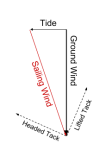
I have drawn a diagram that summarises my understanding on why sailing on the tack that puts the tide on your lee bow can be beneficial:
Lee Bow Vectors(1).png

In this situation you wish to sail upwind. The cross tide changes the angle of the "Sailing Wind" (that instruments would report as "True Wind"), in much the same way that movement changes the angle of apparent wind. This angle change results in a headed and a lifted tack, and clearly you would prefer to sail on the lifted tack, which can be seen to be the one that has you heading into the tide.

The problem is that if you sail on the lifted tack now you will have to sail on the other tack later. Therefore lee bow-ing the tide is only useful if you know that you will experience a different tidal stream later on (and therefore a different Sailing Wind angle). The reason for this change might be that the tide has turned (on a long passage), or that by the time you tack you will have reached still water.
 
I have drawn a diagram that summarises my understanding on why sailing on the tack that puts the tide on your lee bow can be beneficial:
View attachment 76712

In this situation you wish to sail upwind. The cross tide changes the angle of the "Sailing Wind" (that instruments would report as "True Wind"), in much the same way that movement changes the angle of apparent wind. This angle change results in a headed and a lifted tack, and clearly you would prefer to sail on the lifted tack, which can be seen to be the one that has you heading into the tide.

The problem is that if you sail on the lifted tack now you will have to sail on the other tack later. Therefore lee bow-ing the tide is only useful if you know that you will experience a different tidal stream later on (and therefore a different Sailing Wind angle). The reason for this change might be that the tide has turned (on a long passage), or that by the time you tack you will have reached still water.

Perfect - your post should just be quoted in all future threads on lee bowing as the most graphic and simplest explanation - including the caveat. Tide weakening will work a bit too or wind strengthening when having to go on the other tack.
 
Last edited:
I have drawn a diagram that summarises my understanding on why sailing on the tack that puts the tide on your lee bow can be beneficial:
View attachment 76712

In this situation you wish to sail upwind. The cross tide changes the angle of the "Sailing Wind" (that instruments would report as "True Wind"), in much the same way that movement changes the angle of apparent wind. This angle change results in a headed and a lifted tack, and clearly you would prefer to sail on the lifted tack, which can be seen to be the one that has you heading into the tide.

The problem is that if you sail on the lifted tack now you will have to sail on the other tack later. Therefore lee bow-ing the tide is only useful if you know that you will experience a different tidal stream later on (.....

That's not the normal definition of 'lifted tack' though?
The lifted tack is port when the wind backs, or starboard when it veers.
 
That's not the normal definition of 'lifted tack' though?
The lifted tack is port when the wind backs, or starboard when it veers.

I would say that the "Sailing Wind" has been backed* by the tidal effect, resulting in port tack being lifted.

*I am not very familiar with these terms so apologies if I have it the wrong way round (backing = anticlockwise?)
 
I would say that the "Sailing Wind" has been backed* by the tidal effect, resulting in port tack being lifted.

*I am not very familiar with these terms so apologies if I have it the wrong way round (backing = anticlockwise?)

The sailing wind has effectively been backed by the current.
But all your diagram shows is that (if the objective is to go up the page) the effect of the tide is to make Port the 'making tack'.

Consider your diagram with the ground wind at say 040 degrees. The sailing wind is now at 10 degrees. Your port tack heading is now 55 degrees. so the tide is 35 degrees off the lee bow. Starboard is now a faster way to cross the tide. Do you still favour 'lee bowing' on port? And why?
 
The sailing wind has effectively been backed by the current.
But all your diagram shows is that (if the objective is to go up the page) the effect of the tide is to make Port the 'making tack'.
Indeed, because (in my mind at least) that is the fundamental reason for lee bow-ing the tide.

Consider your diagram with the ground wind at say 040 degrees. The sailing wind is now at 10 degrees. Your port tack heading is now 55 degrees. so the tide is 35 degrees off the lee bow. Starboard is now a faster way to cross the tide. Do you still favour 'lee bowing' on port? And why?
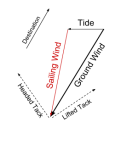
Like this? Starboard may be the faster way to cross the tide but my objective is to get upwind (relative to Ground Wind) so Port is still favoured.
lw395 Lee Bow Vectors.png
 
As you've drawn your new diagram, when you add the tide vector to the lifted tack heading, you can see that the ground track can be exactly along the ground wind direction, or even above it, the boat could beneficially crack off below closehauled as it sails the transit to the mark.

Conversely
If the scenario is you need to cross a deep water channel, then there is a band of shallow water with much less tide, there comes a point where it is quicker to dash across the tide on the headed tack, then beat out in the still water. Because the leebowing boat on the lifted tack spends more time in the tide and therefore has further to sail up tide.
In the limit, the leebowing boat can end up making no progress at all.
I have sailed a fair few races where the first boat to get into more favourable tide wins.

But quite often I've also noticed that the sailing wind doesn't change as much as you'd expect when you leave the current, because the 'ground wind' is bent by friction with the moving water.


I think the point to take away from all this is that you can end up looking at differences between similar vectors, and a small change, error or uncertainty in any of the inputs changes the output very quickly.

I have also noticed that many venues have 'local wisdom' often refined over generations of when it pays to do x, y or z, statistically the outcomes tend to be correct but the explanations can be the wrong side of dubious.
 
I have also noticed that many venues have 'local wisdom' often refined over generations of when it pays to do x, y or z, statistically the outcomes tend to be correct but the explanations can be the wrong side of dubious.

I’ve sailed a few regattas on Blessington lake in the Wicklow Mountains a few miles south of Dublin. No tides obviously, but the wind: one has to choose between working the many shifts or hitting the edges. Lots of doubtful explanations why, but certain winds definitely bend through the mountains. If you know where it is, just hit the inside hard after the gun, tack and marvel ;)

If the bend isn’t there that day, there’s a lot of work to be done!
 
Last edited:
The major electronic OEMs by comparison have adopted the terminology used by sailors all around the world, which is what I and some others have tried to describe.

If you want to use a non-standard language, that's just fine. No point in arguing who is right, anymore than it is worth arguing whether it's better to be German or English. That said, someone has to translate, or someone has to learn the other's language if they wish to communicate. Simples ;)

Funny that, because all (very good) Avionics that Garmin manufacture refer to True wind as ground-referenced. Unsurprising as that's been the industry standard for about 100 years. If a marine instrument refers to True Wind as being referenced to the water it is sitting on it just means the manufacturer can't be bothered to do the necessary sums or perhaps that the system doesn't have the necessary inputs. That doesn't mean that the definition of True Wind suddenly changes though. You won't get any aircraft or system through certification if it calculates True Wind in any other way and it's a requirement that weather stations are anchored to the ground as well.

Unfortunately it's the marine industry that is unique (if it really is the majority of sailors using this terminology and I'm not convinced as I certainly don't hear it a lot) - if anyone wants to use it that's up to them (whoever they are) but please don't pretend it's become some kind of international agreement.
 
Read the document I attached to my last post in the edit.

You haven’t even read your own reference, have you Buck? What are the first three words in that article? “Wind-induced drag”. And the author’s opening formula shows the leeway-drift velocity U to be a multiple of W, the speed of the wind over the water. And the conclusion of his article slightly modified that multiple, but it’s still a multiple, which means that with no wind across the water, there’s zero drag, and boats of all characteristics will float precisely with the current, which is the statement you are trying to argue against.

Not understanding something is fine, but pointing an article you plainly don’t even follow to support your claim is ridiculous, and then appealing to other people to ‘read the document’ is just bluffing.
 
Top