led strip lights

I bought a 5 metre length from an ebay trader for about £10 Guy's trading was something like tony-super-2012. I got the waterproof 3825 stuff in warm white and used two strips each about 1.5 metres long down the cabin sides. Works well, giving pleasant "wall-wash" type light. I keep meaning to write it up with photos.
 
LEDstrip light

At home I fitted a section to the inside of the vertical door frame of our pantry cupboard. It is connected to a power supply then 240vAC. It really is vastly better than the original light in the roof as it gives light to each shelf with much less shadow. The strips are very cheap from China.
On the little boat I fitted an adhesive backed LED patch of 24 LEDs and a resistive current limiter for a cabin light. It is very bright and cheap and easy. You can't go to0o far wrong at the price. good luck olewill
 
I've got Screwfix halogen bathroom lamps in the cabins 240v. I'm now adding separate G4 sockets and 24 LED spades, so that I can have 12v and 240v in the same enclosures
 
I've got Screwfix halogen bathroom lamps in the cabins 240v. I'm now adding separate G4 sockets and 24 LED spades, so that I can have 12v and 240v in the same enclosures

Thinking about that, you will probably find that the heat from the 240 volt units will melt the 12 volt LED circuits if it is inside the same enclosure? :o

.
 
5cm for £2! Are they having a laugh? :eek:

Similar priced item on eBay for 1m.

I think you have mis-read the Ad. It states "it can be cut down into 5cm lengths". This therefore assumes they are longer than 5cm to start with. :rolleyes:

Notwithstanding the above, on their web page, they have forgotten to state the length :p

I have bought some of their strip-lights and they are between cool white and warm white. ;)

.
 
LED Strips

Make sure you get good quality ones. Quite nice.
However the China made ones die like flies :-((.
Or else as they usually die pretty fast, ask the shop to power them up, go away continue shopping and come back an hour or two later. That's called a burn in test which they should have done in the LED manufacturing plant but they don't in order to save cost and increase yield at the customers expense.
 
I bought a 5 metre length from an ebay trader for about £10 Guy's trading was something like tony-super-2012. I got the waterproof 3825 stuff in warm white and used two strips each about 1.5 metres long down the cabin sides. Works well, giving pleasant "wall-wash" type light. I keep meaning to write it up with photos.

Did the same. Bought 5M Warm White and 5m Red from eBay for next to nothing and two way switch. This has given me sufficient white light over the galley with the option of red whilst sailing at night. Looks good, works well and not expensive.
 
hi jfkal-----thanks for reply but how do i know the difference between good and bad lights ----i will be buying on net not going to a shop----thanks lenten
 
How do you know good quality? There is no such thing. Just buy cheapest. The LEDs may die more from over voltage so if you have any concerns add a small resistance to reduce current and voltage. ie one ohm will drop one volt at 1 amp and dissipate 1 watt so need a 3 watt rated resistor. Or fit a silicon diode in series to lose .7 volt.
I have just installed a load of taped LED into an ensuite walk in wardrobe in bedroom. I have stuck the tape around the inside of the door frame. The lights go right down to floor level. This gives light at low levels under hanging clothes for finding shoes. The main reason was to reduce glare from outside the wardrobe when partner is watching TV. It all works well on a small power regulator board from China.

Of many LEDs around the house and boat the only failure was recently. I bought a "corn cob" LED light bulb replacement with B 22 base. It worked well then failed. On research i found it was described as 220v lamp. We have of course 250v AC. The DC was supplied by a simple rectifier from the mains to LEDs in series so high mains voltage equals dead LEDs.
There was a slightly more expensive lamp rated at 65 to 260VAC that has a regulator and would be so much better so watch out for what you buy. (ole cheap skate)
good luck olewill
 
thanks olewill---just bought a 5 metre strip of 5050----fitted to a transfomer and amazed at how much light they give off---i need to buy some more for a project----regards lenten
 
Led Lighting

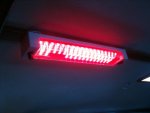
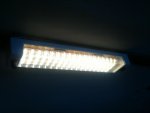
Have found quite easy to modify fluorescent to LED . Mounted alternative strips of red and white LED (ebay) on a piece of gash 1mm acrylic sheet that were wired alternately through 3 position (centre off) then back to dimmer from ebay. Used Velcro strip to mount acrylic inside fluorescent fitting. Drilled hole in fitting for dimmer and changeover switch. Seem to remember putting the changeover switch in the negative side of the Led's and the dimmer in the positive side.
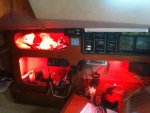
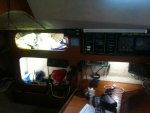
I also found it easier to mount the led strips on 25mm x 2mm wooden strip. This allowed me to do all the wiring at home and use 2 screws to mount them inside the cubby holes. I also put changeovers and dimmers on the strips in the galley over the nav area and all the cubby holes in the saloon. Certainly makes a difference.
 

Attachments

  • image.jpg
    image.jpg
    100.8 KB · Views: 1
  • image.jpg
    image.jpg
    97 KB · Views: 1
  • image.jpg
    image.jpg
    93.8 KB · Views: 1
  • image.jpg
    image.jpg
    91.5 KB · Views: 1
I've used ones like this quite successfully. Under shelves. in cupboards and cubbyholes etc..

+1

I've also fastened four of these around a bit of length of 1"x1" square timber; added a brass hook in the end with a cigar lighter plug - makes a very bright anchor light that doubles as a torch.
 
I have had a discussion on another thread on this subject and by chance came across this thread, so my apologies for entering the discussion at this late stage.

Whilst LED strip lighting provides very good lighting levels and is relatively inexpensive, there are some significant drawbacks to using it in a marine environment.

The strips, particularly the less expensive type, is made from copper tracked flexible PCBs. Many electrical problems on boats arise due to the unwary using stranded copper motor vehicle wiring cable to supply power and lighting circuits. Owners often find that this type of cable develops various forms of surface corrosion, typically this turns exposed connections black and verdigris contamination forms at many exposed connections. This is particularly so if the atmosphere is damp, which of course is not uncommon on many of our boats, particularly over winter in a saline atmosphere. That is why tinned copper cable is the preferred option for boat wiring, the tin covering protects the copper from such atmospheric contamination.

I recently have stripped out LED lighting strip that had corroded to some extent, all had been in for less than 2 years. Surprisingly some of the strip was the so called waterproof variety (installed in silicon sleeve). All strips affected had the same issue, verdigris and blackening/pitting on exposed copper tracks similar to that we see on copper cable. The corrosion was particularly bad at the points where the strip was soldered to supply cables. Most, but not all, strips have a varnish lacquer applied but this tends to be patchy and rather unreliable, particularly on cheap strip, gaps in the lacquer are often at points adjacent to soldered components, up and down the strip.

If you think about it, it's exactly the same as using un-tinned cable in the marine atmosphere, it will corrode. Given that the PCB copper track thickness is measured in microns, corrosion will take its toll quite rapidly. So, before all boat-owners rip out their conventional lighting and install LED flexible strip, step back and think about the location and the affect of the marine environment on this lighting option.

It might be worth smearing all soldered cable terminations with a smear of Contralube to protect and neutralise corrosion, that might offer a temporary solution, time will tell. In my experience the better strip is the waterproof variety that is encased in clear epoxy, this shows better resilience, albeit is still prone to corrosion on bare copper at the point where cables are soldered. Users have to scrape off the epoxy to solder, which unavoidably, exposes bare copper track.


Regards
 
Top