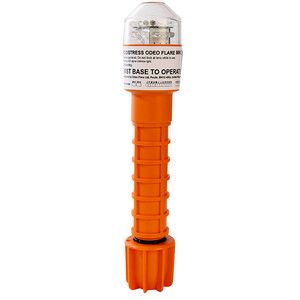
Led flares

Before I sold the yacht I had made my decision. The only pyrotechnic flares to be carried were the ones in the liferaft, plus a 9mm miniature plastic flare gun simply because I had one and its legal in Turkey. In the UK I would not have bothered with the latter. I fitted an LED flare in a spring clip near the companionway where it was easy to grab.
 
but my LED is visible 360 degrees, just like a flare. Unlike a flare though, it goes on being visible for a couple of hours.
But it is not visible for 360 degrees when held out of the small opening of a liferaft. ---90 degrees at best. Plus the operator has to be in a condition to hold it for a couple of hours.
Of course he can turn it off & then back on when a possible aid is in the vicinity, as many times as he needs. Something he cannot do with a limited number of flares.
Ideally one should opt for both, because there will be a place for flares for a while yet, as will there be for newer technologies. Skimping on one for the other though, may not always be the best option.
 
eVDSD (the Orion and Sirius types I quoted) are intended to replace hand-held flares, which in any kind of seaway have a practical range of a few miles (wave height, curve of the earth). Rocket flares are a different catagory and you should carry both off-shore.

The eVDSD signals are 360 degree. They do not have to be pointed.

https://siriussignal.com/

Yes, holding them in a raft is a problem. Sinking a raft with hot slag is another problem. But a raft will have separate kit and signalling from the boat is far more likely. And we come back to the 3 minutes vs. 6-8 hours issue.

The USCG studied recognizability with panels of sailors and landsmen. The flashing SOS was far more recognized at a distance than a light that last only a few minutes . This standard was driven by the USCG, not the manufacturers, as safer and more effective than flares.

Stemar was dead on:
"I think it comes down to the sort of sailing you do. Offshore, I can see a use for parachute flares, inshore, not so much, and I'd far rather put an LED into the hands of an inexperienced, scared crew than a bloody great firework... "

Yes, things have changed since 2013. The first USCG standard was 2015, the more advanced standard 2019, with the first RTCM (orange-red / cyan) product just becoming available 2021. I'm quite sure none of you have seen the Sirius C-1002 (it's only been available for about a month).

No, flares are not much brighter. They are not focused. You have to hang it above you sight line or it is blinding (which BTW, flares ruin you night vision). Also, flares are not 360 degrees. They are blocked by your body and the superstructure of the boat (your not going to hold a flare over your head or hoist it into the rigging!).

---

No, I'm not with any of these companies. I just did some testing and was impressed with how much they have improved. I think they make a lot more sense for inshore and coastal sailors, which is 98% of the market. 98% of the market wouldn't have a life raft.
 
eVDSD (the Orion and Sirius types I quoted) are intended to replace hand-held flares, which in any kind of seaway have a practical range of a few miles (wave height, curve of the earth). Rocket flares are a different catagory and you should carry both off-shore.

The eVDSD signals are 360 degree. They do not have to be pointed.

https://siriussignal.com/

Yes, holding them in a raft is a problem. Sinking a raft with hot slag is another problem. But a raft will have separate kit and signalling from the boat is far more likely. And we come back to the 3 minutes vs. 6-8 hours issue.

The USCG studied recognizability with panels of sailors and landsmen. The flashing SOS was far more recognized at a distance than a light that last only a few minutes . This standard was driven by the USCG, not the manufacturers, as safer and more effective than flares.

Stemar was dead on:
"I think it comes down to the sort of sailing you do. Offshore, I can see a use for parachute flares, inshore, not so much, and I'd far rather put an LED into the hands of an inexperienced, scared crew than a bloody great firework... "

Yes, things have changed since 2013. The first USCG standard was 2015, the more advanced standard 2019, with the first RTCM (orange-red / cyan) product just becoming available 2021. I'm quite sure none of you have seen the Sirius C-1002 (it's only been available for about a month).

No, flares are not much brighter. They are not focused. You have to hang it above you sight line or it is blinding (which BTW, flares ruin you night vision). Also, flares are not 360 degrees. They are blocked by your body and the superstructure of the boat (your not going to hold a flare over your head or hoist it into the rigging!).

---

No, I'm not with any of these companies. I just did some testing and was impressed with how much they have improved. I think they make a lot more sense for inshore and coastal sailors, which is 98% of the market. 98% of the market wouldn't have a life raft.
Sorry the link didnt work, considering the option. please relist
 
Apparently the eye is more sensitive to green light than red or any other colour. Why aren‘t led flares green?
 
Last edited:
Apparently the eye is more sensitive to green light than red or any other. Colour. Why aren‘t led flares green?
Got any evidence for the green light thing? I reckon it may well be true on paper, but that doesn't mean we should use green flares.
For starters, red is the colour of flames, which our minds have evolved to find attention-grabbing.
Fire was used for signalling, then flares, before green-tinted gunpowder was invented.
Those are good reasons not to use green for emergency and distress signals.
I have seen lime green fluorescent sea- surface dye, and it is certainly conspicuous.
 
Another question: Why don't parachute flares make a very loud bang at the top of their their climb?
(as a maroon once would have done, before limp-wristed do-gooders forced their ban in case they frightened the baby seagulls, or some-such nonsense).
An added big bang would be a further improvement on the best non-radio distress signal yet invented by mankind.
 
Got any evidence for the green light thing? I reckon it may well be true on paper, but that doesn't mean we should use green flares.
For starters, red is the colour of flames, which our minds have evolved to find attention-grabbing.
Fire was used for signalling, then flares, before green-tinted gunpowder was invented.
Those are good reasons not to use green for emergency and distress signals.
I have seen lime green fluorescent sea- surface dye, and it is certainly conspicuous.
Peak sensitivity is 555nm (green)
Peak Sensitivity - an overview | ScienceDirect Topics
Why should emergency exit signs be green, not red?
 
Got any evidence for the green light thing? I reckon it may well be true on paper, but that doesn't mean we should use green flares.
For starters, red is the colour of flames, which our minds have evolved to find attention-grabbing.
Fire was used for signalling, then flares, before green-tinted gunpowder was invented.
Those are good reasons not to use green for emergency and distress signals.
I have seen lime green fluorescent sea- surface dye, and it is certainly conspicuous.

I typed in "eye most sensative to green light" and the first response settled the issue.

"There are three types of cones in the human eye. Each type of cone absorbs light waves of specific frequencies: long wavelengths (L), medium wavelengths (M), and short wavelengths (S). ... The eye is most sensitive to green light (555 nm) because green stimulates two of the three kinds of cones, L and M, almost equally. "

Cyan LED emit at about 500 nm, so close to optimum.

In testing, the cyan phase is considerably more visible than the orange/red phase, so it is not just true on paper. The USCG selected cyan because of improved visibility.

Flares are red because the first flares, made for the railroad industry (fusees) where made red by the addition of strontium nitrate, which makes the flame bright red. It was the brightest chemical they had at the time, and thus became traditional. Had they started with something green, then we would be accustomed to green. But the best chemistry gave them red.

Orion (Standard Fusee) got their start making railroad flares. It certainly was not the recreational boating business, which did not exist then. The railroads were high volume at the time, going back to about 1850. Flares had nothing to do with distress signalling and the choise of red had to do with the color of fire or our reaction to it. They were used to signal trains stopped to uncouple cars and similar functions.
 
Thanks for the link.
With today's scientific advances, it would be possible to build emergency winky-twinkies (often erroneously called " LED Flares" ) which emitted a bright rainbow sequence of colours, covering all the possibilities and certainly unmistakeable for any other lights, at least outside of a discotheque.

Did you read the Sirius C-1002 link?

As for your choice of names, I guess you just woke up cranky this week. They are properly called Electronic Visual Distress Signaling Devices (eVDSD).
 
I'm interested. I don't like pyrotechnic flares, my wife found it impossible to set off a hand held one and the demonstrator from the RNLI related the story of a professional who was seriously injured by a hand held that "back fired".
Please describe the 360° variety.
It's this one

Force 4 Odeo LED Flare Mk3 | Force 4 Chandlery

Force-4-Odeo-LED-Flare-Mk3.jpg
 
Another question: Why don't parachute flares make a very loud bang at the top of their their climb?
(as a maroon once would have done, before limp-wristed do-gooders forced their ban in case they frightened the baby seagulls, or some-such nonsense).
An added big bang would be a further improvement on the best non-radio distress signal yet invented by mankind.
Because not blowing up leaves a longer lasting light to float down! Having both in one might be possible though and would aid greatly. I've always thought you would have to be very lucky for there to be someone looking where they needed to just at the right time. On most bits of the coast there is no one standing looking out to sea
 
Because not blowing up leaves a longer lasting light to float down! Having both in one might be possible though and would aid greatly. I've always thought you would have to be very lucky for there to be someone looking where they needed to just at the right time. On most bits of the coast there is no one standing looking out to sea
I see your point about self-destructing flares..
You don't need to be looking in just the right direction, your vision covers 150 degress (guess) of the horizon, and they are very eye-catching.
Plus the characteristic whoosh of the rocket.
Perhaps the rocket could be made noisy, you hear some very loud wails from fireworks, a screaming rocket would be even more conspicuous.
 
Top