Lead line

sailaboutvic

Well-Known Member
Joined
26 Jan 2004
Messages
9,972
Location
Northern Europe
Visit site
After the last thread on who Carries what , I was interested to see how many people carry lead lines .
The question I like to know how many times have Tho who carry them have used them in the last 5 years ,
And how many used them to test the sea bed condition ?

I dont carry one and never have but I can make one up very quickly if need be , the last time was three years ago when I was navigating in a uncharted channel in the Venice lagoon and it was used from the dinghy by my partner while I follow behind.
I have to hold my hands up in 40 years sailing I never used one to test what the sea bed was like I never found the need to.
I sure there going to be some here who use them regularly, :)
 
Last edited:
I've got one but only use it to check how level the sea bed is when anchoring. Normally the charts and pilots are fairly accurate on what the sea bed material is. It gets used most years as well.
 
I guess I can give two answers.
On my own boat. A lead line is not required, as personal yacht no very much is. I am like you. I don’t carry a traditional lead line. However I have been known to drop a line with a weight on it. The grapple dingy anchor has been used as has a light line with a handy weight, shackle or big wrench.
Particularly after dropping anchor in a shallow cove, just to be sure I had enough water bellow to suffice. Easy enough to do.

Other vessels where it’s required. It’s carried.
I have tried the traditional cast of a lead. Just to see if I could and to say I had. In the distant past. I have armed the lead to test the bottom in an unfamiliar anchorage. Never tried to find my way up the channel using the lead line.

Many decades ago.
I got a minor case of frostbite, (My ear lobes froze, stupid new guy didn’t pull my took down )while, sounding round(inside and outside) a vessel, after a steering failure and unscheduled anchor drop, of all 3 anchors. A long conversation with USCG which I would rather not repeat. Turned out OK, we had 3ft under the bow.
Main reason it’s still a basic requirement on vessels which have requirements.

The only other time I have personally been required to use the lead. Was in Alex, when we didn’t quite manage to arrive alongside.
The old man flipped out, when he read my log entry. “vessel aground off dock.” He wanted “vessel touching the bottom adjacent to the dock”. Next time.:)
Either way I had still had to sound round the vessel.

“Never go aground with your anchors in the pipe” “even if dropped on the rock” and “always take soundings”
 
Last edited:
As we draw only 1m we can test the depth, when it is critical, with our, extendable, boat hook and by being slightly aggressive force the hook into the seabed. In clear water we can look over the side and note the distance between keels and seabed.

Do a boat hook count and a No 1 Eye Ball count?

:)

We can cobble up a lead line, as (in common with most here) we do carry the odd (and not so odd) spare shackle and some thin cord (for example - we have 2mm Kevlar lines for lightweight spinnaker sheets - on reels).

Jonathan

another omission from the original list (I agree with the addition of bolt croppers)

Fog Horn

and a decent Malt Whisky
 
Last edited:
Mine was already on the boat, to be frank the only time I have used it, and then only very occasionally, is when I am tying back to the wall in Greece, which really is a bit over kill as often it is deeper than I thought
 
Last edited:
I have a lead line, but have not used it for some time.

It is a back up for the boat’s main electronic depth finder, but its main normal function is to check the depth from the tender. We anchor in some isolated and poorly charted areas so it is nice to have the ability to check the depth within the swing circle, especially with dangers such as isolated rocks. Although this is needed only occasionally it can be valuable in some instances, especially in areas of high tidal variation where even normally deep water can become a hazard at some times of the day.

It also can help decide the best path to escape or where to lay a kedge anchor in the event of a grounding or when going ahead in the tender to decide if a channel is safe.

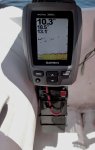
Like many devices this has been replaced by modern technology. Small fishfinders are very inexpensive these days so I made up a depth sounder for the tender. It fits over the stern on a simple plywood bracket that has the fishfinder and small 12v battery for power. It is not attached to the tender most of the time (I think it may be too tempting for light fingers), but it simply drops in place, so it is easy to fit when needed.
 

Attachments

  • 51AE2828-E754-4EE7-816F-BBA94CB51150.jpg
    51AE2828-E754-4EE7-816F-BBA94CB51150.jpg
    286.5 KB · Views: 0
My first boat came with a traditional lead line and I have kept it when I sold the boat. I had never used it in anger, until last summer, when I had to use it a couple of times when moored over a steeply shelving bottom to make sure we were not going to touch anything when the tide went down. The spot sounding from the echo sounder was definitely not sufficient in those cases.
Of course I could have improvised a line with a spanner or a shackle, but it felt nice to have the real thing aboard with a line already marked.
 
I have one on my boat and I use it once a year (unless I forget) to check/calibrate depth gauge / keel offset.

Since retirement I now spend a fair amount of time on other boats. On school boats I get DS students to check if gauge is reading water depth or under the keel. Using a lead line is part of the DS Practical course. On delivery boats I always throw something heavy over the side for the same check to avoid embarrassment in shoal waters :)
 
It came with the boat, unused by me.
Thinking of using the weight as part of an anchor buoy.

Sounds like a good idea (and probably worthy of another spin-off thread). I came into sailing from diving and we always deployed the shot line (buoyed line from surface to sea bed, usually within the wreck field) "top tensioned". The line goes through a ring at the bottom of the buoy and falls towards the sea bed by a small weight on the end of the line, a couple of meters longer than water depth. I use this technique to keep my anchor buoy / tripping line vertical. For weight, I use lead melted into a bean can with cast-in eye. Using the lead line weight might work if the line is light.
 
Yes, I use a lead line now and again, possibly two or three times a year. Mostly to check the sea bed material in an anchorage or to check if it is steeply shelving as that can affect whether your anchor holds or slips down the slope. To me it is an amazing bit of kit as you can "feel" the type of material on the sea bed just by the vibrations coming up the string. I even searched the sea bed for the remains of a wreck in one anchorage (as we wanted to avoid it in case the anchor got caught) and found the remains of the steel deck and hull 7 or 8 meters below the dinghy.
 
Used regularly to check keel offset on new boats or for new echo sounders.

Used regularly when echo sounder plays up in the shallow muddy waters of the Upper Bristol Channel where a million gallons of slurry pass up and down over the "ground" twice a day and finding routes through can be interesting. Depth gauge can read double by second reflection of pulse in shallow water - dangerous if not spotted. Depth can read low - say 2m - by echo pulse bouncing off the slurry thickening in deeper water - frightening if one is slightly unsure of position or current state of the banks. Or gauge can give up and state "error" which is unnerving at least.
 
Like others, I use it mainly from the dinghy. I often put a mark on the required minimum depth and motor with the dinghy all around while feeling if it hits something: I had one with a small lead weight say 1kg but the resistance while moving in the water made the rope go all slanted so I changed with a proper one weighing a few kg which is a lot better. :)
 
I used my lead line sounding around an anchorage in the US Virgin islands. My rotating neon sounder was having a tantrum.
Ever since its been a brill name drop boasty thing!
 
Occasionally when moored on a slope, I'll check the aft end with a lead line ( thin marked cord - big fishing weight) to find out what is going on.
I know my keel offset accurately, but what happens 7metres aft is often guesswork otherwise!
 
Top