Lead angle

PabloPicasso

Well-Known Member
Joined
12 Feb 2010
Messages
2,945
Visit site
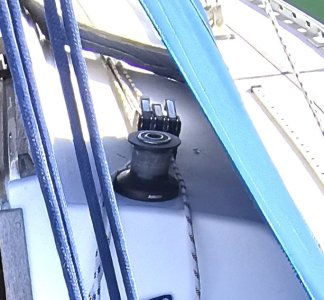
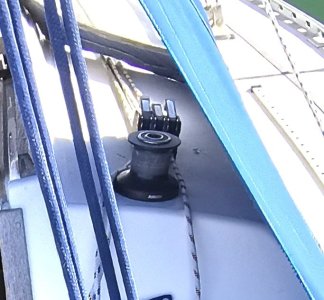
I am intending to fit a triple clutch in the location in the pic.

Will the lead angle to the winch be problematic?

Should I move the existing clutches outboard a bit to reduce the angle on the new jammer that would be nearest to us in the picture?
 

Attachments

  • IMG_20250826_092214.jpg
    IMG_20250826_092214.jpg
    1,018.8 KB · Views: 30
  • IMG_20250826_123932.jpg
    IMG_20250826_123932.jpg
    86.6 KB · Views: 22
Last edited:
The angle looks OK to my uneducated eye, but it’s a very short run from the clutch. Might it not be better a little further forward, depending on what reinforcement you have underneath?
 
If I have understood it, the angle out of the clutch to the winch looks significant and will cause friction and wear. Possibly ok if right next to the existing one. An angle on the clutch would help but might look odd and depends on rope routing.
 
One way of rectifying a bad lead to winch is by using a deck organiser between winch and clutches. It’s what I had to do due to many clutches on smallish boat.
 
All good suggestions.

I might move the existing triple clutch over by one hole, if I can unbolt it of course.

I'll measure angles properly and
take a pic from above next time I'm aboard
 
I am intending to fit a triple clutch in the location in the pic.

Will the lead angle to the winch be problematic?

Should I move the existing clutches outboard a bit to reduce the angle on the new jammer that would be nearest to us in the picture?
The range of lead angles is in the manual, and depending on the brand is about 15 degrees. No, it probably will not work well unless angled (this will require a deck organizer upstream) to operate within this range.

Winch feeder blocks are another solution. Or locate the clutch bank farther away so that the angles are less, perhaps combined with a feeder block.

This is one of the problems with feeding too many lines to one winch with a wide clutch bank. Friction.
 
If it's only one line with a bad lead you could use one of these, just one hole :)
Rinvii 821.050
Harken (crossover block), Seldon, and Spinlock ($118) also make good winch feed blocks.

In my case I DIYed a crossover block using a low friction ring and a core I turned on a lathe. But if I had not just been tinkering, I like the Spinlock Winch Feed Block.

If I had a very wide bank of clutches I might place such a block to redirect them. In my case, the jib sheet would interfere, so I would place the clutches farther forward and very slightly angled, which would probably solve the lead angle problem. But four lines on one winch is enough and six is probably too many, leading to conflicts. In my case, the main halyard and the jib sheet are both used at the same time when shaking out a reef while going to windward, so I lead the halyard to another winch.
2a.%20winch%20feeder%20in%20service,%20shaking%20out%20a%20reef.jpg
 
Last edited:
This is what I'm aiming for, but not sure how the order will be yet.

Starboard side:
1. Main halyard
2. Topping lift
3. Jib Halyard
4. Kicker
5. Cunningham
6.Stack pack bag string (which won't need winching)

Port side:
1. Spin Halyard
2. Spin Uphaul
3. Reef 1
4. Reef 2
5. Spin Downhaul
6. Main Outhaul
 
Harken (crossover block), Seldon, and Spinlock ($118) also make good winch feed blocks.

In my case I DIYed a crossover block using a low friction ring and a core I turned on a lathe. But if I had not just been tinkering, I like the Spinlock Winch Feed Block.

If I had a very wide bank of clutches I might place such a block to redirect them. In my case, the jib sheet would interfere, so I would place the clutches farther forward and very slightly angled, which would probably solve the lead angle problem. But four lines on one winch is enough and six is probably too many, leading to conflicts. In my case, the main halyard and the jib sheet are both used at the same time when shaking out a reef while going to windward, so I lead the halyard to another winch.
2a.%20winch%20feeder%20in%20service,%20shaking%20out%20a%20reef.jpg
Nice photo thinwater however I note the angel of departure of Jib sheet from its sheave on track is very tight. (only a problem on port side. The friction on the cheeks of the sheave must be significant. I would suggest look at attachment of cheeks to car it may be possible to remove redrill so rope departs sheave closer to square. ol'will
 
Nice photo thinwater however I note the angel of departure of Jib sheet from its sheave on track is very tight. (only a problem on port side. The friction on the cheeks of the sheave must be significant. I would suggest look at attachment of cheeks to car it may be possible to remove redrill so rope departs sheave closer to square. ol'will
I’ve never understood why genoa cars don’t swivel to avoid this happening - seems a pretty obvious improvement to me.
 
Nice photo thinwater however I note the angel of departure of Jib sheet from its sheave on track is very tight. (only a problem on port side. The friction on the cheeks of the sheave must be significant. I would suggest look at attachment of cheeks to car it may be possible to remove redrill so rope departs sheave closer to square. ol'will
Good point and I have noticed. In fact it is just shy of being a real problem. An interesting project I may take on.
 

Other threads that may be of interest

Top