Knots : Which version of the Halyard hitch is best?

wipe_out

Well-Known Member
Joined
23 Feb 2013
Messages
1,399
Location
Bournemouth
Visit site
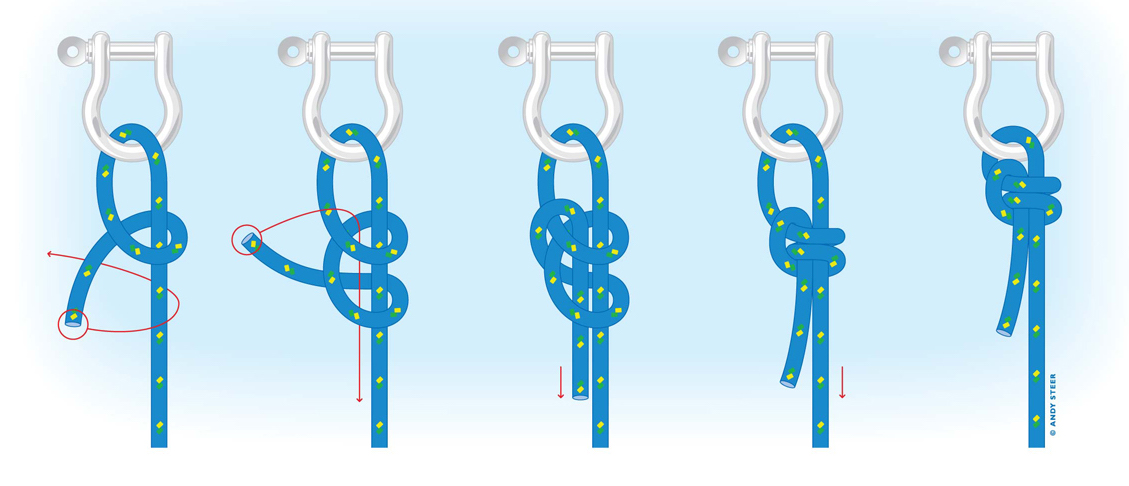
Seems there are two versions of the Halyard hitch.. One has the bitter end go back up through a couple of loops while the other has the bitter end sit below the loops.. Which is the preferred one or is it a "how long is a piece of.... umm... rope" question? :)
 
Don't know about 'preferred' but I use the one with the tail parallel with the halyard.

Need to be careful with this as when the halyard gets to the end of it's travel or an obstruction, it is possible through pulling the halyard to poke the bitter end back in the direction from whence it came, loosening the knot.

Might not happen in practice on a halyard hitch, but a reason why some knots need the bitter end to lie in a particular direction - dependent on application.

In this version, the end could be pushed back into the knot if it was regularly pulled into an obstruction ...

hknot.01.jpg


In this version not possible ...

hqdefault.jpg
 
Last edited:
Don't know about 'preferred' but I use the one with the tail parallel with the halyard.

Me too. It is simply an incomplete fisherman's bend round the standing part. Described in the Selden "Hints and Advice on Rigging and Tuning". When loaded it tightens up hard and won't shake loose.
 
Me too. It is simply an incomplete fisherman's bend round the standing part. Described in the Selden "Hints and Advice on Rigging and Tuning". When loaded it tightens up hard and won't shake loose.

It combines the disadvantages of a splice (you can’t undo it) with the disadvantages of a bend (it greatly weakens the rope).

I fear I am showing my age, but I bought a boat with these abortions on practically everything and I hate them.
 
I don't care what net knots says, I don't think that is a halyard hitch. It is a double overhand noose, AKA poacher's knot.
https://www.animatedknots.com/halyard-hitch-knot
https://www.animatedknots.com/poachers-knot

https://www.youtube.com/watch?v=mqzJj6lYtj8

I've always been amused by critisism of knots for halyards.
* They don't jam in the masthead pulley
* They allow greater hoist because they are shorter than a splice with burry
* They allow for easy shortening of the halyard for wear
* They have no bearing on strnegth, since a halyard NEVER breaks at the knot. They are sized for stretch and fail due to chafe.

I'm amused when I see splices used where they provide no actual benefit, other than looking neat.
 
Need to be careful with this as when the halyard gets to the end of it's travel or an obstruction, it is possible through pulling the halyard to poke the bitter end back in the direction from whence it came, loosening the knot.

Might not happen in practice on a halyard hitch, but a reason why some knots need the bitter end to lie in a particular direction - dependent on application.

In this version, the end could be pushed back into the knot if it was regularly pulled into an obstruction ...

hknot.01.jpg


In this version not possible ...

hqdefault.jpg

Little chance of poking the end through. I need pliers to undo mine at the end of the season.

In my setup there is plenty of space between the swivel shackle and the diverter so there is no likelihood anyway.
 
I just use bowlines on halyards. I realise I’ll burn in the seventh pit of hell for that, but I’ve never had one come undone.
 
I’m not the brightest but why is it better to use this knot round a shackle, rather than a bowline straight through the cringle? The length needed for the bowline is no more and may be less, and the bowline comes undone when you want it to. What, apart from one more thing to fail, slightly more weight where you don’t want it, a more brutally unfair distortion of the rope and the enrichment of chandlers, does the shackle do?

For belt and braces, on a main halyard, seize the tail to the standing part.
 
Last edited:
I just use bowlines on halyards. I realise I’ll burn in the seventh pit of hell for that, but I’ve never had one come undone.
And me. I use a bowline direct on to the mainsail. We have a snap shackle on the spinnaker halyard as we use it to hoist the dinghy up the side of the hull each night using the rope drum on the windlass. The snap shackle is quicker to fit to the lifting bridle on the dinghy when its a little bumpy or you have arrived back from the bar a little tipsy... also easier to release when we relaunch the dinghy each morning.
I try to minimise shackles of any description on halyards, preventers, guys, etc. I see little point in them in most applications where a bowline is just as effective
 
I’m not the brightest but why is it better to use this knot round a shackle, rather than a bowline straight through the cringle? The length needed for the bowline is no more and may be less, and the bowline comes undone when you want it to. What, apart from one more thing to fail, slightly more weight where you don’t want it, a more brutally unfair distortion of the rope and the enrichment of chandlers, does the shackle do?

For belt and braces, on a main halyard, seize the tail to the standing part.

I use the halyard knot on the shackle above the foresail swivel, not to shackle to the sail. On the mainsail I find a quick release shackle far more convenient. I do have the tail seized to the halyard.
 
I use a shackle so I can move the halyard away from the mast when on the berth.

Is that to avoid it clanging? Mine remains attached from start of season to the end so have to clip on a permanently attached bungee to hold it towards a stay.

I always want to be able to just hoist and go if there is a problem overnight.
 
I don't care what net knots says, I don't think that is a halyard hitch. It is a double overhand noose, AKA poacher's knot.
https://www.animatedknots.com/halyard-hitch-knot
https://www.animatedknots.com/poachers-knot

https://www.youtube.com/watch?v=mqzJj6lYtj8

I've always been amused by critisism of knots for halyards.
* They don't jam in the masthead pulley
* They allow greater hoist because they are shorter than a splice with burry
* They allow for easy shortening of the halyard for wear
* They have no bearing on strnegth, since a halyard NEVER breaks at the knot. They are sized for stretch and fail due to chafe.

I'm amused when I see splices used where they provide no actual benefit, other than looking neat.
Not always. My rig with furling headsails has enough room to allow a spliced soft loop and its bury without it coming near jamming the sheave and without restricting the sail height hoist. If I was to have a knot then I would expect the knot to fail first and to introduce an unnecessary weak point requiring an upsized halyard to maintain equivalent strength. A splice is a better option. Also necessary anyway as dyneema halyards should you go for them, as I prefer to do, are not advised to be knotted.
 
Is that to avoid it clanging? Mine remains attached from start of season to the end so have to clip on a permanently attached bungee to hold it towards a stay.

I always want to be able to just hoist and go if there is a problem overnight.

Yes it is. The "halyard slap" noise in the marina is a constant source of irritation so I don't want to add to it. I just move the halyard a bit away so it's a few seconds to reattach it. Not that it's an issue in the marina!
 
... If I was to have a knot then I would expect the knot to fail first and to introduce an unnecessary weak point requiring an upsized halyard to maintain equivalent strength. ...[/QUOTE]

No, not actually a risk. You have to think about the use and the engineering. The halyard is always sized for stretch, not strength, and I don't know of any that have failed at the splice or knot. They fail where the rope rubs on the top block. Thus, it is a good idea to move the chafe points periodically, if chafe is an issue.

Really. The knot or splice is not what fails. The only places I would worry about knots are highly loaded sheets/guys, standing rigging, and ground tackle.

For Dyneema you are right, and what could be easier to splice, anyway? Hardly more difficult than a knot.
 
I use a shackle so I can move the halyard away from the mast when on the berth.
I tie my main halyard to the guardwire when not in use. Just use a fender knot on the guardwire. There is no rattle as no shackle! We also use the main halyard to lift the 15hp engine off the dinghy. Again no shackle, just bowline attached to lifting strop on the engine. Simples
 
I have no shame about using shackles or snap shackles wherever it suits me, even for the main sheet block on the traveller. My main halyard is the original wire but fortunately came with a good shackle with a captive pin that can be reliably tightened by hand. My descendants can change it if they wish.
 
Top