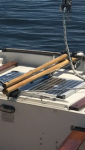
Just spotted wood rot on tiller

I wouldn't be tempted to skimp on such a vital and relatively cheap item. Talk of cutting out and splicing chunks of plywood are ridiculous, the axe handle would make a temporary replacement but a tiller can be subjected to large bending stresses which can really only be resisted by a continuous or laminated piece.
il measure up and buy a new one from ebay there is a guy who makes them. The thought of it snapping fills me with dread.
 
scraped out all the rot and its one layer of wood , tomorrow i will pour some epoxy inside it and use some 6mm plywood to epoxy inside the groove .
I think maybe replace it though some time very soon.
Sorry, I think epoxy is not the product to use. The timber is damp and just pouring epoxy in a 'hole' will not bond properly to it. One wonders why it rotted in the first place? I think ghostlymoron and Tranona are right.
 
Ours is an ash shovel handle from local hardware store. The tiller extension is the top end of the handle of a garden rake. Ash is lovely and strong, yet flexible and feels good in the hand.
Tom Cunliffe in his video ”Storm at Sea" describes among other things his ash tiller breaking! He goes on to say that he would not use ash for a tiller. I would advise against this but if you must go down that route make sure you keep an eye on it and keep it well protected with varnish. I have suffered a broken tiller leaving Portsmouth Harbour in a SW f5 and it was not a pleasant experience. I now have a laminated tiller!
 
Last edited:
I have a spare, unused, tiller on board.

I have wondered how difficult it might be to swap it for a broken one at sea, in rough weather.

Has anyone here any personal experience of doing this?
 
I have a spare, unused, tiller on board.

I have wondered how difficult it might be to swap it for a broken one at sea, in rough weather.

Has anyone here any personal experience of doing this?
Refitting the tiller is today's job as the rudder was rehung yesterday. Easy job despite its size as it goes into stainless cheeks with 2 through bolts and all accessible standing in the cockpit. Fitting in an emergency might be a bit of a struggle keeping the rudder from thrashing around. Many old style rudders like mine had eye bolts attached with lines led up to the cockpit for just such an eventuality and also could be used for emergency steering.

So depends on the tiller attachment and access and your ability to think through in advance how to do it - plus find somewhere in my case to store a tiller that is over 5' long!
 
I wouldn't do this - you'll probably forget it's dodgy.
Fair enough, however our old tiller is solid teak or similar hardwood, but the holding end is cosmetically poor. The bolt holes etc are all there already, would be better than a large shifter or moles on the flange that would be left.
 
Tom Cunliffe in his video ”Storm at Sea" describes among other things his ash tiller breaking! He goes on to say that he would not use ash for a tiller. I would advise against this but if you must go down that route make sure you keep an eye on it and keep it well protected with varnish. I have suffered a broken tiller leaving Portsmouth Harbour in a SW f5 and it was not a pleasant experience. I now have a laminated tiller!
I will happily acknowledge TC's experience and authority in such matters, and thank you for the warning. I do inspect the tiller regularly, repair any nicks in the finish, and
re-varnish it annually. A broken tiller hardly bears thinking of, yet it is something to be prepared for. I do actually keep a spare aboard.
1B7381DB-BB91-443E-89CB-31574A1768FF.png
 
I will happily acknowledge TC's experience and authority in such matters, and thank you for the warning. I do inspect the tiller regularly, repair any nicks in the finish, and
re-varnish it annually. A broken tiller hardly bears thinking of, yet it is something to be prepared for. I do actually keep a spare aboard.
View attachment 133951
I mentioned this because I had, only a few days ago, watched the video from TC and he went to great pains to describe his experience including presenting the snapped tiller which he had kept {from the 70's I believe). Having a spare or some other emergency option and thinking through what you would do in an emergency would be sufficient I suspect.
 
Last edited:
I'd recommend leaving the current tiller as is for the moment, and make haste getting a new one while the going's good. \

Then once you've got the new tiller fitted, you can start digging into the old one to see the extent of the rot, and decide whether it's worth repairing to keep as a spare.

I had a tiller break once when I fell on it as I was climbing back into the cockpit in bouncy conditions. Fortunately it was not immediately completely useless, just the laminations separated in the middle length of the tiller so it was flexing rather alarmingly. I don't think it would have lasted long like that, but fortunately I was approaching harbour at the time.

I was also lucky that the boat had come with a spare short stumpy tiller (presumably for easier storage?) - not particularly comfortable but it was quite usable for the remainder of the cruise. Swapping the two should have been a few minutes work, but there was some complication with a non-standard nut and/or thread in the arrangement that clamped the tiller to the rudder, which cost me a day out of my passage for a visit to an engineer, and a few quid, to sort out. (Lucky I wasn't trying to do it at sea.)

I later made a new solid tiller to replace the de-laminated one, using oak (red oak, IIRC), as recommended to me by a helpful and seemingly knowledgeable chap at Robbins Timber, Bristol.

My current boat has a spare tiller, also short and dumpy, but in this case it's short so that the cockpit can be kept clear while the boat is being steered by tiller pilot, or from the wheelhouse. It's the work of seconds to remove and replace the tiller on this boat - it fits in a large stainless socket on the rudder head, and is secured in it by a captive pin through the tiller.
 
Fitting an emergency tiller is not fun in rough weather.


Many years ago, on a racing 42ftr in the Solent opposite Yarmouth, SW F7 on an ebb tide, we had a series of Chinese gybes, the last one of which ripped out the wheel steering and pedestal as the main sheet flailed around. Being a Sparkman's boat, we had an emergency steel tiller to fit on the quadrant head.

The crew of eight were very experienced Admiral's Cup people, so no lack of beef. Nevertheless as the boat fell prey to the cross-purposes of wind and tide, and it took some time adjusting the sails before I could get near the lazarette with the spare tiller from the forepeak. Persuading the square section of the tiller to mate up with the square on the quadrant was not easy, even with a foredeck gorilla helping push down with a block of timber.

Eventually, a long eventually, we united the tiller with the steering column, and the skipper decided to carry on racing.

It took all of 3 minutes before there was an almighty bang and the emergency tiller, a steel tube about the size of a scaffolding pole, parted company with the top of the quadrant. At which point, the skipper decided to retire to Cowes for lunch.

I guess the lesson is that if it can be difficult, it will be very difficult.


This is us on the way home afterwards, with my head just visible in the hatch.

63XcI1O.jpg
 
I've just noticed the varnish had a crack so pushed it and found rotten wood underneath . What's the best way to repair it , do I use some kind of epoxy wood repair kit.
That may work short term but I expect it was glued with resorcinol glue and will likely delaminate. Rot getting at one section of the laminate is usually a warning that is days are numbered. similar thing happened to me with a laminated Centaur tiller where cleaning out the failed glue line and rot led to other joints opening up. Fortunately was able to open up all the glue lines, clean up the wood and stick it all back together with epoxy.
Ours wasn’t rotten as such, just worn, rough, a tiny bit of delamination. A month in the airing cupboard, and epoxied and clamped up, before being wrapped in carbon cloth. I don‘t think it's breaking any time soon.
 
Top