Jet Ski and boat collision - Calshot - afternoon Monday 7 May 2018 - 2:30pm ish

Fair enough, all boats are different and you'll know it better than anyone.

Indeed even some boats that are the same are different, so a boat designed to run best with a single petrol might benefit from extra lift aft if twin diesels are installed for example.

Or take the Fairline Corniche - same hull has to cope with shaft drive and sterndrive diesels, I guess the hull can't be optimised for both.
 
Fair enough, all boats are different and you'll know it better than anyone.

Indeed even some boats that are the same are different, so a boat designed to run best with a single petrol might benefit from extra lift aft if twin diesels are installed for example.

Or take the Fairline Corniche - same hull has to cope with shaft drive and sterndrive diesels, I guess the hull can't be optimised for both.

My boat was designed with petrol engines in mind but left the factory with twin diesel lumps so you have a point. Maybe an extra 300? plus kilos to contend with.
 
Unusual. Normally a boat runs most efficiently with them up (as clearly the hull is designed to run at its best with as little intrusion into the water flow as possible).
Not unusual at all actually, because there's no such thing as a single "normal" situation around which to design a P hull.
Just think of what is possibly the major factor (though there are others), i.e. speed: any P hull is normally designed having in mind a somewhat wide speed range, say 20 to 30 kts, if not wider - sometimes, much wider.
Trouble is, for any given hull, the stern lift (hence the AoA) at 20kts and 30kts is inevitably different.
So, if you would optimize a hull for running efficiently and with an optimal AoA at 20kts without using the trim tabs, at 30kts the higher stern lift would reduce further that AoA, potentially to the point of creating hook and spin conditions upon steering (though it normally takes a higher speed to reach such limits).
So, since there's no way to get a "negative" effect by raising trim tabs above their neutral position (i.e. you can't reduce stern lift further), hull designers normally aim at P hulls which don't need any trim tabs when running at WOT, at the expense of needing some as the stern lift decreases when speed is lower.
Up to a point, obviously, because when the speed is too low to keep the boat on the plane and she "sinks" into displacement, normally it's not worth lowering the tabs anymore, because they only add drag as you said, with no other pros in return.
 
Not unusual at all actually, because there's no such thing as a single "normal" situation around which to design a P hull.
Just think of what is possibly the major factor (though there are others), i.e. speed: any P hull is normally designed having in mind a somewhat wide speed range, say 20 to 30 kts, if not wider - sometimes, much wider.
Trouble is, for any given hull, the stern lift (hence the AoA) at 20kts and 30kts is inevitably different.
So, if you would optimize a hull for running efficiently and with an optimal AoA at 20kts without using the trim tabs, at 30kts the higher stern lift would reduce further that AoA, potentially to the point of creating hook and spin conditions upon steering (though it normally takes a higher speed to reach such limits).
So, since there's no way to get a "negative" effect by raising trim tabs above their neutral position (i.e. you can't reduce stern lift further), hull designers normally aim at P hulls which don't need any trim tabs when running at WOT, at the expense of needing some as the stern lift decreases when speed is lower.
Up to a point, obviously, because when the speed is too low to keep the boat on the plane and she "sinks" into displacement, normally it's not worth lowering the tabs anymore, because they only add drag as you said, with no other pros in return.

Negative lift or suction occurs at the stern 1/4 , the faster you go more you get .
What counteracts this to stop the boat s AoA increasing or the stern sinking is the fact that the majority of the lift or upwards pressure is from ( on an good designed P hull aspect ratio of 3.5 or thereabouts) is the dark shaded area on this pic .As you can see it’s just slightly forwards of the CoG , so the boats is actually “ lifted “ mostly from that dark V shape .V in the longitudinal plane .

View attachment 70910
Black is lift positive upward pressure just behind the point of contact in a chevron.
50/50 no force up or suction down
Predominantly white areas suction —— at the stern .

These results are from pressure sensors placed under a plane hull dragged in a tank .
Props in the rear mostly white stern 1/4 will exacerbate the suction / loss of lift even more .

Furthermore this pic below shows a variable deadrise mid section in hatched .
You can see the proportion of lift and suction at the mid section .
That proportion varies in pic 1 as you approach the transom.

View attachment 70911

So it’s possible if designed right with the CoG as close to the centre of lift ( see the dark chevron in pic 1 ) that the AoA will NOT noticeable change in the planning speed range .
More likely if true mid engined , less likely the engines are shifted back .
Any extra Kg ,s or any additional kgs like a big tender on the bathing platform will exacerbate stern sinking .
This creates a grater wetter area and more drag , less speed .

It’s true you can have a hull which require 0 tab to plane , and 0 tab throughout planning speeds .
Only tab needed down in a head sea to get more parting from the front finer sections and minus tab ,ie up from the horizontal in a following sea ( going fast ) to get the bow up to minimise broaching .
Other than that 0 all the time .
 
Excellent videos , how calm was that sea. Anyway this popped up as recommended viewing
https://www.youtube.com/watch?v=mIz-sJRnVKA

Good video. I pulled this from the comments.

"That's Alan Merritt, he's been going out of that inlet before most of you were born. He is the owner of Merritt Boat and Engine Works about half a mile from the inlet. Been in business making custom boats since 1956. I think this year he will be 93 or 94. One of the most famous fishermen on the coast. He's in the IGFA Captain and Crews Hall of Fame. I can assure you he knew what he was doing..."


Sorry for the Fred drift.:D
 
Good video. I pulled this from the comments.

"That's Alan Merritt, he's been going out of that inlet before most of you were born. He is the owner of Merritt Boat and Engine Works about half a mile from the inlet. Been in business making custom boats since 1956. I think this year he will be 93 or 94. One of the most famous fishermen on the coast. He's in the IGFA Captain and Crews Hall of Fame. I can assure you he knew what he was doing..."


Sorry for the Fred drift.:D

But if you keep reading down from that, someone points out that the chap in the boat has dark hair (unlikely at 90+) and the writer who'd said it was Alan Merritt said 'You know you're right! I checked and it is Alan's boat, but his mate took it out when he was extremely upset... I think getting a divorce... wow!'
 
I suggest they try out Portsmouth Harbour if Calshot is too crowded - plenty of fun for a jet ski for the QHM volunteers me thinks ? I heard one came into the other day on the wrong side of the channel and created some local activity ?
 
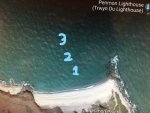
Safe? No it can be tricky. Too close in and its pebbles. Too far out and you can get a nasty back eddy from the straits during an ebb. Just right you are in a mud shell mix. Make sure you dig in. Get it right and you can anchor through the tidal range. Any north wind get out. The sweet spot is visible at low tide. Look for the rock shelf 1/3 along the beach from the peninsula. At low approach to about 15ft depth to 20 foot. Pay out 70 to 80 foot chain and then you can swing safely. Adiabatic winds at night can make it a bit bumpy. We like it as a waypoint wait for the tide as at low water the kids go rock pooling and we will go eat in the cafe.

Edit. I will see if I can get a chart up to show. Alternatively I am happy to show you sometime.
 
Last edited:

R9pnXKc.jpg


suWXRsy.jpg


see the pebbles in the water in the last shot, see how far they go in, note the start of the tidal rip.

CHART

https://webapp.navionics.com/#boating/menu@14&key=yjkdIfstW
 
Last edited:
btw. The yacht in the vid... too close in. He dragged 10 minutes later, ran out of scope and I had to pull him off the lighthouse rocks with the tender. Best of all, it wasn't his boat, it was his mate's who was abroad on holiday and he thought he'd borrow it.... it's Wales.
 
Yes. Just note the position of the lighthouse in that pic. The rocks are submerged. That must have been a helluva spring high. You always want to be inside of the light house.

Edit. 3 is where you drop anchor, not where you come to rest
 
Last edited:
Top