Jackstay

A suppose that is possible, but I'm happy to take that rare risk in preference to fumbling around with multiple clips. To me it would be like clipping on to every rung whilst climbing a ladder, it might help to save you from a fall but it could equally be the cause?
The exception I make is I have a tether round the mast waiting for me to arrive so once there I'm clipped on twice. Once to the deck jackstay and once round the mast. I started using the second tether after a dodgy night in the Atlantic where I spent ages waiting for a safe moment to unclip from the deck and reclip round the mast. Boat was getting a battering at the time as was I.
 
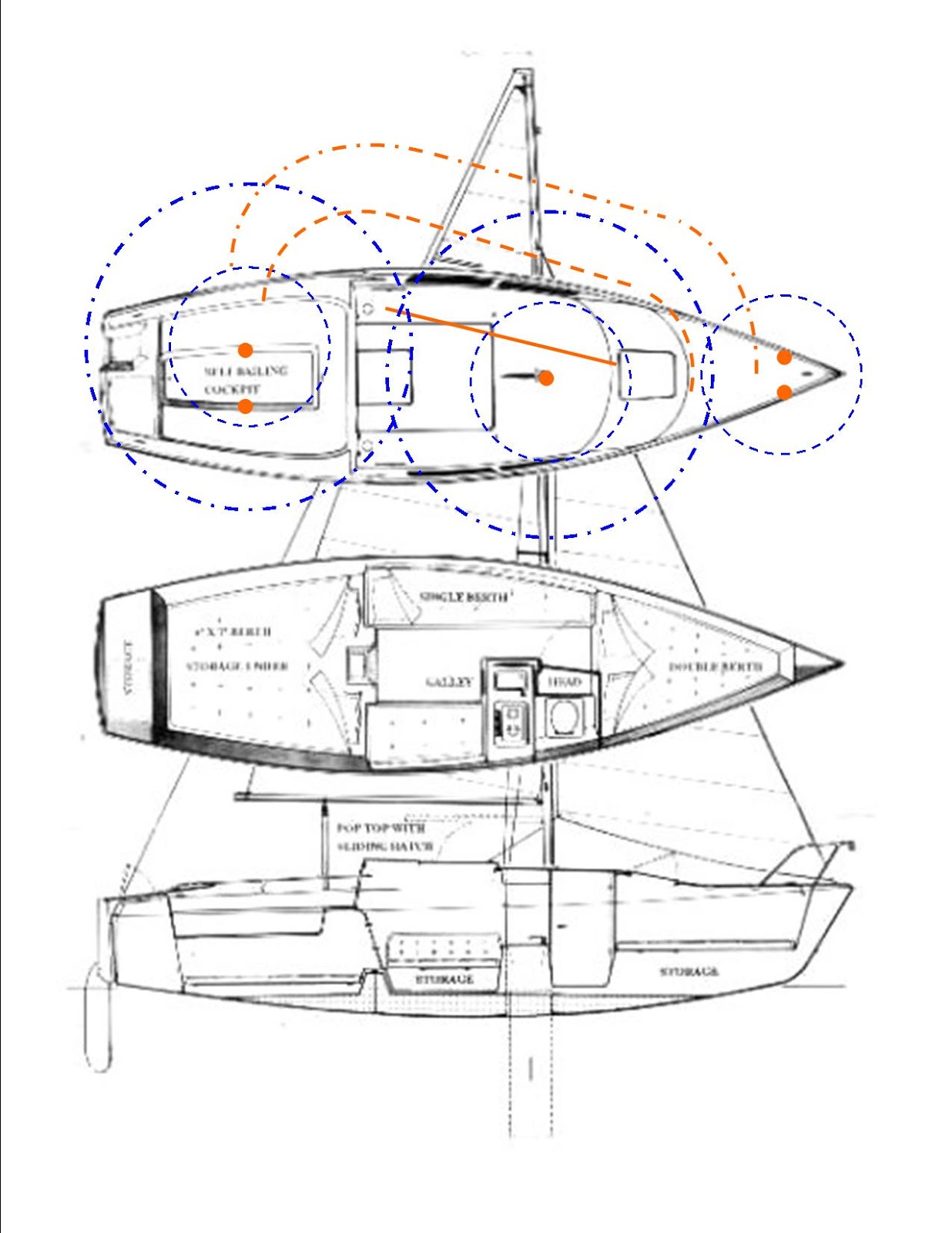
I've a sprayhood, and I've jackstays. Both sides of the jackstays run close to the centre line of the boat. I sail with the sprayhood down so the jackstays are above it in its laid down position; the boat's got a low boom, so it's what it is. I never leave the cockpit without being clipped on, and from one position can go to either side, and be sure that I won't go over the side as long as I'm clipped on. With these things down the outside of the stays, running along the edge of the boat, if one falls over, you'll be in the water, being towed along and trying to think "Why didn't I make it so that I can't fall into the water?".
My sprayhood is only deployed in harbour, as it's part of the cockpit tent, which isn't going to be acceptable for many, I mean going sailing and getting wet, but as RunAgroundHard states in #6 it might require a bit of effort, where one should think of the priority and figure it out as it's not tricky.
So what happens when you get near the bow forward of the mast? How far are you from the side of the boat then? Surely going on the bow is one point where one could be at risk- Sail handling anchoring , mooring etc.
 
I would do all possible to avoid a toe-rail version ... the idea is for jackstay - not to tow you alongside - but to prevent you falling in !!
But is it? I would suggest that on most boats up to 3 M beam a pair of stays running down the top of the cabin would still not prevent the body going over the rail. I do not see many larger yachts without tents either so I doubt many do have centre jackstays. I have been on a few where getting past the tent is pretty restricted for starters.

I have been over the side & getting back on is no joke.
Now, as single hander of 77 years the best I can hope for is that my body gets dragged along for my relatives to recover. Alternatively, the boat may hit a harbour wall or run aground so I can unhook & get ashore.
For me the dangerous part of sailing is getting sails down & lines & fenders rigged so I tend to do in a way that that might happen. ie inside the harbours at, Dieppe, Ostend, Dover Ramsgate, Cherbourg,the , Orwell etc.. In all those places I have the engine pushing the boat at a couple of knots, not six, & hopefully I will hit something. I do not go on the deck to use silly snuffers etc. Conventional sail handling with recovery under the boom works safer. Single line reefing from the cockpit as well.
I also have lines rigged along the outside of the boat that hang down just above the water line. From just in front of the mast to the stern. I have found that having a rope to grab is important. The topsides are far to high to reach from the water. I have used them when going to cut nets from the prop & it is useful. I have seen people fall out of tenders & an upturned dinghy has no hand hold. A line over the side of the craft would make all the difference.
 
Last edited:
I guess there’s the ideal and then there’s what works or what fits. What’s practical and safe will vary greatly between 20 and 50 ft loa.

I’d really like a centreline Jackstay but it just wouldn’t work. V to the mast is as good as it gets.
 
A suppose that is possible, but I'm happy to take that rare risk in preference to fumbling around with multiple clips. To me it would be like clipping on to every rung whilst climbing a ladder, it might help to save you from a fall but it could equally be the cause?
Interesting point.

Also, the longer you are exposed, hanging on with one hand instead of two, the greater the risk of a big wave or bad roll. Rock climbers worry about getting tired while hanging on with one hand and placing gear, and mountaineers worry about time exposed in avalanche corridors. Steady movement, with a focus on the climbing and not falling makes it safer in many cases.

Better to get where you are going in a streamlined manner, with both hands holding something, and then clip at a workstation hardpoint.

I'm not arguing against a Y-setup if it works smoothly. Trips just to the mast or near there are more common than trips to the bow anyway.
 
I'm not sure I have ever heard a case of someone falling off to windward (up hill).
Sometimes there is no choice but to be on the leeward side of the boat: working on the genoa sheet or traveler, reef lines or reefed sail at the boom end, preventer, leeward shrouds, etc etc. It's usually when something is going the wrong way, not a good moment to add further uncertainties.
 
It is worth considering where you go on deck. trips to the bow, in fact, are VERY rare on many boats. We're not flying a chute and the jib furls. The anchor should have been tied down. Tangles at the mast or with jib sheets are far more common. Perhaps we should focus on that. Re-clipping to go to the bow should be very, very unusual. I know that 90% of my trips forward are to the mast area or slightly forward, but not the bow.

If you have hank-on sails, totally different.
 
Sometimes there is no choice but to be on the leeward side of the boat: working on the genoa sheet or traveler, reef lines or reefed sail at the boom end, preventer, leeward shrouds, etc etc. It's usually when something is going the wrong way, not a good moment to add further uncertainties.
True. And you are best clipped to the windward side and then climb down to leeward. There will also be less loaded running rigging to trip you up. Been there, done that. Clipping to the lee jackstay, or even a center jackstay, may be useless.

I think maybe you misunderstood my point in the earlier post, or perhaps I was unclear. Yes, falling to leeward is the FAR greater risk, so clipping to a jackline to windward of the CL is not a risk factor, but a benefit.

The right answer also varies with the boat and geometry. Absolutely. On my cat I used one tether leg longer than 2 meters because of the width. A a very small boat shorter than standard length would be better. On my trimaran the answers are different. For example, a V with hard points in the cockpit is probably the best system for this 9 meter boat.

mac%2B26%2Bjacklines.jpg
 
Last edited:
Sometimes there is no choice but to be on the leeward side of the boat: working on the genoa sheet or traveler, reef lines or reefed sail at the boom end, preventer, leeward shrouds, etc etc. It's usually when something is going the wrong way, not a good moment to add further uncertainties.
Unless it was impossible, I would heave to and make the lee side the windward side. Or as thin water says, go forward out of cockpit on high side then go down to lee side - staying clipped on high side by one of two clips.
And only on deck if a problem, as genoa tracks, travelleter, reef lines etc all done from the cockpit.
 
And you are best clipped to the windward side and then climb down to leeward. There will also be less loaded running rigging to trip you up. Been there, done that.
"Been there, done that" a fair bit myself, if about 20k miles maneuvering solo count. No way I would clip to a windward jackstay then lower myself to leeward. As you say, every boat/situation is different :)
 
"Been there, done that" a fair bit myself, if about 20k miles maneuvering solo count. No way I would clip to a windward jackstay then lower myself to leeward. As you say, every boat/situation is different :)
Yup, different boats and sometimes different situations. I've done it both ways, but only on the leeward side if the jackstay was far enough inboard or something else to clip short. On my cat the area by the cabin could not be reached from windward (cabin too big), but the jackstay was on the cabin top, near the edge, so no problem. My tri is wide, so no problem aft of the front beam, but if the problem is forward of the front beam, I go to windward.

And as Dunedin pointed out, many times heaving to or running helps, if the maneuver is possible and not jammed.

Similar mileage.
 
The best jackstay I've ever seen are fitted to my Catalac. The cabin top grabrail is a substantial C-shaped bronze extrusion fitted with a slide. I clip on to the slide from the cockpit and it takes me all the way to the foredeck where I have other places to clip onto. This on a boat with the least need to clip on!
 
I've never thought of two straps in a V formation from cockpit to mast base, like many I'm not in the habit of having the sprayhood up it's really for clarity of what is in front. Attaching them to run as close as possible to the centerline of the boat leaves some distance between jackstays and guardrail which seems safer. I've now got some idea of where these will be fitted. Thanks for your opinions.
 
I've never thought of two straps in a V formation from cockpit to mast base, like many I'm not in the habit of having the sprayhood up it's really for clarity of what is in front. Attaching them to run as close as possible to the centerline of the boat leaves some distance between jackstays and guardrail which seems safer. I've now got some idea of where these will be fitted. Thanks for your opinions.
Even with the sprayhood up (at least mine), with a short tether passed around that type of jackstay and hooked back to the harness, pay the price of a little crawling on deck and it's impossible to fall outboard, windward or leeward.
If you attach the V-jackstays on the mast at some height you barely need to detach from them, otherwise once at the mast I have a fixed tether (a line around the mast with a snapshackle at about 1-1.5m) which allows plenty of movement around it, should it be necessary.
Try what suits you best, modifying attachments and lines positions, IMHO the aim should be to be able to go anywhere on the boat in whatever conditions, sooner or later one will have to, sometimes very quickly and without any warning and that's where accidents usually happen.
 
Even with the sprayhood up (at least mine), with a short tether passed around that type of jackstay and hooked back to the harness, pay the price of a little crawling on deck and it's impossible to fall outboard, windward or leeward.
If you attach the V-jackstays on the mast at some height you barely need to detach from them, otherwise once at the mast I have a fixed tether (a line around the mast with a snapshackle at about 1-1.5m) which allows plenty of movement around it, should it be necessary.
Try what suits you best, modifying attachments and lines positions, IMHO the aim should be to be able to go anywhere on the boat in whatever conditions, sooner or later one will have to, sometimes very quickly and without any warning and that's where accidents usually happen.
Good call totally agree, I like the idea of being closer to the boat Centreline than the toe rail.
 
Top