Is there an interface to convert analogue engine data to digital?

Andy Cox

Well-Known Member
Joined
9 Oct 2018
Messages
166
Location
Falmouth, Cornwall
Visit site
Something I've been thinking about for a while. Is there some sort of interface that can can take the analogue data from a non electronic diesel and convert it to something that could be used in a digital format, such as on a plotter or a PC?

I appreciate the info would be limited to RPM's, temp, engine and trans oil pressures and possibly temp / oil pressure alarm status.

I'm using a 19inch screen near the lower helm as an MFD, the plan being to show camera images, two in the engine room, one looking aft from the aft end of the rigid canopy and one showing the after deck and also to run something like PC Planner from a laptop that will act as independent back up to the Simrad plotters. Because the screen is mounted high up I figured engine data would be useful as it would be easy to see from anywhere in the saloon area.

I'm a bit concerned that if something happened to the main Simrad system, then apart from a small hand held GPS I'd be doomed.

Incidentally, I'm linking the camera looking aft on the canopy to the upstairs plotter to help when berthing stern to on the starboard side.

Andy
 
Andy

Several choices Actisense EMU1 probably the easiest, but limited in “Fidel-ability”, NoLand RS11 more confiurability but you need to be a bit computer savey to get the best out of it. If you google nmea2000 engine data you will get lots of info. Warning, with Actisense you have to buy the NGT-1 also, but it’s very useful managing your NMEA network and configuring sensors
 
A few years ago I did consider importing the Noland RS11, but found it simply too expensive and insufficiently supported to sell on. I did put one on my last boat and it was quite difficult to set up, but once set was brilliant and didn't miss a beat.

They are sold from Florida. You pays your money and you gets the unit, then read the details of how to set it up as they are unlikely to offer much other support, and as I said not a cheap unit especially with the current £ : US$ rate. Be aware you will need access to hyper terminal and a RS32 serial port unless they have changed the interface to USB. Less laptops have these available now.
 
I added a Noland RS11 a few years ago, well 2 actually, mine has a usb connection so no problem with my laptop.
There is a bit of work involved in setting it up. I found it needed a bit of trial and error but it has been very good since set up properly.
I didn't have any engine temp or fuel level guages on the flybridge and this was my main reason for buying it.

Saying that they are sensitive to voltage, e.g. turning on my instrument lights changes the engine temperature a couple of degrees. This probably happens on the normal gauge as well but it's not noticeable on the analog readout.

Regarding support, I only ever had one issue and as I remember they were very helpful. I think it required a new firmware version.
 
Thanks to all for your replies..........much food for thought.

Looking at the products mentioned is interesting. I think before I go any further with this I need to have a good clear idea of exactly what I would want from the system.

It looks as though there are various USB- NMEA 2K gateways available to be able to view the info via a Windows based system rather than a plotter.

Cheers
Andy
 
Thanks to all for your replies..........much food for thought.

Looking at the products mentioned is interesting. I think before I go any further with this I need to have a good clear idea of exactly what I would want from the system.

It looks as though there are various USB- NMEA 2K gateways available to be able to view the info via a Windows based system rather than a plotter.

Cheers
Andy
The Noland was NMEA 2K. I viewed it on my Garmin GPSMAP550 plotter. I particularly liked the bar graph tacho format as this made balancing the engines much more precise, although this may have been a Garmin feature rather than a Noland one.
 
I bought one of the NoLand RS11 that Trevor had.
I think it's a brilliant bit of kit, with relatively easy but rough calibration for most inputs.
Remember, all these take (as in steal) signal from the gauges you typically have on the lower helm (if it's a f/b, yours is, right?)
RPM is a different thing, it's v.accurate as it takes the alternator signal and you have to find/experiment with the dividing value (it's called something but it's 3-4yrs since I installed it...)

So the idea is that with a NoLand or Actisense, or whatever such device you create NMEA2000 sentences and throw them to the bus. Any device that is capable of presenting them, it will.
Now, if you don't have a N2K bus already and your plotter is not N2K, things are a bit iffy, you have to count on the cost of all that.

OTOH, if you're handy with electronics and arduinos, you can use the brilliant library built by a Fin called Timo and start building your own sentences and pump them down the bus.
If I'd start now that's what I'd do. Cost would be in the 40-50euro range for a 10-15-20 signal processing. Mind Noland and the others are 8 signals per device iirc. Further you'll notice that they mention that you need one per engine, haven't bothered with that, everything seems to work fine...

For the record, I have coolant temp, rpm, oil pressure and boost X2 on the NoLand.
Now, setting up a custom teensy device to do gearbox oil pressure, gearbox oil temp, gearbox gear, EGT X2 for 30euro + box + cables/proper connector

so ymmv, check and thread carefully. Would be good to explain what you want to do so we can suggest ways of doing it. FE, many plotters have a mirroring feature to show their screen contents on a tv/vga monitor, would that be sufficient? Want to have redundancy and have things on a tablet/notebook, that's more complicated.

cheers

V.
 
I bought one of the NoLand RS11 that Trevor had.
I think it's a brilliant bit of kit, with relatively easy but rough calibration for most inputs.
Remember, all these take (as in steal) signal from the gauges you typically have on the lower helm (if it's a f/b, yours is, right?)
RPM is a different thing, it's v.accurate as it takes the alternator signal and you have to find/experiment with the dividing value (it's called something but it's 3-4yrs since I installed it...)

So the idea is that with a NoLand or Actisense, or whatever such device you create NMEA2000 sentences and throw them to the bus. Any device that is capable of presenting them, it will.
Now, if you don't have a N2K bus already and your plotter is not N2K, things are a bit iffy, you have to count on the cost of all that.

OTOH, if you're handy with electronics and arduinos, you can use the brilliant library built by a Fin called Timo and start building your own sentences and pump them down the bus.
If I'd start now that's what I'd do. Cost would be in the 40-50euro range for a 10-15-20 signal processing. Mind Noland and the others are 8 signals per device iirc. Further you'll notice that they mention that you need one per engine, haven't bothered with that, everything seems to work fine...

For the record, I have coolant temp, rpm, oil pressure and boost X2 on the NoLand.
Now, setting up a custom teensy device to do gearbox oil pressure, gearbox oil temp, gearbox gear, EGT X2 for 30euro + box + cables/proper connector

so ymmv, check and thread carefully. Would be good to explain what you want to do so we can suggest ways of doing it. FE, many plotters have a mirroring feature to show their screen contents on a tv/vga monitor, would that be sufficient? Want to have redundancy and have things on a tablet/notebook, that's more complicated.

cheers

V.

Thanks vas, all very interesting.

Yes, we are f/b and yes there is a 2K bus which has 2 plotters, vhf, depth unit, radar and a couple of other bits and pieces on it.

My thinking would be to run a completely separate Windows based operating system and using the 19" display downstairs to view the camera imagery or the pc / laptop via a VGA switch. The pc / laptop would run something like C-Map Planner and using a separate USB GPS. This would give complete redundancy should a fault occur that might take the Simrad system out.

Then came the idea of adding engine data to it as well, but it would have to go through the PC / laptop. So using something like a RS11, which looks great, I could send engine data onto the 2K bus and then use a 2K-USB gateway to input the data to the pc.

I don't think I'm that bothered about having engine data on either plotter, as the plotters are adjacent to the engine panels.

I've just recently started messing around with an Arduino Mega 2560 but I'm still trying to get to grips with writing the code, but I plan to persevere with it, as it seems a great bit of kit with almost endless applications.

I know this might sound like the ramblings of a madman, but I think I know what I'm talking about, even if no one else does! ;)

Cheers
Andy
 
Thanks vas, all very interesting.

Yes, we are f/b and yes there is a 2K bus which has 2 plotters, vhf, depth unit, radar and a couple of other bits and pieces on it.

My thinking would be to run a completely separate Windows based operating system and using the 19" display downstairs to view the camera imagery or the pc / laptop via a VGA switch. The pc / laptop would run something like C-Map Planner and using a separate USB GPS. This would give complete redundancy should a fault occur that might take the Simrad system out.

Then came the idea of adding engine data to it as well, but it would have to go through the PC / laptop. So using something like a RS11, which looks great, I could send engine data onto the 2K bus and then use a 2K-USB gateway to input the data to the pc.

I don't think I'm that bothered about having engine data on either plotter, as the plotters are adjacent to the engine panels.

I've just recently started messing around with an Arduino Mega 2560 but I'm still trying to get to grips with writing the code, but I plan to persevere with it, as it seems a great bit of kit with almost endless applications.

I know this might sound like the ramblings of a madman, but I think I know what I'm talking about, even if no one else does! ;)

Cheers
Andy

if your f/b engine panel is as complete as the lower helm one, fine. Mine only had three indicator lights and a tacho for each engine...

I'm in the process of getting data out of the VDO original instruments/senders (well the ones not covered by RS11), so I should have some decent code in a couple of weeks for that. You could easily do all that without any expensive h/w.

Play with the Mega, but it's no good for NMEA2000 stuff. Get to Timo's github, study A LOT, and then buy a couple of teensy 3.5 or 3.6 and a few MCP2562 dip chips from farnel or wherever you want. A breadboard, a few resistors and you're ready to rock.
Ah, you'll also need proper 5pin M12 connectors (that's what N2K bus uses typically) and a few more tees.

I have a testbed at home with a Garmin GMI10 and my teensies and when something's ready take it for testing in the boat.

cheers

V.
 
I know this might sound like the ramblings of a madman, but I think I know what I'm talking about, even if no one else does! ;)
Cheers
Andy

Not ramblings of a madman.
Thats, more or less, what I've actually done.

That said, I've not bothered to integrate engine management systems but for the last 11 years, I have had a fully integrated ships PC.
Video, keyboard and sound are distributed throughout the boat.
A 4 station Raymarine G Series displays the PC along with other inputs on the flybridge and lower helm - 2 displays at each position.

The Raymarine G Series displays are just simple monitors - there are 2 Raymarine GPM (processors) that provide all the Raymarine nav systems inc radar etc.
There are five Cat 6 networks running through the boat - handling VGA video, Raymarine nav, Satellite TV, Cameras and finally a PROPER Ethernet network.
Video from all systems also feed into the TVs in the saloon and bedrooms.

Initially, the PC was a low power Windows system but over the years, it has developed and grown more powerful.
IMO, Windows 10 is not suitable as a ship bound operating system - you can never be sure if it has changed during an update.
So, over the last couple of years, I have finally dumped Microsoft in favour of Linux which seems to be more robust and I can count on it working when I want.

Over the years, I have built systems various addons using the likes of Arduino which have mostly been replaced with other kit. Lots of Raspberry Pis though, feeding Internet TV etc throughout the boat.

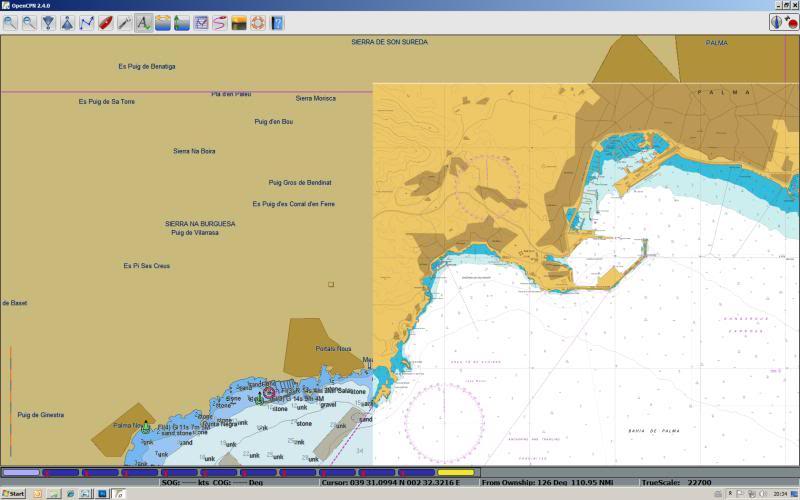
I use the popular OpenCPN PC navigation software and have about 2500 charts available - some that I've made and georeferenced myself.
So, the end solution is a full 4 station Raymarine nav system with a powerful PC nav system running on the same hardware.

I find it really useful having a ships PC on all the time.
Mostly, the boat is in a marina and the PC system then becomes the focal part of everything.
I wouldn't be without it.

It is just something that I've done over the years but I have never integrated the engine systems into it.
I've got lots of photos of it if you are interested.
 
Hurricane, thanks for your input.
What you're doing is really interesting and definitely gives me food for thought.

I think for me, the ultimate long term solution, which I saw on a bigger Trader a few years ago, was to have a 'glass' lower helm station with two sizeable integrated displays side by side. From memory, one was used for nav and radar and the other was used for most other ships systems and displayed the status of all external lights, pumps, engine and transmission data, generator data etc. etc. etc.

Out of interest, are you running the pc system through an inverter or are you running with the genny whilst at sea?

I'd be interested to see the photos of your set up at some point if that's not too much trouble.

Andy
 
Hurricane, thanks for your input.
What you're doing is really interesting and definitely gives me food for thought.

I think for me, the ultimate long term solution, which I saw on a bigger Trader a few years ago, was to have a 'glass' lower helm station with two sizeable integrated displays side by side. From memory, one was used for nav and radar and the other was used for most other ships systems and displayed the status of all external lights, pumps, engine and transmission data, generator data etc. etc. etc.

Out of interest, are you running the pc system through an inverter or are you running with the genny whilst at sea?

I'd be interested to see the photos of your set up at some point if that's not too much trouble.

Andy

Sorry for the delay - we have been away over the weekend.

I've looked at this type of system for a number of friend's boats.
The big issue always is the video displays.
To make a system work, they have to be as good as the dedicated industry plotters that we have all been using over the years.
Primarily, that means water resistant and sunlight viewable.
In my case, 11 years ago. I was installing a system onto a new boat so it was a bit easier.
I chose to use a Raymarine G Series (Glass Bridge System) - mainly because the monitors incorporated lots of different video feeds.
My experience of any technology is that it HAS to be easy to operate.
In this case, it has to be simple to switch from one video feed to another - quickly.
The feature of a "Glass Bridge System" like the G Series is that the intelligence is in a "black box" - the displays are just simple monitors.
The vintage of Raymarine G Series monitors that we fitted, incorporate lots of buttons along the bottom of the display.
Each button is allocated to a separate video feed - simply push a button and the feed associated with that button is displayed.
There was and is a central video box that I could have fitted but that would mean switching video signals via menus.
I chose to make the installation more complex and to route all my video feeds to each of the displays - yes - thats EVERY video signal to ALL my displays.
I have two on the flybridge, two on the main helm and all the TVs in the boat.
I also routed sound/audio to these positions.
I installed two Raymarine wireless keyboards to control the G Series GPMs (the Black Boxes).
In the early days, we used a wireless PC keyboard and an Air Mouse to control the PC from anywhere on the boat.
But now days, I just use a cheap media centre wireless keyboard and carry it to wherever I want to use it.

I also have two Raymarine G Series GPMs "Black Boxes" that feed to all the nav systems.
So, whilst we are under way, we have complete duplication of all the navigation systems.
A typical situation would be on the flybridge with the Raymarine Nav on the port display and OpenCPN PC navigation of the starboard display.

Here is a pic of one of the flybridge displays showing the output from one of the GMPs (Raymarine Black Boxes)
(No guesses to where we were going at the time!!!)
Note all the buttons along the bottom of the display - one for each input.

serve.php


The next pic was taken on a different passage early in the morning so the pic is a bit dark but it shows both displays at the lower helm.
The starboard one is displaying radar (actually from one of the GPMs) and the port one is displaying OpenCPN - PC navigation software.
Actually the port display is using CMap vector charts - the GPM use Navionics charts.

serve.php


And here is a pic of one of the lower helm displays showing a docking camera view.
Remember, ALL displays can view ANY video feed.

serve.php


Satellite TV has also been fed into the system.
Note the wireless Raymarine keyboards in the next pic - they can be moved between the driving positions or plugged in permanently.

serve.php


There is also a PIP (Picture in Picture) facility but it is a bit fiddly so we don't use it much.

serve.php


This pic shows the flybridge layout.

serve.php


Now a bit on the PC software.
I use OpenCPN - the Open Source Chart Plotter Navigator.
Free to download and free to use.
It supports vector and raster charts - even at the same time on the same page.
I have created loads of my own charts by scanning and then georeferencing them myself.
All my own charts are raster format that I grab from various places.
OpenCPN allows you to create groups of charts so you can switch very quickly between different views.


Charts can be "quilted" - this is an example:-
Note the extra detail where there is a more detailed chart.

Quilt_Vector_Small.jpg


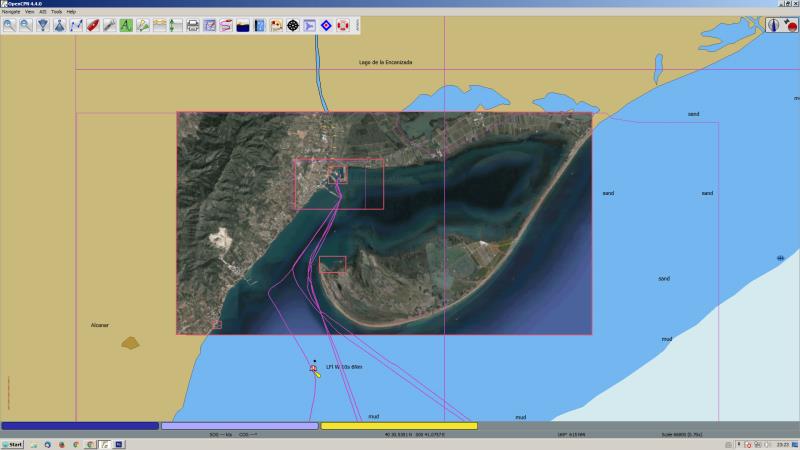
And here is one of my additions - a Google Maps image within a chart.
Note the ship's track that OpenCPN records.

SC1_Small_zpsm4g7x2fx.jpg


OpenCPN is particularly good at tracking AIS.
Most of the time, I will use OpenCPN to track AIS than the Raymarine system.
Here is an example - it is very clear what is going on here - the CPA is obvious.

serve.php


Finally, you asked about powering the PC.
Until recently, I used a DC/DC converter and the PC incorporated a vehicle PSU but at the beginning of last year, I bought a cheap Victron inverter that I have dedicated to the PC and its routers. I often stay on board for several months and during that time, the PC is on all the time - never switched off. When we start the engines to go to sea, the PC is ready to go.

I have loads of other electronic devices on board - three music zones fed using wireless interfaces onto separate amplifiers - Raspberry Pis to watch movies and UK TV across the internet etc - to mention a few.

If you have any questions - just ask.
 
Thanks Hurricane for your in depth reply and photos.

My system will, at this stage, be considerably simpler than yours for several reasons.

Initially, I'm just 'playing' with this and adding bits and pieces as ideas come along (and you really have given me some ideas), but I'm not going to be throwing large numbers of beer vouchers at this at the moment, so that will preclude buying dedicated marine displays for use on the flybridge.

At the moment the only thing I really want to do upstairs is to take a video feed from the aft security / docking camera and input it into the Simrad plotter. My thinking is that I would use the plotter in it's normal format until I'm in the marina and then switch to the video screen for backing into the berth. I still have the small Simrad MFD next to the plotter to give me depth and rudder angle.

Down at the main helm is where I'm thinking of making the most changes and that includes fitting the new display, which in all honesty is no more than a 19" pc monitor with a VGA input. That will be used to display all the camera feeds via the network recorder and nav information. You mentioned Open CPN in a previous post and I've now downloaded it and am playing with it on my laptop. It looks really good but I'm struggling to get hold of UK charts to cover my area of interest which is Cornwall and Devon as well as the Scilly isles, Channel Isles and north French coast. But I suspect I just haven't been looking in the right place yet!

The plan is to create a 'dock' for the laptop in the chart table and have it connected to the aforementioned display via a remote controlled VGA switch, have it's own dedicated GPS input as well as connected to a 4G router and a wireless keyboard and mouse. My thinking with this set up is redundancy, as it's not linked in any way with the main Simrad system.

I'm guessing your boat is quite a bit bigger than mine and is in the 20m range? Our current 45' is great but our long term boating plan involves going up to a Trader 575 Signature at some time in the future and that would lend itself to a more ambitious plan regards these sorts of upgrades.

I'll try and add some photos soon once I've got something to show.

Many thanks
Andy
 
Thanks Hurricane for your in depth reply and photos.

My system will, at this stage, be considerably simpler than yours for several reasons.

Initially, I'm just 'playing' with this and adding bits and pieces as ideas come along (and you really have given me some ideas), but I'm not going to be throwing large numbers of beer vouchers at this at the moment, so that will preclude buying dedicated marine displays for use on the flybridge.

At the moment the only thing I really want to do upstairs is to take a video feed from the aft security / docking camera and input it into the Simrad plotter. My thinking is that I would use the plotter in it's normal format until I'm in the marina and then switch to the video screen for backing into the berth. I still have the small Simrad MFD next to the plotter to give me depth and rudder angle.

Down at the main helm is where I'm thinking of making the most changes and that includes fitting the new display, which in all honesty is no more than a 19" pc monitor with a VGA input. That will be used to display all the camera feeds via the network recorder and nav information. You mentioned Open CPN in a previous post and I've now downloaded it and am playing with it on my laptop. It looks really good but I'm struggling to get hold of UK charts to cover my area of interest which is Cornwall and Devon as well as the Scilly isles, Channel Isles and north French coast. But I suspect I just haven't been looking in the right place yet!

The plan is to create a 'dock' for the laptop in the chart table and have it connected to the aforementioned display via a remote controlled VGA switch, have it's own dedicated GPS input as well as connected to a 4G router and a wireless keyboard and mouse. My thinking with this set up is redundancy, as it's not linked in any way with the main Simrad system.

I'm guessing your boat is quite a bit bigger than mine and is in the 20m range? Our current 45' is great but our long term boating plan involves going up to a Trader 575 Signature at some time in the future and that would lend itself to a more ambitious plan regards these sorts of upgrades.

I'll try and add some photos soon once I've got something to show.

Many thanks
Andy

On the subject of cameras.
I've found that IP cameras are not as good as the older analogue ones.
The reason is that there is a delay whilst the IP camera streams its video.
Analogue cameras by their nature show a picture as it happens.
My two docking cameras (one each that "look" over the bathing platform are analogue.
I also have an IP anchor camera which feeds into the ship's LAN.
The difference between the two technologies is significant.
Depending on the software, you can experience delays of up to a second.
My anchor camera delays are about half a second.
It is a very cheap camera - maybe a more expensive one would be faster.

On the computer front - I'm not sure that a laptop is the best option.
I prefer the flexibility of a dedicated system.
In this day and age, multiple USB ports is a good thing.
The hard disk drive in one of my early systems failed - since then, I've always used SSD.
SSD drives are more robust, faster and require less power.
My latest PC that I installed last year is a "Barebones" PC.
Intel make a range of "Barebones" PC that they call NUC
I opted for a Gigabyte version which incorporates an M2 PCie SSD as well as providing space for a standard hard drive (where I fitted a SATA SSD).
This is the one I'm currently using - https://www.scan.co.uk/products/gig...r4-m2-2280-pcie-sata-25-sata-acwifi-usb31aplu
In comparison to a laptop this solution can cost less.
As said above, I've dumped Windows and all my systems these days are Linux based so there is no (or very little) costs of software.
Let me know if you would like more information.

I use Actisense USB interfaces to import the ships NMEA data into the PC.
That gets GPS and AIS information into OpenCPN
 
Top