Is the gas bottle empty?

I have never heard of that before or seen any safety instructions to do so.

Gas bottles out here are date-stamped on manufacture, and can only be refilled for ten years before requiring retesting and restamping. I assume this is the reason.

We also have a "swap-and-go" system whereby you can take your empty gas bottle to (usually) a service station, give to them (with some money), and accept a full cylinder in exchange. You have then lost your original bottle for good. My supplier recommends you don't have anything whatever to do with such a scheme unless your bottle is only new, as the bottles they provide are far inferior to the one you're likely to have. So I continue to get all mine retested, restamped, and refilled as necessary.

Mike
 
Gas bottles out here are date-stamped on manufacture, and can only be refilled for ten years before requiring retesting and restamping. I assume this is the reason.

We also have a "swap-and-go" system whereby you can take your empty gas bottle to (usually) a service station, give to them (with some money), and accept a full cylinder in exchange. You have then lost your original bottle for good. My supplier recommends you don't have anything whatever to do with such a scheme unless your bottle is only new, as the bottles they provide are far inferior to the one you're likely to have. So I continue to get all mine retested, restamped, and refilled as necessary.

Mike

Your situation is very country-specific in Europe. Refilling your own bottles is common in Germany and the Netherlands but pretty much unheard of in many other countries. In Greece it is difficult to obtain any gas at all sometimes and we are often obliged to accept rusty old bottles that would be condemned elsewhere.
 
Water in a pressure vessel can be very dangerous, causing corrosion and weakness. Water enters gas bottles as condensation when users dont close the valve when changing an empty bottle. The plastic sealing plug should also really be re-inserted.
My 907 bottles have no valve to either open or close. They do have a small ball valve but I don't know if it is spring loaded or just held in place by gas pressure.

I do wonder how much of a problem a drop of water will be in a gas (and therefore low oxygen level) bottle?
 
My 907 bottles have no valve to either open or close. They do have a small ball valve but I don't know if it is spring loaded or just held in place by gas pressure.

Spring loaded. 904 and 907 bottles have a screw-in seal/carrying handle. At one time most dealers wouldn't accept a bottle for exchange without it as it was a term of the contract with Camping Gaz.


I do wonder how much of a problem a drop of water will be in a gas (and therefore low oxygen level) bottle?

Gas bottles must be checked every 10 years or so (maybe it was 15?) for corrosion (you'll find a date stamp on them if you you look). The only way corrosion can occur in a gas bottle is moisture/oxygen inside, true. But if the valve on a (propane) bottle is left open, why should the inside remain with a low oxygen/vapour level? And sprung valves can stick.
 
CIMG2933.jpgCIMG2932.jpg
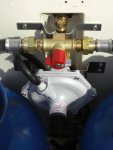
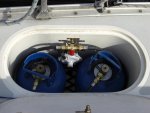
If you fit a changeover regulator it will show you when one of the bottles is empty.

+1

I even added a dab of silver paint to make it clear which one is selected. It's a simple manual changeover valve on the regulator outlet, we normally only open the bottle valve on the selected bottle, but when you go to turn the bottle on or off, it's always clear which one is in use.
 
. But if the valve on a (propane) bottle is left open, why should the inside remain with a low oxygen/vapour level? And sprung valves can stick.

Because the gas is heavier than air?

For that matter I don't know how they could really check the inside of a gas bottle for corrosion. I'm sure that it would technically be possible to do, but I rather doubt that the bottles get much more than a visual examination and perhaps a pressure test and a new valve.

To be honest I don't know the truth of it. I was just querying your, if I may say, somewhat dogmatic comment about how dangerous a bit of water might be inside a bottle. I suspect that it is a minor issue, but I'm happy to be shown to be wrong.
 
Sorry, didn't mean to be dogmatic about it. Only repeating what I learnt working for Shell gas, and all put to me as fact. But your experience seems to be different. Worlds big enough for all opinions.
 
I can tell the level of liquid gas in our outside domestic bottles at home by looking at the condensation line on the outside, I presume there is a marked temperature difference where the liquid meets the gas, so it might be possible to get the level by feeling the outside of the bottle. However, if the temperature drop is caused by the evaporation inside the lower usage in a boat might not be enough to activate enough change so its probably another daft idea.
 
Top