
colind3782
Well-Known Member
If you fit a changeover regulator it will show you when one of the bottles is empty.
+1

If you fit a changeover regulator it will show you when one of the bottles is empty.

I have never heard of that before or seen any safety instructions to do so.

Gas bottles out here are date-stamped on manufacture, and can only be refilled for ten years before requiring retesting and restamping. I assume this is the reason.
We also have a "swap-and-go" system whereby you can take your empty gas bottle to (usually) a service station, give to them (with some money), and accept a full cylinder in exchange. You have then lost your original bottle for good. My supplier recommends you don't have anything whatever to do with such a scheme unless your bottle is only new, as the bottles they provide are far inferior to the one you're likely to have. So I continue to get all mine retested, restamped, and refilled as necessary.
Mike
My 907 bottles have no valve to either open or close. They do have a small ball valve but I don't know if it is spring loaded or just held in place by gas pressure.Water in a pressure vessel can be very dangerous, causing corrosion and weakness. Water enters gas bottles as condensation when users dont close the valve when changing an empty bottle. The plastic sealing plug should also really be re-inserted.
My 907 bottles have no valve to either open or close. They do have a small ball valve but I don't know if it is spring loaded or just held in place by gas pressure.
I do wonder how much of a problem a drop of water will be in a gas (and therefore low oxygen level) bottle?

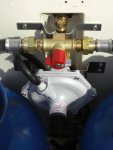
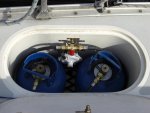
If you fit a changeover regulator it will show you when one of the bottles is empty.
I read about this on another thread. Apparently the bottles are simultaneously full and empty until you open the locker lid to look, at which point they turn into a cat.
. But if the valve on a (propane) bottle is left open, why should the inside remain with a low oxygen/vapour level? And sprung valves can stick.


