Is a ping pong ball the best ball to see flow inside a strainer with see-through lid

tudorsailor

Well-Known Member
Joined
12 Jun 2005
Messages
2,756
Location
London
zebahdy.blogspot.co.uk
I would like to be able to see that water is running in through the strainer for the raw water intake for the genny. The strainer has a clear lid. A friend has used a ping pong ball to help visualise the flow, but I wonder what will happen to the ball after prolonged immersion in sea water. Would a polystyrene ball be just as good or will it disintegrate? Should I look for a hollow polypropylene ball which is tougher apparently but harder to find sold singly? Any suggestions???

Before someone suggests looking at the water flow in the exhaust, I cannot do this as I have a dry exhaust!

Thanks
TudorSailor
 
I fitted a flow switch in my raw water feed connected to a indicator light and the oil pressure water temperature alarm buzzer.

You can also set up a piddle pipe somewhere it can be seen easy.

Anything that floats like a cork or to from you favorite wine would also do as long as you can see the strainer when the engine is running
 
I fitted a flow switch in my raw water feed connected to a indicator light and the oil pressure water temperature alarm buzzer.

You can also set up a piddle pipe somewhere it can be seen easy.

Anything that floats like a cork or to from you favorite wine would also do as long as you can see the strainer when the engine is running
Rather like watching varnish dry
 
I would like to be able to see that water is running in through the strainer for the raw water intake for the genny. The strainer has a clear lid. A friend has used a ping pong ball to help visualise the flow, but I wonder what will happen to the ball after prolonged immersion in sea water. Would a polystyrene ball be just as good or will it disintegrate? Should I look for a hollow polypropylene ball which is tougher apparently but harder to find sold singly? Any suggestions???

Before someone suggests looking at the water flow in the exhaust, I cannot do this as I have a dry exhaust!

Thanks
TudorSailor
Surely you need a flow meter in the pipewok with blue teeth and all that stuff and a "app" on your phone which will monitor, and record, the flow to raise an alarm if it fall below a certain value and enable you at any time in the future to recall the data for analysis and correlation with other factors
 
Surely you need a flow meter in the pipewok with blue teeth and all that stuff and a "app" on your phone which will monitor, and record, the flow to raise an alarm if it fall below a certain value and enable you at any time in the future to recall the data for analysis and correlation with other factors
Some of what you get in a crowded anchorage or marina will obscure anything :(
 
I would like to be able to see that water is running in through the strainer for the raw water intake for the genny. The strainer has a clear lid. A friend has used a ping pong ball to help visualise the flow, but I wonder what will happen to the ball after prolonged immersion in sea water.
A ping pong ball would be good, but take a black marker pen and draw bands on it as if they were lines of longitude, running between the poles. That way, if the ball is just spinning on its axis rather than batting about the strainer, it will still be obvious even at just a glance.
 
Before someone suggests looking at the water flow in the exhaust, I cannot do this as I have a dry exhaust!
A genset on dry stack? That's a weird design indeed, unless you enjoy breathing exhaust gas while anchored in no or little wind! :unsure:

Regardless, are you aiming at spotting the strainer flow from a camera, or directly in flesh?
I never came across a strainer where you can't distinguish if the water is flowing or not, with just a bit of practice.
I mean, also when there's nothing inside it to emphasize the water movement.
 
The ball from a roll on deodorant is a tougher beast and will do the job.

But do put the lines on it to confirm rotation.

regards clive
 
A genset on dry stack? That's a weird design indeed, unless you enjoy breathing exhaust gas while anchored in no or little wind! :unsure:

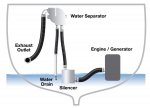
Both the engine and the genset have a water separator . So the water goes out under the boat and the gas comes out the exhaust. As a result, the noise is much reduced. We do get helpful people yelling at us that there is no water coming out the exhaust! Having had the engine exhaust gas mixed with sea water before being separated, we do not have any worse exhaust fumes than a boat with a standard wet exhaust.


Dry exhaust.JPG
TudorSailor
 
Top