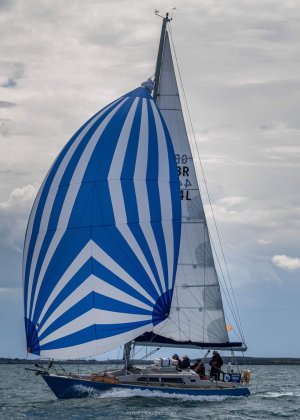
Is a Contessa 32 basically a man cave for Boomers longing for the halcyon days of the 70s?

Comfort Ratio was a tongue in cheek idea from Ted Brewer, yacht designer. You can read his comments about it on line, his website. It was picked up by others and has become a trope for comfort; it’s not really worth considering.
Oh yes.
Thanks for the pointer.
A bit more here. The notion of quantifiable comfort, although put up partly in jest, seems to have acquired some wider traction.
CRUNCHING NUMBERS: Brewer Comfort Ratio - Wave Train
Some boats are undoubtedly more comfortable, length for length to be on at sea. How you put that into numbers I have no idea!

I know, I’ve owned one once that was awful.
But lovely in other ways and the crew liked it
 
Last edited:
What exactly is "looking after you in a storm" ?

The '79 Fastnet, the '98 Sydney to Hobart, these are rare occasions when large fleets of diverse sailing boats are subjected to roughly the same atrocious weather conditions. In my humble opinion, it's the maritime equivalent of a duck race - (duck race: when a few hundred numbered ducks are tipped into a river and the one which reaches the finish line first wins - the winner is completely random)

These severe weather events are effectively a sailing duck race. We know that within a violent storm there are rogue waves, and massive differences in wind speeds, we've seen the effects - a flipped cat in Auckland and a superyacht laid on its side, the Bayesian sunk by a downburst or other freak wind event, and a few hundred metres away nothing has been touched. On top of this there is variability in the skill, experience and fitness of the crew - way too many variables to decisively say a boat survived purely due to its design parameters, and not because it got lucky and didn't encounter the rogue wave or downburst that saw off the competition.

The Contessa 32 was the only Class V boat to finish the 1979 Fastnet ... but instead of that being interpreted as "buy a bigger boat", the Contessa got marketed as a go anywhere world girdler.

... a Hick 35 won the 1998 Sydney to Hobart, 10th across the line and won its class. It is as close to an AWB as you can get - 10,6m long, fin keel, balanced spade rudder, 3/4 rig, Yanmar 2GM + Saildrive - another lucky duck which most people have never heard of. They missed a marketing opportunity on that one.

The sailing club bars around the world are full of sailors claiming their chosen boat is best, with tales of survival to back it up - but when the sh!t really hits the fan, we're all in a duck

Meh. There are other similar sized yachts that look better and sail just as well. ;)
Well that’s matter of opinion. Both pretty cool though😀
 
What often gets ignored is the hydrodynamics of the keel righting the boat, short keel length with a bulb travels sideways through the water with less resistance than a long keel .. so even though the gravitational force from a heavy long keel may be higher, it needs to displace more water to travel sideways and right the boat
Pretty sure this has been proven incorrect as the depth of keel makes a difference more than length.
 
I realise that the original post is a tad tongue-in-cheek in order to encourage engagement but there are some simple facts about the CO 32 that cannot be disputed. Until Madame Annette Beneteau revolutionised yacht production with spray laminating, ring cradles and the rest, boatbuilding had changed little since the inception of leisure yachting. Boatbuilding was dying until she introduced her new methods.
That makes the CO 32 all the more remarkable in that, despite being basically a traditional 'family business' style setup in a mature and dying market, they achieved great success against the odds. To achieve 'Boat of the Show' and then jump to a two year waiting list is in itself impressive - but to then build a boat per week, every week for over ten years, topping out at a total of 750 boats produced is an outstanding record which simply could not have been achieved with a 'Lemon' that could not sail or did not meet the market requirements at the time.
Over 50 years of a (very) active owners group is further testimony. As a one time broker there was nothing easier to sell than a Contessa, they openly stated that the design would not be compromised for either class rules, fashion or accommodation needs and indeed it was not. They did what it said on the tin, and for that reason 750 people stumped up the cash and, running costs aside, most have not lost a bean for the privilege of years of fun.
 
Has anyone done the ‘classic car vs modern equivalent’ analogy yet? In case they haven’t, a current Golf GTI is a better car in pretty much every way than a Triumph TR6, but many people would pick the latter in a heartbeat, or half a heartbeat for a British racing green example. Yum.
 
Has anyone done the ‘classic car vs modern equivalent’ analogy yet? In case they haven’t, a current Golf GTI is a better car in pretty much every way than a Triumph TR6, but many people would pick the latter in a heartbeat, or half a heartbeat for a British racing green example. Yum.
It was done by YM some years ago between a CO32 and a Bavaria 30(ish) soap dish. The CO32 came out on top! Cue Tranona to rubbish the comparison and conclusion .......................................
(and the Bavaria's keel stayed attached!)
 
Has anyone done the ‘classic car vs modern equivalent’ analogy yet? In case they haven’t, a current Golf GTI is a better car in pretty much every way than a Triumph TR6, but many people would pick the latter in a heartbeat, or half a heartbeat for a British racing green example. Yum.
Doesn't work.

I'm prepared, indeed anxious to believe that at least some old boats are better than new boats, but its far too much of a stretch to believe that new boats are relatively anything like as awful as new cars.
 
I’m sitting at anchor on our Fulmar with the family. The fridge is running, the kids have Internet and we all have plenty of space. The boat has the same kind of legendary seakeeping, and prices are competitive (although ours is much improved thanks to help from this forum). It and the Sadler 32/34 offer some of the Contessa vibe but if you want the good looks perhaps they fall short.
 
I thought they were wonderful sailing boats. Then I tried one, and discovered that they are horribly wet, slow, disastrously in anything under 10kn, and difficult to sail with less than 4 large blokes. The rig is nearly unmanageable by modern standards, with that huge genoa and pathetic little main. The foredeck is tiny and cluttered for kite work, and they don’t point very well. Then you park up and go below….. There, it’s dark, pokey and if you’re sailing with a race crew, you’ll be hot bedding. What’s not to love?
Pretty much spot on.
 
I’m sitting at anchor on our Fulmar with the family. The fridge is running, the kids have Internet and we all have plenty of space. The boat has the same kind of legendary seakeeping, and prices are competitive (although ours is much improved thanks to help from this forum). It and the Sadler 32/34 offer some of the Contessa vibe but if you want the good looks perhaps they fall short.
According to the new YTC handicap system a CO32 is faster than a fin keel Fulmar.
 
Last edited:
It was done by YM some years ago between a CO32 and a Bavaria 30(ish) soap dish. The CO32 came out on top! Cue Tranona to rubbish the comparison and conclusion .......................................
(and the Bavaria's keel stayed attached!)
Indeed the comparison was nonsense when the only thing in common was the notional hull length. If I recall there were only a couple of points difference in the "score" and if they had waited a year for the update on the Bavaria the changes to the later model would have eliminated the difference.

That is what you get when the person who devised the test and the scoring system was a CO32 owner who openly had no time for modern boats and currently sails a leaky old wooden centreboarder around the mud of the Thames.

Still it gave bragging rights to the 750 or so owners of the older boat some of whom have dined out on it for years.

Actually I think the idea of a comparison across era would be useful IF the boats chosen represented the latest in the chosen market sector. For example the CO32 against an Elan 33 or a First 31.7 would be interesting. Or you could look at what might represent a similar position money wise then you could put the CO32 up against the First 40.7 as boats that might appeal to a similar type of person. They also sold in similar numbers! Of course you still have the scoring system issue as it is difficult to be objective when there are such big differences in the way the boats are designed and built.
 
Last edited:
I realise that the original post is a tad tongue-in-cheek in order to encourage engagement but there are some simple facts about the CO 32 that cannot be disputed. Until Madame Annette Beneteau revolutionised yacht production with spray laminating, ring cradles and the rest, boatbuilding had changed little since the inception of leisure yachting. Boatbuilding was dying until she introduced her new methods.
That makes the CO 32 all the more remarkable in that, despite being basically a traditional 'family business' style setup in a mature and dying market, they achieved great success against the odds. To achieve 'Boat of the Show' and then jump to a two year waiting list is in itself impressive - but to then build a boat per week, every week for over ten years, topping out at a total of 750 boats produced is an outstanding record which simply could not have been achieved with a 'Lemon' that could not sail or did not meet the market requirements at the time.
Over 50 years of a (very) active owners group is further testimony. As a one time broker there was nothing easier to sell than a Contessa, they openly stated that the design would not be compromised for either class rules, fashion or accommodation needs and indeed it was not. They did what it said on the tin, and for that reason 750 people stumped up the cash and, running costs aside, most have not lost a bean for the privilege of years of fun.
That is a very odd view of the market in the 1970s/80s. it was the very opposite of "mature", but in the early stages of a boom in demand. The CO32 really had very little competition. It was one of those products that hit the sweet spot (in the UK at least) but as you say as soon as serious production builders entered the market with designs that appealed to a much wider market and production capacity to meet the demand sales fell off a cliff. There were several attempts to find a successor design but most failed because the pool of potential buyers (mostly UK) had shrunk.

There were of course other factors in the economic and political climate of the UK that made life very difficult for builders and most UK firms were gone by the 1990s as the UK was no longer a force in the market which had moved elsewhere.
 
Top