
Iron keel rust treatment

MagicalArmchair

Well-Known Member
Joined
11 Jan 2013
Messages
1,540
Location
Kings Hill, Chatham Marina
Visit site
When we hauled out, there was lots of rust on the iron keel.

The process I wanted to follow was:
  1. Use 40 grit flap grinding discs to get back to bare shiny iron.
  2. Degrease completely.
  3. Paint on three coats of rust converter.
  4. Prime with interprotect epoxy. First coat thinned, two further coats.
  5. Antifoul on top.
I ground back one side of the keel and we applied 3 coats of rust converter after degreasing using Hempel degreaser.

I noted the next day bubbling under the rust converter. If you pop a bubble it appears wet underneath. Could it be I missed a step of washing down the keel before degreasing? Is that salt water in the bubbles? Drawn out from the porous iron?


I suppose the only way ahead is to grind it back again, pressure wash it down, degrease it again and reapply?
 
When we hauled out, there was lots of rust on the iron keel.

The process I wanted to follow was:
  1. Use 40 grit flap grinding discs to get back to bare shiny iron.
  2. Degrease completely.
  3. Paint on three coats of rust converter.
  4. Prime with interprotect epoxy. First coat thinned, two further coats.
  5. Antifoul on top.
I ground back one side of the keel and we applied 3 coats of rust converter after degreasing using Hempel degreaser.

I noted the next day bubbling under the rust converter. If you pop a bubble it appears wet underneath. Could it be I missed a step of washing down the keel before degreasing? Is that salt water in the bubbles? Drawn out from the porous iron?


I suppose the only way ahead is to grind it back again, pressure wash it down, degrease it again and reapply?


In my view that will be a waste of time you need to grit blast and paint with epoxy tar under the waterline for a long lasting protection.

Needle descale is an alternative but then acid wash with hydrochloric acid and then phosphoric acid which is in face a rust converter without the sealing coat that prevents further conversion with further coats.

Just been doing my steel boat after damage in the marina breakup in Durban 3 years ago.
 
+1

You don’t want a ‘layer’ of rust converter on a cast iron keel. Those products (with silicone etc added) are good for steel but cast iron is too porous.

We had our keel blasted before lockdown but I was still advised to grind out the worst of the rust and leave it to breathe for a while. I left it for a good few weeks and washed down with phosphoric acid in between.
 
Thank you both. I may change my approach then. I thought as soon as the keel had been shot blasted, it could "flash rust" meaning it was advisable to get a coating on as soon as possible after? After you left it some weeks to breathe, was there any surface rust? Or did the phosphoric acid keep that at bay?

I was following Tinos approach here, that seemed a year later to look pretty good:
 
The problem with Cast Iron is porosity. Casting always contain impurities which absorb moisture. It may be practically impossible to dry them out completely.
We also have a Bav and after spending several winters afloat the keel was a rusty mess. We had it grit blasted, multiple coats of high build epoxy, faired and then Copper Coat. The boat was in Greece so easier to the keel dry.
6 years on this is still in good condition, but we haul out for the winter which seems to make a big difference.
 
Thank you both. I may change my approach then. I thought as soon as the keel had been shot blasted, it could "flash rust" meaning it was advisable to get a coating on as soon as possible after? After you left it some weeks to breathe, was there any surface rust? Or did the phosphoric acid keep that at bay?

I was following Tinos approach here, that seemed a year later to look pretty good:
Yeah you’re absolutely right about the flash rusting. But equally, apparently they also benefit from some time to ‘breathe’ (especially soon after a haul out).

If sticking with the grinding route, then the ‘breathing’ can happen now. In fact, it looks like it is already!

With blasting, you either go for the immediate recoating option (perhaps best if the keel is dry already) or you can treat the flash rusting in between washes/degreasing. Acid is best for this as it only leaves residue behind from the chemical reaction - it doesn’t try to form a skin/film/primer layer.

The blasting is so powerful that I wonder if it also displaces some moisture itself?
 
Last edited:
Okay then, how about this.
  1. Strip off the rust converter and strip the other side to bare metal with the grinder.
  2. Pressure wash it to remove any salt deposits and to try and draw moisture to the surface.
  3. Wash with phosphoric acid.
  4. Allow it to breath for a few weeks, washing with phosphoric acid once a week.
  5. One final wash with phosphoric acid, and a further grind if any surface rust is visible.
  6. Degrease.
  7. Epoxy x3 or x4 coats.
  8. Antifoul x 2 coats.
The total capex is low, and the effort is not that extreme now one side is already ground, so if it DOES all fall off next year... I'll shot blast it then and go again :D... I'll get some shotblasting quotes all the same... I might replace step 1 with the shotblasting option yet...
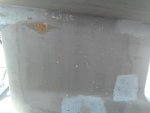
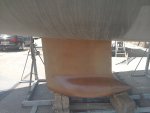
How on earth do you treat the bit of keel on the bottom?? Can the yard prop the boat up so that the keel is floating? Or is it a case of shuffling the chocks around under the keel to reach different parts of the bottom of the keel?
 
The chap who did our Keel insisted that the yard blocked the boat so the keel was hanging and he had 300-400mm clear under the keel. It worked as it’s still in good condition.
A friend had their keel hand stripped by the yard and then she applied ‘Epoxy Coal Tar’, which has been successful. From memory ECT is used to protect the chassis of vintage cars.
 
The total capex is low, and the effort is not that extreme now one side is already ground, so if it DOES all fall off next year... I'll shot blast it then and go again :D... I'll get some shotblasting quotes all the same... I might replace step 1 with the shotblasting option yet...

How on earth do you treat the bit of keel on the bottom?? Can the yard prop the boat up so that the keel is floating? Or is it a case of shuffling the chocks around under the keel to reach different parts of the bottom of the keel?
[/QUOTE]
I had my Bav keel blasted last year. Around £400 including applying the first coat of epoxy and 5l of epoxy (Hempel Hempadur) to do 5 coats before Coppercoat. Impossible to do underneath unless you can get the boat held in slings. In reality nobody does this - I had here blocked up using narrow pads about 40cm off the ground in a 6 prop cradle which meant that about 60% of the underside got blasted and epoxied and i slap a bit of normal AF on the rest, which inevitably is a bit rusty. however the rust does not spread under the epoxy. If you are going this route use Coppercoat which well cost less than £200 to do the keel.

Before

IMG_20200605_180124.jpg


IMG_20200623_150038.jpg

10 days later after a lot of sweat in last June heatwave.

Will know whether it has stuck when we lift in a few weeks time for a wash.
 
Last edited:
Holdtight 102 flash rust preventer might be worth checking out.

Worked for me, allowing me to de-rust and jet wash one day, then paint next day onto a rust-free surface. Quite how it works is beyond me - it's not a coating of any sort, indeed it claims to (and appeared to) leave no residue.

You mix it with water in a bucket, and the jet washer sucks out of the bucket. Surprised it's not more well known - searching this forum produced one hit.

I get obsessed with doing the bits underneath. Tend to use a hydraulic car jack and do the shuffling blocks around thing, working on one half at a time. Easier with two keels.
 
Thank you all, I have some work to do!

...left it for a good few weeks and washed down with phosphoric acid in between.

What concentration of phosphoric acid do you use to wash it down with? This comes with 45% purity and on the bottle it suggests a 5:1 dilution , Azure Liquid Solutions Phosphoric Acid Descaler Rust Remover 45% Safe On Metal Surfaces - 5L: Amazon.co.uk: Business, Industry & Science . Would that be too weak at that concentration?

...I get obsessed with doing the bits underneath. Tend to use a hydraulic car jack and do the shuffling blocks around thing, working on one half at a time. Easier with two keels.

The bottom of the keel will drive me nuts - Mirage is big, heavy, and single keeled, so the only way I'll do it is if I get her held in the strops... hmmmm.
 
What concentration of phosphoric acid do you use to wash it down with?
Maybe best wait for advice from someone a bit better informed, as I found an old bottle from the previous owners (via Greece) in the lazarette marked only 'Phospohic Acid'! I diluted it 4:1 and brushed it on carefully as an experiment and it almost immediately turned the surface rust a black colour. On this basis, I figured it was doing something and stuck with that.

So 5:1 sounds about right.

Otherwise the new proposed method (above) sounds sensible to my limited knowledge/experience... One thing I was very cautious of was the warning that rusty cast iron can 'polish' when sanded such that it's indistinguishable from solid metal. You therefore might want to consider something like these (composite abrasive grinder discs), at least for a last pass, as I found they were more aggressive and ate into/flung off stubborn rust better than regular (fibre) sanding discs on the grinder: Abracs Poly Abrasive Disc 115 x 22mm
 
I just did mechanical de-rusting and epoxy painted over, thinking the paint would exclude the oxygen so any remaining rust would not be able to grow.

I like to think of the paint sticking directly to the keel, having introduced as little as possible in the way of treatments that might weaken the bonding.

Just my own logical take on it. Am no expert - could be completely wrong.

That was only last year, time will tell I guess...
 
I just did mechanical de-rusting and epoxy painted over, thinking the paint would exclude the oxygen so any remaining rust would not be able to grow.

I like to think of the paint sticking directly to the keel, having introduced as little as possible in the way of treatments that might weaken the bonding.

Just my own logical take on it. Am no expert - could be completely wrong.

That was only last year, time will tell I guess...
In an ideal world that’s what you’d do (namely blasting then immediate re-coating).

Problem is when you introduce other factors, especially moisture and the need to let the keel ‘breathe’ if was recently hauled out.

It’s still best to abrade the surface one final time (as well as clean with thinner/acetone) before paint. Acids don’t really leave anything behind on the surface, but rust treatment products usually do (black dust with fertan or a silicone film with Bit Hamber, etc.).
 
I ground the keel again and let it rest, hoping a couple of weeks would be enough to draw the moisture out. Twice a week I washed the keel with diluted phosphoric acid and that cleaned up any flash rusting wonderfully.

On the final day, I washed it over twice with phosphoric acid, before allowing it to dry and then degreasing before applying the first coat of Interprotect.

The next day I came down to do the second coat and to my horror some little bubbles of rusty water had popped up. I shrugged and carried on. Four coats of epoxy on and now antifouling on top, there are some larger blisters.

I launch on Wednesday - do I burst these guys and prime with something one pack (hammerite??)? And then patch in the antifoul on launch day? Or do I ignore it and go sailing? ?

 
Mark. Forget about the bubbles. Launch and go sailing. Cast iron is porous and the bubbles are likely from trapped moisture in the keel. Your keel will not rust away in the next decade, so treat when you lift out again. My keel has some rust spots everytime I lift out, but I just spot treat with Fertan and then recoat the affected areas with several coats of Primocon and the antifoul.
 
Ugh. Sorry to hear that. What a pain! Sounds the moisture, potentially including some from the acid washes, is trapped. It's hard to say how long a 'drying period' is required, because the porosity of the iron is so variable (as is local weather!). Our keel was wet blasted on the same day it had its first coat of epoxy - and to no ill effect (now 6 months on - still on the hard). But the wet blasting removed a previous layer of epoxy at the same time and the keel had been passively drying for 6 years (yes!) so that may have been a factor. We also held the compressed air - which for wet blasting is ridiculous PSI - over the keel after blasting in an effort to dry out the surface.

I agree - better launch and worry about it next season. You may just want to knock the tops of some of the worse blisters and 'feather' them in to the surrounding epoxy. A light machine sanding with, say, 120 grit perhaps? The logic being that a high proportion of the epoxy has adhered well and you don't want the blisters to grow and spread under that surface. Then prime the lot with vinyguard/primocon/similar and deal with the stubborn areas next winter?
 
When I used phosphoric acid and let it dry then paint with normal epoxy undercoat I found that rust came back fairly quickly.

I now still use phosphoric acid but wash it off and dry the washed surface and use high build primer and now find no rust return. This is on steel.
 
Top