
You are using an out of date browser. It may not display this or other websites correctly.
You should upgrade or use an alternative browser.
You should upgrade or use an alternative browser.
Interim MAIB Report Salong/Immaculate
- Thread starter Snowgoose-1
- Start date

Plum
Well-Known Member
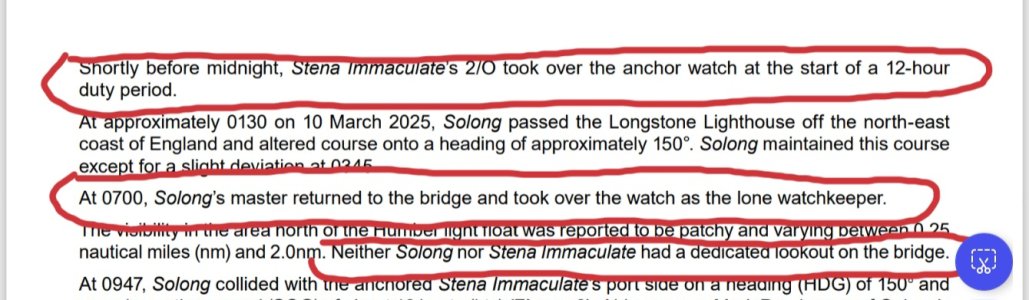
Thanks. Doesn't the third statement in the interim report, below, contradict the first two statements?
Attachments
DreadShips
Well-Known Member
The OOW / Watchkeeper has other duties, which may prevent them keeping a proper lookout at all times - especially at night or in poor visibility when (say) a good scan every couple of minutes isn't sufficient.
A dedicated lookout is a separate member of the crew assigned purely to keep an eye (and ear, in fog) on what might be out there. They're also handy for keeping the OOW awake in the early hours - something that is regularly pointed out in accident reports where a lone watchkeeper fell asleep and woke up parked aground on something unexpected like the Farne Islands.
It'll be interesting to see what comment they make on Stena Immaculate here - a proper lookout at anchor is somewhat ill-defined at the moment.
A dedicated lookout is a separate member of the crew assigned purely to keep an eye (and ear, in fog) on what might be out there. They're also handy for keeping the OOW awake in the early hours - something that is regularly pointed out in accident reports where a lone watchkeeper fell asleep and woke up parked aground on something unexpected like the Farne Islands.
It'll be interesting to see what comment they make on Stena Immaculate here - a proper lookout at anchor is somewhat ill-defined at the moment.

Biggles Wader
Well-Known Member
They appear to be not counting the OOW as a "dedicated lookout". On the Solong as a vessel under way this would contravene the rules as we used to apply them(in the 1970s)where there should be an OOW plus a quartermaster/lookout on the bridge. At anchor my recollection is that there was always an OOW on the bridge but not a dedicated lookout. The OOW would check the position regularly to ensure the ship was not dragging and summon assistance if required.
Wansworth
Well-Known Member
I am shocked that large vessels can cruise around with only one man on watch……what about illness ,accident,tiredness…..Is such manning legal?
DreadShips
Well-Known Member
The short answer is sometimes it's legal, sometimes it's not legal, and sometimes it's not clear. At night it should be two people for sure, but during daylight STCW Code Chapter VIII (the bit covering standards of watchkeeping) says the following:I am shocked that large vessels can cruise around with only one man on watch……what about illness ,accident,tiredness…..Is such manning legal?
The officer in charge of the navigational watch may be the sole lookout in daylight provided that, on each such occasion:
- .1 the situation has been carefully assessed and it has been established without doubt that it is safe to do so;
- .2 full account has been taken of all relevant factors, including, but not limited to:
– state of weather; – visibility; – traffic density ; – proximity of dangers to navigation; and – the attention necessary when navigating in or near traffic separation schemes; and - .3 assistance is immediately available to be summoned to the bridge when any change in the situation so requires.
Illness and/or fatigue obviously falls under "other factors".
Wansworth
Well-Known Member
On the ridge at 0700 there was only the Capitain although itwas still dark,although he should have been alert having been off watch.Thanks for your info
DreadShips
Well-Known Member
Sunrise was something like half six, so no problems on that front - it was daylight and had been for a while. It's the other stuff in that little list above they'll be looking at when considering if a lookout was necessary.On the ridge at 0700 there was only the Capitain although itwas still dark,although he should have been alert having been off watch.Thanks for your info

LittleSister
Well-Known Member
. . . It's the other stuff in that little list above they'll be looking at when considering if a lookout was necessary.
Regardless of the numbers involved, what they singularly failed to do was . . .
LOOK OUT !

RunAgroundHard
Well-Known Member
I did a long voyage on a Stena vessel last year, and they posted a dedicated watch keeper whose sole job was looking out on the bridge wings, underway. When at anchor they did not do this but the bridge was permanently manned, as expected, monitoring systems e.g. radars, alarm panels et cetera, as well as looking out.
RunAgroundHard
Well-Known Member
Sunrise was something like half six, so no problems on that front - it was daylight and had been for a while. It's the other stuff in that little list above they'll be looking at when considering if a lookout was necessary.
Visibility was stated as “patchy” and quoted between 0.25 to 2 miles. That suggests a more diligent watch should have been maintained, especially on radar. It is curious how a ship dead ahead on radar was not detected, assuming radar was operational. I wonder if the Stena vessel was assumed to be crossing at right angles based on the AIS image overlay showing the vessel graphic and not realising it was at anchor.
ylop
Well-Known Member
The surprising thing for me was not that Solong wasn’t keeping a proper lookout (collisions at sea would be almost zero if everyone did what they are supposed to) but that Stenna Immaculate seemed to be unaware of the pending problem until impact - I had assumed that vessels with millions of pounds of highly dangerous cargo, especially cargo owned by the US Military, would have a constant watch for “pirates” / “terrorists”.I did a long voyage on a Stena vessel last year, and they posted a dedicated watch keeper whose sole job was looking out on the bridge wings, underway. When at anchor they did not do this but the bridge was permanently manned, as expected, monitoring systems e.g. radars, alarm panels et cetera, as well as looking out.
Snowgoose-1
Well-Known Member
Apparently, the anchorage is not shown on the chart . The report does state that other ships were anchored.I wonder if the Stena vessel was assumed to be crossing at right angles based on the AIS image overlay showing the vessel graphic and not realising it was at anchor.
DreadShips
Well-Known Member
I'm not for a moment suggesting that the watch was sufficient (there's millions of pounds of evidence parked in Aberdeen right now that suggests it wasn't!) - it was in response to a question about the legal situation, which isn't clear cut in all circumstances.Visibility was stated as “patchy” and quoted between 0.25 to 2 miles. That suggests a more diligent watch should have been maintained, especially on radar. It is curious how a ship dead ahead on radar was not detected, assuming radar was operational. I wonder if the Stena vessel was assumed to be crossing at right angles based on the AIS image overlay showing the vessel graphic and not realising it was at anchor.
Interesting point about the AIS overlay, although as it was swinging slowly at anchor there'd be very little trail showing its position over the next few minutes?
(the anchorage might not be shown on charts, but it's pretty frequently used - there's half a dozen ships at anchor in the area right now, not including those with Immaculate)
rotrax
Well-Known Member
Surely the AIS would give CPA? Anchored ship swinging or not, some very important and useful info was on the screen of BOTH vessels.
If, of course, anyone was watching!
It would appear that First Mate and I are far more dilligent in our watchkeeping and lookout than professional seamen! We would have been aware of all the anchored ships through AIS and Radar if the vis was poor.
If, of course, anyone was watching!
It would appear that First Mate and I are far more dilligent in our watchkeeping and lookout than professional seamen! We would have been aware of all the anchored ships through AIS and Radar if the vis was poor.
dunedin
Well-Known Member
Absolutely - any AIS would surely have shown a CPA of only a few metres. I assume on a commercial ship the AIS is integrated into the ECDIS system, so should also have alarms raised even if nobody looking at screen.Surely the AIS would give CPA? Anchored ship swinging or not, some very important and useful info was on the screen of BOTH vessels.
If, of course, anyone was watching!
It would appear that First Mate and I are far more dilligent in our watchkeeping and lookout than professional seamen! We would have been aware of all the anchored ships through AIS and Radar if the vis was poor.
The generic issue I believe with ECDIS is have so many spurious alarms can get into routine cancel mode (not suggesting necessarily happened here - see MIAB report on ship which had a “rapid uncheduled deceleration” on Eilean Trodday a couple years back.
LittleSister
Well-Known Member
Apparently, the anchorage is not shown on the chart . The report does state that other ships were anchored.
. . .
(the anchorage might not be shown on charts, but it's pretty frequently used - there's half a dozen ships at anchor in the area right now, not including those with Immaculate)
A ship, fishing vessel, leisure craft or other vessel is not limited to designated or chart indicated anchorages. It may anchor where it likes, apart from specifically prohibited channels or if restricted by harbour regulations etc, and even in those one might find a vessel anchored by force of circumstance.
In this case it was reported that the Stena Immaculate was specifically instructed by VTS to anchor in that location, as was presumably the case for the other vessels anchored nearby.
Other threads that may be of interest

- Replies
- 108
- Views
- 4K