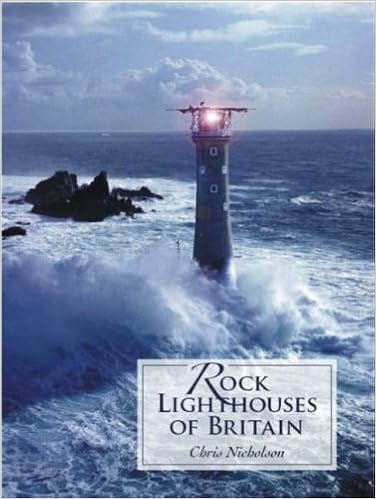
Interesting book on off-shore lighthouses

iLens

Well-Known Member
Joined
5 Oct 2017
Messages
108
Visit site
"Seashaken Houses" by Tom Nancollas
Interesting and well written story of the construction and manning of eight "rock" lighthouses, including Bell Rock, Eddystone and Fastnet.
 
I enjoyed it, but it has almost no photographs and no useful diagrams which much detracts from it. One can talk of engineering and architecture just with words, but it's not the best way.

The lack of diagrams comes across as just laziness on the part of the author: he could have drawn a few diagrams to illustrate the points he is making (maybe a day's work?) - but it seems he couldn't be ar%#d. I would have given it a 9/10 but have to reduce that to 5/10.
 
This is an excellent book on the subject:

51632A4DC2L._SX374_BO1,204,203,200_.jpg


and has more diagrams, drawings and photographs than you can shake stick (or house) at.
 
I got it for Christmas and have been a bit disappointed with it - I think he could have done with a good editor. It is his first book, so I should not be too harsh, but I do not think he is a naturally gifted writer. His prose aspires towards the purple at times, only to be let down by a clunkingly poor choice of word or sentence construction. As examples, referring to a shortage of quarried granite as "a drought" is an unhappy choice of metaphor, and he tells us that Star Castle on St Mary's (in the Scilly Isles) was built " ... in 1593 to dispel another Spanish invasion." Dispel? Discourage, defend against, resist, repel, repulse would all have been better; dispel is simply the wrong word. Again, as an example of the style of writing that would a make a middle-school English teacher reach for their red pen I offer "... the pilot draws the helicopter upwards and, with a returning wave, suavely veers off towards land."

There are signs, too, that he does not always understand what he is writing about. In the chapter on Haulbowline (having explained that a bowline is not just the name of a rope attached to a sail, it is also a kind of knot) he tells us that at one time a light or day signal was displayed from the "half-tide room" so that vessels would know when there was enough water to cross the bar. He then goes on to refer to the the light "shining ... when the tide was on the flood, extinguished when it was on the ebb."

There also seem to be factual errors. Of Bishop Rock he writes "32 miles SW from Cornwall, it is the furthest rock lighthouse from Britain." What does that mean? From the British Mainland? What about Monach, 59 miles west of Applecross, or Muckle Flugga, 148 miles north of JohnO'Groats? Perhaps he means "Trinity House's furthest rock lighthouse from the mainland of England and Wales."

I agree about the paucity of illustrations, some maps and colour photos would have been a help. I kept referring to Wikipedia and the Lighthouse Authorities' own websites for more information.
 
Restricted to Scotland and the IoM but my recommendation is 'Northern Lights' by A D Morrison-Low and published by the National Museums of Scotland, more about history of engineering and optics than geography but well indexed with copious maps and illustrations for only £18.
Bella Bathurst is good on the generations of Stevensons.
 
I recently read 'To the Lighthouse' by Virginia Woolf. It was rubbish, having little or no technical information on lighthouses or their construction.
Avoid.
 
I recently read 'To the Lighthouse' by Virginia Woolf. It was rubbish, having little or no technical information on lighthouses or their construction.
Avoid.

Review of "Lady Chatterley's Lover" from the November 1959 edition of "Field and Stream":

Although written many years ago, Lady Chatterley’s Lover has just been reissued by the Grove Press, and this fictional account of the day-to-day life of an English gamekeeper is still of considerable interest to outdoor minded readers, as it contains many passages on pheasant raising, the apprehending of poachers, ways to control vermin, and other chores and duties of the professional gamekeeper. Unfortunately one is obliged to wade through many pages of extraneous material in order to discover and savor these sidelights on the management of a Midland shooting estate, and in this reviewer’s opinion this book cannot take the place of J.R. Miller’s Practical Gamekeeping.
 
Review of "Lady Chatterley's Lover" from the November 1959 edition of "Field and Stream":

Although written many years ago, Lady Chatterley’s Lover has just been reissued by the Grove Press, and this fictional account of the day-to-day life of an English gamekeeper is still of considerable interest to outdoor minded readers, as it contains many passages on pheasant raising, the apprehending of poachers, ways to control vermin, and other chores and duties of the professional gamekeeper. Unfortunately one is obliged to wade through many pages of extraneous material in order to discover and savor these sidelights on the management of a Midland shooting estate, and in this reviewer’s opinion this book cannot take the place of J.R. Miller’s Practical Gamekeeping.

:D
 
Top