in mast reefing.- is it a problem

I have recently cleaned my mast track, jammer and lubricated with McLube Sailkote. My mainsail, full battens, is around 35.5 m² (41’ LOA masthead rig). Raising it by hand had become difficult, but now is significantly easier. If I open the jammer on the main halyard, it is even easier. My arm strength and fitness has dropped significantly over the last few years as well. It is now being reported that leg and arm strength training, using calisthenics, or weights, rather than cardiovascular training is vital for old age fitness. Obviously this helps with mainsail hoisting. I think, as we age, if we engage in regular strength training, stuff like sail handling is easily manageable without electric winches.

I agree with your point though, that the convenience of in mast mainsail reefing is very convenient for leisure sailing, especially when one gets older.
+ 1 for the McLube Sailcote. What a great product; a real help in eliminating friction, the bane of the sailor’s existence
 
I suppose that I would be regarded as a Ludite in saying that were I still sailing I would prefer slab single line reefing lead back to the cockpit with fully battened main and intermediate cars. I have never even been on a boat with in mast reefing so have no knowledge just the old prejudice however I have sailed on a 50 foot long keel boat with in boom reefing which was fine you just had to set the angle of the boom exactly which was done with the topping lift being marked and the vang pulled down. The owner even had a short stick that could be used to place between the sprayhood frame and the bottom of the boom to check the gap. The consequence of not getting it correct was that the sail would migrate towards the mast or back towards the cockpit and eventually jam. Get it right and it was very good.
 
I suppose that I would be regarded as a Ludite in saying that were I still sailing I would prefer slab single line reefing lead back to the cockpit with fully battened main and intermediate cars. I have never even been on a boat with in mast reefing so have no knowledge just the old prejudice however I have sailed on a 50 foot long keel boat with in boom reefing which was fine you just had to set the angle of the boom exactly which was done with the topping lift being marked and the vang pulled down. The owner even had a short stick that could be used to place between the sprayhood frame and the bottom of the boom to check the gap. The consequence of not getting it correct was that the sail would migrate towards the mast or back towards the cockpit and eventually jam. Get it right and it was very good.
When you read about all the tricks that folks have devised to make up for the inherent shortcomings of slab reefing having a stick to measure the position of the boom is small beer. Just read various posts on this thread - electric winches, special cars, climbing up mast steps to pull the sail down, special lubricants to reduce friction - even sending a small child up in a bosuns chair to pull the sail down and deal with the stack pack.

You have never owned a boat with in mast and have nothing useful to add - and in boom is nothing like it anyway with its own problems. It is only when you go back to slab reefing after 20 years of faultless experience and many thousands of miles with in mast that you realise what a crap system it it is. Even when you have spent large sums of money like I have to make it moderately usable you are still stuck with a limited number of discrete sail sizes and yards of string in the cockpit.
 
... It is only when you go back to slab reefing after 20 years of faultless experience and many thousands of miles with in mast that you realise what a crap system it it is. Even when you have spent large sums of money like I have to make it moderately usable you are still stuck with a limited number of discrete sail sizes and yards of string in the cockpit.
…and it is only when you go back to a hank on head sail that you realise what a crap system furling sails are when it comes to the efficiency of a perfectly shaped sail. I’m just repeating what others have said - that in the end it comes down to a personal choice between optimum sail shape or ease of use.
 
Last edited:
sending a small child up in a bosuns chair to pull the sail down and deal with the stack pack.
Just in case that's a reference to my comment, it was a tongue in cheek musing on how I might zip up the stack pack when the boom is so high above the deck. I'm not even 5'6" so a more normally proportioned person would be fine.
 
…and it is only when you go back to a hank on head sail that you realise what a crap system furling sails are when it comes to the efficiency of a perfectly shaped sail. I’m just repeating what others have said - that in the end it comes down to a personal choice between optimum sail shape or ease of use.
That is only partly true. When roller furling first came in it was often used to convert boats with large overlapping genoas and small mains to make them more manageable for cruising. Inevitably using one sail to replace a set of varying size headsails was not a good idea. However more recent mainsail dominated rigs with non or little overlap the need for reducing headsail area through furling is less and sails c an be cut to keep a good shape with 2 or 3 rolls in.

Anyway my criticism of slab reefing is about the mechanical complications and the limitations on size of of sail when reefed, not about the shape or efficiency of the sail. Furling mains can be made better without changing the simplicity of use. I often wonder what would have happened if in mast and in boom furling had been invented before slab reefing had become dominant on cruising boats
 
When you read about all the tricks that folks have devised to make up for the inherent shortcomings of slab reefing having a stick to measure the position of the boom is small beer. Just read various posts on this thread - electric winches, special cars, climbing up mast steps to pull the sail down, special lubricants to reduce friction - even sending a small child up in a bosuns chair to pull the sail down and deal with the stack pack.

You have never owned a boat with in mast and have nothing useful to add - and in boom is nothing like it anyway with its own problems. It is only when you go back to slab reefing after 20 years of faultless experience and many thousands of miles with in mast that you realise what a crap system it it is. Even when you have spent large sums of money like I have to make it moderately usable you are still stuck with a limited number of discrete sail sizes and yards of string in the cockpit.
Having sailed many thousands of miles crewed and single handed in all sorts of conditions on a variety of yachts with slab reefing at the mast in the cockpit and single line, in fact all variants with and without cars and intermediate cars the only problem I ever had was when I first decided to change to a fully battened main and a kindly sailmaker thinking he would save me a bob or two suggested a half and half system using some cars that still has the original sail toggles and wheels that rested on the face of the mast. Once discarded and changed for a decent set of cars (Harken) and improved a season latter by fitting intermediate cars I never had a problem on that yacht or indeed the two that followed it. It worked and having only 3 reefing points never was an issue. Maybe I would have been just as happy with in mast, I don't know because I never tried it as it would have involved a new mast etc or an half arsed solution. There is no doubt that in mast works as many boats have circulated the globe with it just as a great deal more have without it. In the end I tend to favour the KISS principal and for that slab reefing with decent cars you can't beat.
 
Having sailed many thousands of miles crewed and single handed in all sorts of conditions on a variety of yachts with slab reefing at the mast in the cockpit and single line, in fact all variants with and without cars and intermediate cars the only problem I ever had was when I first decided to change to a fully battened main and a kindly sailmaker thinking he would save me a bob or two suggested a half and half system using some cars that still has the original sail toggles and wheels that rested on the face of the mast. Once discarded and changed for a decent set of cars (Harken) and improved a season latter by fitting intermediate cars I never had a problem on that yacht or indeed the two that followed it. It worked and having only 3 reefing points never was an issue. Maybe I would have been just as happy with in mast, I don't know because I never tried it as it would have involved a new mast etc or an half arsed solution. There is no doubt that in mast works as many boats have circulated the globe with it just as a great deal more have without it. In the end I tend to favour the KISS principal and for that slab reefing with decent cars you can't beat.
Therefore you know no better. That has always been my point. Advocates of particular systems have come to terms with them and don't see problems - until they try something different. For example, how do you know that only three different sail areas has never been a problem when you have never experienced infinitely variable areas? Do you also have markers on your furling jib to mimic fixed sizes equating to individual hanked on sails? Many people do, and same with in mast because they "learned" on boats that had fixed sail areas. On the other hand if you were younger and had never sailed a boat with slab reefing and individual headsails you would not dream of restricting your furling sails to fixed sizes.

I simply fail to see how you can describe slab reefing as "simple" and then go onto say how much you need to "get it right" for it to work properly - and still have the restrictions of inflexibility of sail area. Just look at all the "tricks" people use. Yes, reefing to fixed reef points is simple in its original form when it was all done at the mast with tied down reef points on large floppy gaff sails, but as soon as you start adding it to Bermudan battened sails it gets complicated. Horns and spectacles, 2 lines for every reef each requiring a jammer or cleat plus a trip to the mast at a time when you would rather be in the cockpit. So lead lines back - more blocks, organisers, clutches etc. Or single line reefs with lines running through the boom with more turning blocks. As boat size increases and with it mainsail sizes and weight you need more expensive roller batten cars to ensure the sail goes up and down smoothly plus lazy jacks and a stack pack to keep the unused bits of sail under control when reefed. Plus electric winches to deal with the loads and weight once you get over 35 or 40sqm sail area. Need I go on. It is only when I started to add single line reefing to my GH that I fully realised how rubbish it all was - and costly to buy and fit all the bits to make it work.

So it depends on your starting point. If you have only ever sailed with slab reefing and you have managed to deal with its shortcomings there is little incentive to change. On the other hand once you do change and buy a boat designed for in mast you would never go back willingly. Or like many newer sailors who have only experienced in mast you might find it difficult to understand why others still extol the virtues of slab reefing. And as many do here fabricate problems that simply do not exist as reasons for not liking in mast
 
As a purely Cruising sailor, often with a weak crew-First Mate and myself, not very experienced and elderly at first, far more experienced but older at the finish-'In Mast' reefing proved far superior for our needs. Racing, with a strong and experienced crew, would, of course, be a different matter. It was a revalation coming from slab reefing to in mast with regard to ease of use and sail area flexibility.

I believe 'for our needs' is the key. Our needs might not be the needs of others.

The Lewmar 40 powered winch made sail handling a doddle with the last boat.

As with much of sailing, in mast is a compromise. In our case, a compromise we were happy with.

Only had one jam in nine seasons, getting on the pilot house roof and pulling the sail out cleared it. Later, I removed four vertical battens and we never had another issue.
 
I have a ketch. The main is in-mast, and the mizzen has lazy jacks and a stack pack, so I have constant experience of both systems.
The main is simple and easy, and all done by one person standing at the helm, whereas the mizzen involves usually both of us, and a bit of climbing over the aft cabin, and taking care that the battens ends don't get caught up in the lazy jacks when hoisting.
Reducing sail with the main is easier on starboard tack, but not impossible on port. An advantage is that any chosen amount can be furled, much more easily than with the mizzen. The result being that in strong winds we often finish up with genoa and mizzen, with the main completely furled away. That's my experience. I'm not racing and I'm not bothered about the last quarter of a knot.
 
Therefore you know no better. That has always been my point. Advocates of particular systems have come to terms with them and don't see problems - until they try something different. For example, how do you know that only three different sail areas has never been a problem when you have never experienced infinitely variable areas? Do you also have markers on your furling jib to mimic fixed sizes equating to individual hanked on sails? Many people do, and same with in mast because they "learned" on boats that had fixed sail areas. On the other hand if you were younger and had never sailed a boat with slab reefing and individual headsails you would not dream of restricting your furling sails to fixed sizes.

I simply fail to see how you can describe slab reefing as "simple" and then go onto say how much you need to "get it right" for it to work properly - and still have the restrictions of inflexibility of sail area. Just look at all the "tricks" people use. Yes, reefing to fixed reef points is simple in its original form when it was all done at the mast with tied down reef points on large floppy gaff sails, but as soon as you start adding it to Bermudan battened sails it gets complicated. Horns and spectacles, 2 lines for every reef each requiring a jammer or cleat plus a trip to the mast at a time when you would rather be in the cockpit. So lead lines back - more blocks, organisers, clutches etc. Or single line reefs with lines running through the boom with more turning blocks. As boat size increases and with it mainsail sizes and weight you need more expensive roller batten cars to ensure the sail goes up and down smoothly plus lazy jacks and a stack pack to keep the unused bits of sail under control when reefed. Plus electric winches to deal with the loads and weight once you get over 35 or 40sqm sail area. Need I go on. It is only when I started to add single line reefing to my GH that I fully realised how rubbish it all was - and costly to buy and fit all the bits to make it work.

So it depends on your starting point. If you have only ever sailed with slab reefing and you have managed to deal with its shortcomings there is little incentive to change. On the other hand once you do change and buy a boat designed for in mast you would never go back willingly. Or like many newer sailors who have only experienced in mast you might find it difficult to understand why others still extol the virtues of slab reefing. And as many do here fabricate problems that simply do not exist as reasons for not liking in mast
No it's you that seems to know better that seems to think that your preferences are the definitive answer, they are not. I haven't said you need a great deal to get it right, what I have said is if you are having difficulty then there are answers and I have indicated them just as there are answers to problems with in boom and no doubt with in mast there are nearly always solutions to problems.

The ultimate test would be would it stop me buying a boat with in mast reefing? The answer is probably not but it would make me think long and hard and look around a bit more. Why because it would be a very expensive mistake if I didn't get on with it.
 
Last edited:
I think to go back to the OPs question there is no real downside for cruising. Boats are all about compromise and none are perfect except the next one. I would ask your surveyor to check it was all working properly and has been serviced etc. I have always shied away from it because the folks who taught me to sail scoffed at it as new fangled.
 
No it's you that seems to know better that seems to think that your preferences are the definitive answer, they are not. I haven't said you need a great deal to get it right, what I have said is if you are having difficulty then there are answers and I have indicated them just as there are answers to problems with in boom and no doubt with in mast there are nearly always solutions to problems.
Nothing to do with "knowing better". I am just trying to explain that attitudes - and tolerance of "difficulties" depends on where you are starting from. If you have not experienced the simplicity and flexibility of in mast then how do you know? For example you have not experienced infinitely variable mainsail areas so how do you know that you might find it more useful than only having 3 fixed areas. You are right in the sense that you don't think it is a problem because you have not had an alternative for comparison. Suggest you read the many posts from people with experience of both so that you know it is not just me saying all this.

As to getting it "right" I thought I had explained pretty well the varied "solutions" like your example of "a decent set of cars" that are used to make it work effectively. My solution was a Tides Marine sail track (a modest £1k!) to that fundamental problem inherent in having to pull the mainsail up and down every time you want to use it or change its size. Then another £1500 for the stackpack, blocks, lines, organisers, clutches etc. I total over twice the cost of the new sail.

The Selden in mast is virtually unchanged from the original nearly 40 years ago. Inherently "right" mechanically. The limitations in terms of sailing performance have been largely eliminated by improvements in sail design and materials, much of which can be retrofitted to earlier systems. Compare that to the amount of development and changes to the inherently inefficient slab reefing systems over the same period.
 
It seems perfectly simple to me. In mast systems are reliable, using them is just a technique you learn. So it’s just down to whether you want to slant your sailing experience to ease of use or the best performance. The type of boat you have will probably dictate your choice anyway. If I were after a pure cruiser, I wouldn’t dismiss it. But, as it will be a cold day in hell before that happens….
 
No it's you that seems to know better that seems to think that your preferences are the definitive answer, they are not. .......

Wash your mouth out for doubting the word of the master. 🧐 I have to agree with you that ownership of a furling main would not cancel it's disadvantages no matter how well you liked it.
The shortcomings and advantages of in mast reefing systems are well known and few sailors with an interest in quick sailing would touch them with a barge pole - unless they had some special requirement.

Cruising with a larger boat, perhaps in old age, is another matter. As you say, it is a matter of preference a idea that some find very tricky to grasp.

.
 
Wash your mouth out for doubting the word of the master. 🧐 I have to agree with you that ownership of a furling main would not cancel it's disadvantages no matter how well you liked it.
The shortcomings and advantages of in mast reefing systems are well known and few sailors with an interest in quick sailing would touch them with a barge pole - unless they had some special requirement.

Cruising with a larger boat, perhaps in old age, is another matter. As you say, it is a matter of preference a idea that some find very tricky to grasp.

.
:ROFLMAO: :ROFLMAO: :ROFLMAO: ....

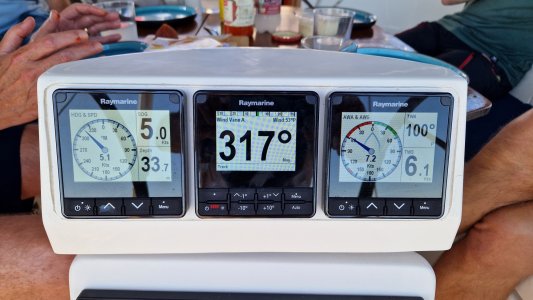
Enjoying a spot of lunch in 6,1 kn TWS with one of those pesky in-mast systems .... and to make matters worse, it's a Bavaria AWB with a keel that is showing no signs of dropping off - hasn't even got a skeg with which to redeem itself.

We rolled the sails away as we approached the marina, and no-one had to leave the shade of the bimini and get sunstroke packing the main away or dealing with the main halyard. A very civilised day was had by all.

20250918_140600.jpg
 
Very genteel, Baggy. We find getting rid of the sail is amazingly effort free. If you didn’t care about your halyard you could just dump the clutch. We’re a bit more careful, but the sail takes 5 seconds to stack itself on the boom. Putting it up though, I let a friend who fetishizes his Apple watch do it once. It was about a metre from the top when he gave up, his heart rate had hit 170.
 
Top