
Impossible Stern Gland Access

ROXANNE

New Member
Joined
28 Jul 2002
Messages
16
Location
Netherlands
Visit site
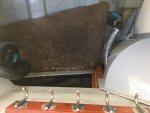
Having just bought a Victoria 34 my impression before buying the boat that access to the stern gland would be a bit difficult has turned into the realisation that it’s not so much ‘a bit difficult’ but more like ‘near impossible’ at least for me (to tall - body/legs would need more joints) without either removing the engine/cutting a large part of the cockpit floor out and installing an access manhole/removing the calorifier. I’m not sure that the second two options would solve the problem. The photos show the gland and (I hope) the set up. As it stands somebody small and flexible enough could possibly reach the gland via the removable inner panel in the port side cockpit locker (pictured).

Assuming I can get a boat yard to service it when necessary (every year?). My main concern with the present arrangement is what happens if it develops a serious leak when I’m on my own offshore – boat will be used for a mixture of short-handed coastal sailing and single handed offshore. It seems to me the possible failure scenarios are:

1) Gland becomes ‘unscrewed’ and packing comes out.
2) packing disintegrates internally.
3) The short piece of rubber hose splits or the hose clips fail.

Thinking positively (something that doesn’t come naturally to me) if the gland has been properly serviced the chance of any of these happening is pretty remote?

Would much appreciate you views/advice – should I stop worrying and think positively or what action should I take. I’m assuming in all this that this gland is some form of conventional stuffing box and that the thinner (aft) brass/bronze nut is a locknut. If anybody can identify the make that would be most helpful, I could then google adjustment/repacking instructions (assuming I find a way of getting to it).
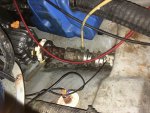
Stern Gland copy.JPG

Locker Access copy.JPG

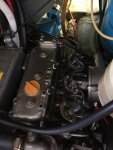
Engine Access copy.JPG
 
Nothing unusual about the poor access1. However nothing to really worry about as these are extremely robust and the fears you have listed ungrounded. Once they are adjusted properly - and yours looks like it is it might drip a little as it relies on water to lubricate the packing. Inspection a couple of times a year to ensure the drip is small or non existent is all it needs. This will show you how it is constructed and how to replace the packing if necessary pbo.co.uk/expert-advice/expert-answers/how-to-repack-a-stern-gland-step-by-step-1031 however does not look like you need to do that - and probably best done by a professional as your tight installation will require a lot of work because the engine will need to be removed to get the gland off the shaft. The hose should be replaced at the same time using a special type made specifically for the job.

But that is all in the future, so in the meantime enjoy your new boat.
 
  • Like
Reactions: Ink
Coincidentally I have just been in a similar situation where a friend had the misfortune to pick up a line around his prop which then neatly extracted the prop shaft from the drive flange and the gland. This allowed water into the boat via the now vacated gland.
The line was fairly easy to remove and a short bung was inserted in the gland to stop the leak. I considered the shaft would not re-enter the gland to the flange which was a split one with four clamping bolts. I recommended the drive flange be removed at the flexible joint (stainless screws) and brought ashore for cleaning up which indeed was what happened. Refitting needs to be done with the boat (at least substantially) out of the water.
In your case, with the boat aground, a similar process would allow inspection.
 
Coincidentally I have just been in a similar situation where a friend had the misfortune to pick up a line around his prop which then neatly extracted the prop shaft from the drive flange and the gland. This allowed water into the boat via the now vacated gland.
The line was fairly easy to remove and a short bung was inserted in the gland to stop the leak. I considered the shaft would not re-enter the gland to the flange which was a split one with four clamping bolts. I recommended the drive flange be removed at the flexible joint (stainless screws) and brought ashore for cleaning up which indeed was what happened. Refitting needs to be done with the boat (at least substantially) out of the water.
In your case, with the boat aground, a similar process would allow inspection.
Except that one of the reasons the stern tube and stuffing box is so congested is because the prop is in an aperture in the skeg and can only come ot backwards if you drop the rudder - arguably a worse job than lifting the engine up (probably does not need to come right out).

See the profile of the boat here sailboatdata.com/sailboat/victoria-34 The engine pushed back as far as it will go so it does not impinge on the accommodation.

If it were my boat I would replace that stuffing box with a Radice seal and the coupling with a Bullflex. all les bulky and minimum maintenance (and no drips and messy grease).
 
the prop is in an aperture in the skeg and can only come ot backwards if you drop the rudder

Not necessarily. My Cutlass 27 similarly has a prop in a rudder aperture. I discovered that, with the rudder pulled and fixed fully to one side, it was ( just ) possible to pull the prop and shaft back and free. The deisgner of the Victoria 34, Chuck Paine, would surely have thought of this matter, so it's worth checking.

As for 'with the boat aground', that's another good reason for fitting yacht legs ( see Vyv Cox's website ).

The internal access I have is, on a smaller boat, similar and every bit as confined and I managed with lotsa difficulty to remove the components to inspect, clean and remount, complete with new packing material. I have every reason to think the job successful, but next time it is needed, that will be via a hatch mounted in the floor of the cockpit to give much easier access to the gland AND to the rear of the gearbox, for oil changes. Again, see Vyv Cox's website.
 
The Joint Services Sailing Centre in Gosport used to have a small fleet of these boats.

You might get a useful contact through them to someone who maintained them. I'm no longer in regular contact with the yard people but I think John Morris on this forum would be. Sorry John!
 
Not necessarily. My Cutlass 27 similarly has a prop in a rudder aperture. I discovered that, with the rudder pulled and fixed fully to one side, it was ( just ) possible to pull the prop and shaft back and free. The deisgner of the Victoria 34, Chuck Paine, would surely have thought of this matter, so it's worth checking.

Alas not with the Victoria 34. Lots of posts on the owners forum about the difficulties of the stern gear design and the need to remove the rudder (not easy!) to work on it. Plus they changed the stern tube design during the production run as most boats were built by Victoria but later by Northshore.
 
Thanks to everybody who replied. Tranona - thanks for the link and the sound advice. I'm familiar with the Bullflex and will look into the Radice Seal (which coincidentally is also mentioned in the owner's association forum). James_Calvert - I'll try and follow up with the Joint Services Sailing Centre.
 
None of the boats I have owned have had easy access to the stern gland, my present boat Sadler 25 requires one to squeeze down into the cockpit locker and access the stern gland through a small hatch, fine when one is an agile 25 year old, at 75 it starts getting ‘difficult’.
The engine stern tube arrangement is interesting in that the engine and stern tube are aligned slightly off centre so the prop shaft can be extracted fully without removing the aft slung rudder.
 
I bought a Victoria 800 and found the same situation. Access to the stern gland virtually impossible. I suspect that most of the hull fitout was done before the "lid" was put on. Victorias' seem to have been built by a yard who did not consider building in maintenance access as part of their remit!
.Solution was to install an 18" x 12" oval hatch and a Volvo stern gland. Access is still awkward (the joys of a double ender) but possible. When I change the stern gland I will install a Radice as it saves "burping" the seal. Some Victoria owners have converted the cockpit sole into a hatch.
 
I’m assuming in all this that this gland is some form of conventional stuffing box and that the thinner (aft) brass/bronze nut is a locknut. If anybody can identify the make that would be most helpful, I could then google adjustment/repacking instructions (assuming I find a way of getting to it).
Yes the thinner nut is a lock nut. It looks as though this has a remote greaser? - without it you would have needed to slacken off the lock nut ant tighten up the main nut to reduce any drips. With any luck the packing will last years so hopefully you won't need to get in there regularly. Looks like the original gland that Victoria used. Don't know make.

What is there to the side of the engine bay? Is there something like a pilot berth, or a bit cockpit locker that you can cut a hatch into? Always good to be able to get into every crevice of a boat without too much dismantling.

Have you tried the Victoria Association?
 
The white tube to the greaser appears to have air spaces between grease so it might be a good idea to disconnect and try to pump some grease through to check it’s not gone solid
to adjust the packing gland flat short spanner’s should help perhaps the owner group will have the dimensions available
Removing the white R&D coupling temporarily may allow some wriggle room but it is all very tight and you may have to move the engine forward fo any real work
 
The white tube to the greaser appears to have air spaces between grease so it might be a good idea to disconnect and try to pump some grease through to check it’s not gone solid
to adjust the packing gland flat short spanner’s should help perhaps the owner group will have the dimensions available
Removing the white R&D coupling temporarily may allow some wriggle room but it is all very tight and you may have to move the engine forward fo any real work
Faced with a similar problem I made two stubby spanners out of 10mm ally which made the occasional adjustment much easier - well worth the effort.
Jim
 
I had a similar situation to you. In the end, after a few years of being nervous about it. I cut a decent hole almost the width of the cockpit floor and added a hatch. Made it out of plywood and fiberglassed it all. It was all under a floor grill anyway. Otherwise, it was practically impossible to get to even on a berth, with overalls on, with a cold engine - At sea - Not a chance!
 
Top