I have a problem .... with a KAD 300 ---where are you Spannerman ?

This was the first thing I fixed as I had the same leakage fore and aft on the compressor lid. Looking at the pictures it could have been mine. A thin layer of blue Permatex sealed the leakage. O-rings on the silencer (black tube across the engine) where fine. So was the check valve to the air filter and no leakage from the turbo to the manifold as far as I could feel with my hands. Still the problem remained. I hope checking the tube and replacing the boost sensor will fix the problem. Not sure I will know this season as the boat is scheduled to be lifted out of the water next Friday.
 
Now I have replaced the pressure sensor (actually a Sensata 100CP2-47 sensor) and would recommend the following procedure. Hold the sensor with a 14mm wrench and carefully spin off the t-tube from the outside. The t-tube is not fixed to the EDC unit in any way. Then carefully pry the sensor out of the transparent substance poured over the circuit board. If you start at the nut end and get the opening end just above the edge of the box you may use a screwdriver to leverage it out of the gluey substance. You may want to carefully assist with a sharp knife by “filleting” away the sensor, but be careful as the connecting wires may be just underneath.
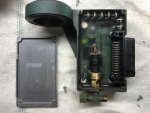
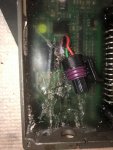
A74A0EA6-2D80-4D04-9E03-F3ABBFBE0547.jpg (Before picture) 700A40A2-E021-48A6-A3BA-7E6FB0DA0981.jpg (Sensor removed)
I tried to carve it out before removing the t-tube which was extremely difficult as the substance is both a little flexible and very tough. The t-tube prevented any outward flex and the substance any upward movement.
Connect the new sensor to the EDC and spin in the t-tube after having lubed the o-ring with a tiny dab of silicone grease. Make sure the open end of the t-tube point in the right direction.
The boat is now on land, so I will have to wait until next season to see if the problem is solved. Fingers crossed!
 
Last edited:
If you want to re-seal the circuit board then something like this should work for you

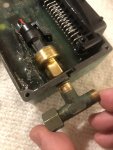
Thanks, but I never carved very deep. Didn’t want to come even close to the electronics on the circuit board. Here’s a picture showing the t-tube as I am about to screw it into the sensor.
2BF8C54F-5153-4576-A407-FF122FD01427.jpg
 
Engine behaves perfectly normal when starting in the morning and rev's up to plane speed without any problems. But after having on the plane for some time and getting the engine warm (coolant temp 90 degr celcius) and then slowing down to idle speed it enters limp mode when trying to accelerate again. The compressor sounds abnormal with a wierd resonating sound to it just as if it cannot push the air forward.
Using Vodia the VP mechanic could read error:
”8:2 - Internal error in control unit. Faulty boost pressure sensor, value to low.”
The boat is now on land, so I will have to wait until next season to see if the problem is solved. Fingers crossed!

The boat is now on the water and yesterday’s premiere trip for the season went very well! No limp mode with a compressor sounding like a bad fog horn when trying to rev the engine when varm. It now responded to the throttle perfectly all day. Fingers crossed that switching the boost pressure sensor fixed the problem.
 
[I have to coax them up again to the normal 3400/- 38knot limit]
They should rev up to 3900 ish and 3400 is a bit low at WOT.
 
I am having the exact problem with my kad300 that the original poster RIMCO had , did anyone definitively lock down what was going on here ? I’m stumped as well.
 
There can be many causes for these issues
check the fly wheel sensor is clean
Check supercharger engages and disengages as per the user manual NOT an internet forum. Different KADs have different settings and people sometimes mix them up which may confuse you.
Check belt tensions with a torque wrench as per the manual.
Check for air leaks from the super charge, via the air box flap and through the turbo charger.
Check the diverter flap in the air box is working freely
If you can get over 3000 rpm OK but the engine drops back to sub 2000 rpm when it gets rough or bouncy your turbos are probably knackered. Replace both, don't waste money on a rebuild they don't get the tolerances right.
Check take apart and clean with decent contact cleaner ALL the connections on the engines several times. Be very careful with the ECU connector see manual for details. It is fragile!
Check fuel lines are not linked or compressed anywhere. If in doubt fit new fuel supply hoses. It's cheap and easy to do to make sure there are no tight corners.
Check fuel valves are full open.

If all that doesn't work check the pressure sensor in the inlet manifold.
Be patient and don't guess. Good luck
 
Top