How to start single handing

Last year, I jumped in the river wearing it whilst the boat sat on her mooring.
In these benign conditions I had no problems getting back on board unaided (climbing a 3-step fenderstep).
Likewise I have no problem getting out using the boarding ladder with one rung underwater once I have put my fins on the pontoon after scraping barnacles off the prop.
However MOB in open water is unlikely to be so benign, and the discussion so far seems to assume the solo MOB is still fit and uninjured..

The TPS looks like a very good idea for northern waters, though my preference is inboard jackstays and short tether so no going over the side.
 
I've recently moved from Figure of eight to an Admiralty Stopper knot for all my sheets and halyards. Feels far more comfortable in the hand.

I was really into that stopper knot - it's more attractive - until a crewmate pointed out that it's harder to undo if you need to in an emergency.
 
Have you ever tried to get out of the water yourself? I very much doubt it. About 6 years ago I was getting the boat tidied up from sailing when I heard a shout of help. Looking round I could see no one. Another shout and I then identified where to look. There was a man clinging to a mooring buoy at the bow of a moored boat. As I already had fenders fitted I pulled alongside the boat and the man moved to my transom. With the boat now drifting, he tried to get out of the water using the boarding ladder, but this did not go deep enough in the water for him to get a foot on it. So I used a mooring line and made a loop so I could help by lifting him. This failed. During this time a motorboat passed completely oblivious to what was going on. Then another yacht saw my problem, so tied up to me. The couple gave me a hand to lift him, but 3 of us could not lift him. I was getting concerned as the water was cold due to it being April. So I decided to motor over to a pontoon close bye that had a ladder. The other couple slipped off and headed over to the pontoon to ensure I could tie up close to the ladder and get some extra help. Luckily the man managed to get out of the water without assistance, this surprised me as he must have been in the cold water for about 20 minutes. He was a very large man, fully clothed wearing a lifejacket that had inflated. I estimate he weighed about 18 stone plus wet clothing. He then started to remove his clothes and wring them out. I found some towels to help him dry off. He then put his clothes back on so he could walk back to his club nearby so he could phone his wife as his phone and car keys had been fried by the salt water. From this experience I have lowered the boarding ladder by about 6" and fitted an emergency rope ladder in the transom that can be reached from the water. However I still belive if I went overboard whilst tethered, I could only get out at the transom, so may not reach there. As mentioned before, sailing at 6 knots tethered can drown you. Hence why I think letting the boat sail away is better and to use a PLB for contacting the emergency services.

Yes, I've been overboard a whole bunch of times, and never had a problem getting back on board, even under way, BUT I use a scambling net rather than the boarding ladder. The lifeboat I'm building will have 2 on each side, and one normal ladder at the stern.

Very few yachts or fishing boats are rigged correctly for single handing in terms of getting back on board, and the most common mistake is a boarding ladder that does not go deep enough to be easy to use, although at the end of the day, a scramble net system is far easier to use in heavy weather.
For larger yachts a tiller disconnect or engine cut system is a real good idea, and I would emphasise the dog lead must be kept as short as possible.

It's also very important to try and stay off the deck, foredeck in particular when sailing SH in heavy weather. Quite why anyone on a long tether drowns I don't know. All you need to if you do get stuck in the running rigging or fishing gear, is to use your emergency knife, (Always have one tied to you some place).

I'm not a coastal sailor, and although I think the PLB gear is useful, the chances of anyone picking up the signal when you are well offshore are slim, BUT the chances of the new PLB systems encouraging a new SH sailor to ignore the complexities of rigging a boat for singlehanded sailing correctly, seem to be far greater!

PS: Getting heavy people or a big fish out of the water is not easy, and it's one reason I'm planning to fit an A frame, as I can then use the same gear as the RNLI use.
 
Yes, I've been overboard a whole bunch of times, and never had a problem getting back on board, even under way, BUT I use a scambling net rather than the boarding ladder. The lifeboat I'm building will have 2 on each side, and one normal ladder at the stern.

Very few yachts or fishing boats are rigged correctly for single handing in terms of getting back on board, and the most common mistake is a boarding ladder that does not go deep enough to be easy to use, although at the end of the day, a scramble net system is far easier to use in heavy weather.
For larger yachts a tiller disconnect or engine cut system is a real good idea, and I would emphasise the dog lead must be kept as short as possible.

It's also very important to try and stay off the deck, foredeck in particular when sailing SH in heavy weather. Quite why anyone on a long tether drowns I don't know. All you need to if you do get stuck in the running rigging or fishing gear, is to use your emergency knife, (Always have one tied to you some place).

I'm not a coastal sailor, and although I think the PLB gear is useful, the chances of anyone picking up the signal when you are well offshore are slim, BUT the chances of the new PLB systems encouraging a new SH sailor to ignore the complexities of rigging a boat for singlehanded sailing correctly, seem to be far greater!

PS: Getting heavy people or a big fish out of the water is not easy, and it's one reason I'm planning to fit an A frame, as I can then use the same gear as the RNLI use.
Interesting and sensible advice.

How do you rig and let down the scrambling nets when single-handing? Do you have some kind of quick release gear or are they stopped up with light twine etc?
 
It's also very important to try and stay off the deck, foredeck in particular when sailing SH in heavy weather.
In which case I could not have sailed my 42ft 8metre C/R singlehanded. Sloop rig, halyards and reefing where they belong at the mast and hank on headsails. I did have twin headstays so chose the two appropriate sails, hanked them on with the expected change stowed along the rail. Usually genoa and working jib, but sometimes working and small jib. I never had to go down to storm jib with that boat but then never saw more than a F9. Foredeck could get interesting off Shetland but as well as jackstays the pulpit top rail extended aft the length of the fore deck at hip height, about eight feet, plus a substantial toe rail.
If you do not regard moving around and working on deck a normal activity how are you going to manage when something snarls or tangles, or the roller reefing gear jams?
 
Last edited:
Try is not a synonym for never, @srm.

I think previous posts have already expounded upon what can be summarised as the 7 P's: Proper Planning and Preparation Prevents Piss Poor Performance.
 
Looks very interesting. As you have one, can you comment on how well the fabric would wear compared to a regular wet weather gear. Also if wearing it for say 12 hours or more, how sweaty do you become or too hot.

It's not something I would wear all day for any length of time - unless the situation warrants it.
Regular oilies are more comfortable and practical (pockets).

I've worn it for 6hrs+ only twice.
Experience has taught me that if I wear anything more than thermal underwear (long legs and sleeves) and socks underneath, I am going to be too hot and uncomfortable.
 
I was really into that stopper knot - it's more attractive - until a crewmate pointed out that it's harder to undo if you need to in an emergency.
I always carry a knife for emergencies... no matter what knot you have on a line you will never undo it fast enough.
 
However MOB in open water is unlikely to be so benign, and the discussion so far seems to assume the solo MOB is still fit and uninjured..

What other assumptions should we make?
Any distance offshore and given the very nature of singlehanded sailing...
Tomorrow is promised to no-one.

The TPS looks like a very good idea for northern waters, though my preference is inboard jackstays and short tether so no going over the side.

One does not preclude the other.
Indeed, I have both.
 
I carry a personal Epirb and wear a life jacket when singlehanding on passage. Apart from that just behave as normal and use autopilot
 
Interesting and sensible advice.

How do you rig and let down the scrambling nets when single-handing? Do you have some kind of quick release gear or are they stopped up with light twine etc?
MOB Rescue via scramble net - YouTube

I make my own scramble nets, as they really need to be cut the length, and left in position so you, or the MOB's can pull them down. I just use elastic bands.
The stern net length is limited by potential prop fouling issues, even with floating orange Polyprop lines. There are small deck lights covering both the rescue/fishing deck, and a red bar LED to indicate the position of the stern pull down net. The system in the clip is a good one, because in a bad case of hypothermia you must keep the victim horizontal as much as possible, (Avoids an increased risk of heat failure).

Sailing SH does not mean you should ignore the need to know how to rescue another person.
 
For those SHing a boat that are a fan of SOLAS Regs, this system can be deployed by the plonker, or even plonkers in the water, and the pull down line is visible in one of the pictures. Don't forget the LED strip light to help you, or the plonkers in the water find the net at night.

In extreme conditions a fixed boarding ladder can be dangerous to try and use, cos you can get pushed against the hull as the boat heels away from you, and then bashed on the head by the ladder as it rolls back! Boarding ladders are better for MOB incidents in port.

MOB Scramble Nets and Rescue Nets for Maritime Rescue Operations by Markus Lifenet (seamarshall-us.com) .

Finally do not forget the length of the dog lead between the fore and aft safety line or rail and your harness, (I don't wear a life jacket offshore, for fear of being eaten alive, as some of the bloated floaters I've located around Trinidad were missing rather significant parts, legs in particular), AS SHORT AS POSSIBLE, even if it results in you crawling along the deck. The ones I plan to fit to the side decks, should be, (They be fully tested during local sea trials when the RNLI are out training the rubber duck crews just in case), so short that when attached to the cabin side safety line that runs from the aft cockpit to about 1.5m forward of the stern, only my lower body should be in the Oggin.

In the event that I'm washed overboard during a fairly serious 60 degree plus roll whilst underway, that results in me not hanging up on a solid galvanised and thru bolted stanchion, I should finish up with my feet near the lower rudder support bars and my upper body against the small aft scramble net. On Dicha, the steel Van Der Stadt 34 I did my first SH circumnavigation in many moons ago. I finished up with my feet against the main support bar for the Hydrovane self steering, and found that there was no need to use aft net or pull down ladder. That overboard test was done just outside Puerto Mogan in the Cannery islands at about 5 knots, (Dicha was under powered, so 5 kts was at max continuous RPM when fully loaded with 6 months of chewables, drinkables and a grands worth of burnable for the 3 cylinder Dutch donkey). I got back onboard first try.

This thread has convinced me that some modern electronic safety systems, seem to result in some SH sailors, or Wanabee on my owners, to think that they are immortal. Those systems should be regarded as extra safety items only, not an excuse for not figuring out how to install a real good safety line and fixed attachment system for your particular boat, and how you are going to disable the tiller pilot if you do go AWOL from your comfy roll over and pitchpole resistant hammock.
 

Attachments

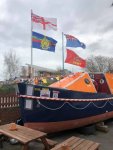
  • Lifeboat with flags.jpg
    Lifeboat with flags.jpg
    55.6 KB · Views: 12
Last edited:
Try is not a synonym for never, @srm.
But, if you spend all your time trying NOT to go on deck you are unlikely to gain the confidence to do so safely should it become necessary, possibly working in a hurry in the dark . I feel that being able to confidently move around the deck in the dark at sea, automatically knowing where all the hand holds are and where every item should be adds to my safety. It takes time and practice on a specific boat to reach that stage.

Fortunately, we can all do things the way we want to on our own boats. Even now I prefer to reef at the mast so that I can better see and anticipate problems such as chafe or a line snagging, others feel they are safer staying in the cockpit - its up to each skipper to decide what is best for them and their boat.
 
But, if you spend all your time trying NOT to go on deck you are unlikely to gain the confidence to do so safely should it become necessary, possibly working in a hurry in the dark . I feel that being able to confidently move around the deck in the dark at sea, automatically knowing where all the hand holds are and where every item should be adds to my safety. It takes time and practice on a specific boat to reach that stage.

Fortunately, we can all do things the way we want to on our own boats. Even now I prefer to reef at the mast so that I can better see and anticipate problems such as chafe or a line snagging, others feel they are safer staying in the cockpit - its up to each skipper to decide what is best for them and their boat.

Agree with that post, and I should have said, NOT TO GO ON DECK IN HEAVY WEATHER, rather than the more general terms I used. Sometimes that's just a matter of reefing or furling early, or simply changing the sail controls or plan to a simpler one that avoids the need to use a whisk or spin pole in particular. On my last yacht I did lead the controls for the first 2 reefs aft, although that turned out to be less than perfect, as I never used first reef again. I did go on deck to tie in the third reef, which took some time, as I only used the reefing points for third reef, not needed for second.
I normally do a daily inspection of almost everything at sea, and not sure what the issue is with finding handholds. Some skippers rigging a boat for an offshore trip, add a few small red or green LED lights, or even a short LED strip light at the ends of each rail to help guide folks from one rail to another.

If you plan a SH passage that includes sailing at night, see if you can depart in a full moon, If the weather is clear, you can then see far better, although you don't really need a full moon in the Southern Pacific or Atlantic, as there is far more starlight than up North. The Indian ocean is a bit different, as you don't need to go on deck too often. In fact the typical average year the route from Darwin to Mauritius, only involves a donkey until you reach the Western end of Auz, then a storm jib for the rest of the fast leg. Spilt a big mug of coffee all over the place about half way across, as although it's a downwind run, the swell is from the South. Net result is freak wave or three. Nearly had to appeal to the Scandinavian God OFA as I watched the inclinometer indicate it's displeasure.
 
Last edited:
and not sure what the issue is with finding handholds
When in the dark you hear the distinctive rush of a breaking wave and feel the boat start to lift, you can crouch and duck while instinctively reaching for two secure holds wherever you are. No time to look for a coloured LEDs or whatever.
 
Agree with that post, and I should have said, NOT TO GO ON DECK IN HEAVY WEATHER, rather than the more general terms I used. Sometimes that's just a matter of reefing or furling early, or simply changing the sail controls or plan to a simpler one that avoids the need to use a whisk or spin pole in particular. On my last yacht I did lead the controls for the first 2 reefs aft, although that turned out to be less than perfect, as I never used first reef again. I did go on deck to tie in the third reef, which took some time, as I only used the reefing points for third reef, not needed for second.
I normally do a daily inspection of almost everything at sea, and not sure what the issue is with finding handholds. Some skippers rigging a boat for an offshore trip, add a few small red or green LED lights, or even a short LED strip light at the ends of each rail to help guide folks from one rail to another.

If you plan a SH passage that includes sailing at night, see if you can depart in a full moon, If the weather is clear, you can then see far better, although you don't really need a full moon in the Southern Pacific or Atlantic, as there is far more starlight than up North. The Indian ocean is a bit different, as you don't need to go on deck too often. In fact the typical average year the route from Darwin to Mauritius, only involves a donkey until you reach the Western end of Auz, then a storm jib for the rest of the fast leg. Spilt a big mug of coffee all over the place about half way across, as although it's a downwind run, the swell is from the South. Net result is freak wave or three. Nearly had to appeal to the Scandinavian God OFA as I watched the inclinometer indicate it's displeasure.
Perhaps worth noting that Roger Taylor of Ming Ming fame designed the layout of his yachts to remove the need to go on deck, or even leave the companionway, except under exceptional circumstances. That's one reason why he adopted the junk rig - its handling could be arranged to be done from a single point.
 
Perhaps worth noting that Roger Taylor of Ming Ming fame designed the layout of his yachts to remove the need to go on deck, or even leave the companionway, except under exceptional circumstances. That's one reason why he adopted the junk rig - its handling could be arranged to be done from a single point.

There's a lot to be said for that.
However, not all boats lend themselves to that.
To lead all lines back to the cockpit would involve some (expensive) modifications to my boat if I were to go down that route.
So, I've opted to 'live with' all the halyards and reefing lines being at the mast.
One advantage I do have is that the deck is all flush - other than the genua tracks there are no trip hazards.
I also sail somewhat conservatively: I set the my sails for the predicted gusts and at night I always reef down to reduce the chances that I would have to go on deck in the dark.
 
When in the dark you hear the distinctive rush of a breaking wave and feel the boat start to lift, you can crouch and duck while instinctively reaching for two secure holds wherever you are. No time to look for a coloured LEDs or whatever.
Sorry, I should have made it clear that the LED light strips are for survivors or even crew in the water, as they help them find where the scramble net or boarding ladder is. The single LED's are just to define where the start of a handrail is in the dark. I agree that you hear 99% of breaking waves, even when below. I did get one freak wave fill the cockpit of my first yacht, a Pacific Seacraft Dana 24 just South of Madeira. It was such a good night and the wind was only about 15kts, and I never heard that wave. It made a mess of the cabin sole, cos it overflowed the cockpit. I only had the bottom of 3 washboards in, rather than 2 or all three, and was broad reaching at the time.
 
Last edited:
Top