How to start single handing

The advise I wish I would have know is to make sure there is a knot tied to the end of your halyards.
As I lost my topping lift straight up the mast what a nightmare it's been with just one rope.
Will get it sorted soon.
That was drilled into me at a very early age! I tie figure of eight knots in rope ends almost automatically.

The other thing that was emphasized once we had a boat with an anchor is to ensure that the end of the chain is secured! "We didn't mean to go to sea" hinged on that one!
 
Re going overboard. I wear an automatic lifejacket with a PLB, but rarely use a safety line. It will be almost impossible to get back onboard whilst singlehanded. If sailing at 6 knots and teathered to the boat you will be dragged along and guaranteed to drown. Untethered you will see your boat sail away but once the PLB is triggered your position is notified within 50 seconds to emergency services to facilitate a rescue. The PLB will be used to locate you. This at least raises your chance of survival from 0% from being tethered or not having a PLB to about 50%. One great friend never used to wear a lifejacket when singlehanding and now follows my advice of a lifejacket with PLB, he also lost a friend of his when he slipped off a boat without a lifejacket a few years ago.

It is not impossible to get back onboard whilst single handing, IF you have figured out where to attach the safety line, strap or side cabin track. In most MOB cases your safety line hangs up on a stantion, and you swing back onto the side of the hull not too far from where you were washed overboard. I a real serious knockdown or over canvased foul up in a squall, you might end up at the end of the deck line near the stern, where you should have a folding boarding ladder, or simple rope job.
I always rig loopy lines to make it easy to get onboard from any position along the hull, although the real important area is at the stern, where it's essential the have a pull down boarding ladder with an operating line, my lifeboat, (A frame sloop in strong winds, but Lanteen in light winds), is a double ender, so I'm going to rig a smallish crawl net on either side.
My safety line is up against the cabin, not on the deck, so I can't really fall overboard properly.
It is very important to figure out what will happen if you do go overboard for real, (Preferable in a marina), as you might find your deck line plan or dog lead length is too long, or you can't reach the clip for the mast.

If you really can't figure out how to rig a safety line system, either buy another boat with a cabin that can be used for the safety line, or rig a tiller release system, (there are some diagrams in the various SH books. Make sure the end has a small light on the ring, Then practice using it whilst escorted. Tiller release systems result in full rudder causing the boat to suddenly turn into the wind, or gybe right around. They can be a PITA to rig if you have a wind vane with steering lines, (My last yacht had a Hydrovane, but the rudder was more effective). If you use TP's the pin should pull out if the system is rigged correctly

PLB's are an extra, and relying on them as a means of rescue is just nuts, So you really should figure out how to deal with an emergency yourself.
 
I sail single handed most of the time. Forward planning makes life much easier. Reef early. Tiller pilot. Have anchor ready to deploy if you have engine problems on rivers. Lines ready. I use a midships cleat when tieing up. Be sensible with weather.always have a back up plan. And its as easy as putting up with crew.
Steveeasy

Easier, because you don't have to explain what you want and how you want it done.
 
It is not impossible to get back onboard whilst single handing, IF you have figured out where to attach the safety line, strap or side cabin track. In most MOB cases your safety line hangs up on a stantion, and you swing back onto the side of the hull not too far from where you were washed overboard. I a real serious knockdown or over canvased foul up in a squall, you might end up at the end of the deck line near the stern, where you should have a folding boarding ladder, or simple rope job.
I always rig loopy lines to make it easy to get onboard from any position along the hull, although the real important area is at the stern, where it's essential the have a pull down boarding ladder with an operating line, my lifeboat, (A frame sloop in strong winds, but Lanteen in light winds), is a double ender, so I'm going to rig a smallish crawl net on either side.
My safety line is up against the cabin, not on the deck, so I can't really fall overboard properly.
It is very important to figure out what will happen if you do go overboard for real, (Preferable in a marina), as you might find your deck line plan or dog lead length is too long, or you can't reach the clip for the mast.

If you really can't figure out how to rig a safety line system, either buy another boat with a cabin that can be used for the safety line, or rig a tiller release system, (there are some diagrams in the various SH books. Make sure the end has a small light on the ring, Then practice using it whilst escorted. Tiller release systems result in full rudder causing the boat to suddenly turn into the wind, or gybe right around. They can be a PITA to rig if you have a wind vane with steering lines, (My last yacht had a Hydrovane, but the rudder was more effective). If you use TP's the pin should pull out if the system is rigged correctly

PLB's are an extra, and relying on them as a means of rescue is just nuts, So you really should figure out how to deal with an emergency yourself.
Have you ever tried to get out of the water yourself? I very much doubt it. About 6 years ago I was getting the boat tidied up from sailing when I heard a shout of help. Looking round I could see no one. Another shout and I then identified where to look. There was a man clinging to a mooring buoy at the bow of a moored boat. As I already had fenders fitted I pulled alongside the boat and the man moved to my transom. With the boat now drifting, he tried to get out of the water using the boarding ladder, but this did not go deep enough in the water for him to get a foot on it. So I used a mooring line and made a loop so I could help by lifting him. This failed. During this time a motorboat passed completely oblivious to what was going on. Then another yacht saw my problem, so tied up to me. The couple gave me a hand to lift him, but 3 of us could not lift him. I was getting concerned as the water was cold due to it being April. So I decided to motor over to a pontoon close bye that had a ladder. The other couple slipped off and headed over to the pontoon to ensure I could tie up close to the ladder and get some extra help. Luckily the man managed to get out of the water without assistance, this surprised me as he must have been in the cold water for about 20 minutes. He was a very large man, fully clothed wearing a lifejacket that had inflated. I estimate he weighed about 18 stone plus wet clothing. He then started to remove his clothes and wring them out. I found some towels to help him dry off. He then put his clothes back on so he could walk back to his club nearby so he could phone his wife as his phone and car keys had been fried by the salt water. From this experience I have lowered the boarding ladder by about 6" and fitted an emergency rope ladder in the transom that can be reached from the water. However I still belive if I went overboard whilst tethered, I could only get out at the transom, so may not reach there. As mentioned before, sailing at 6 knots tethered can drown you. Hence why I think letting the boat sail away is better and to use a PLB for contacting the emergency services.
 
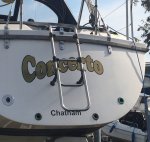
This shows the changes I made after the rescue attempt.

IMG_1548 cropped 1000pix.jpg
This shows where the boardling ladder extended to. The water is at the lower side of the boot top.

IMG_1551 1000pix.jpg
Moving the fixing of the boarding ladder from the deck on to the transom lowered the bottom step by about 8", but only just reaches the water.

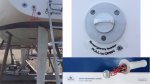
Composite emergency ladder 1000pix.jpg
This is the emergency rope ladder I fitted from Osculati. The bottom step is weighed to keep the ladder taught. Yes, it can swing, but this stops if used on the edge with a foot each side. The red "step" is a handle to steady a person whilst climbing. It is easy now to transfer over to the boarding ladder to get onboard.
 
View attachment 125175
This is the emergency rope ladder I fitted from Osculati. The bottom step is weighed to keep the ladder taught. Yes, it can swing, but this stops if used on the edge with a foot each side. The red "step" is a handle to steady a person whilst climbing. It is easy now to transfer over to the boarding ladder to get onboard.

Looks like a good idea... in theory.
In practise... I have my doubts.

You're sailing singlehanded.
You go over the side - say from the forward end of your cockpit.
Your boat continues on at 5kts.
Even if you are clipped on, by the time you have made it to the transom of your boat you will already been banged against the hull a couple of times.
You will be cold, possibly injured/in shock, your LJ will have inflated ... and your boat is continuing on at speed.
Good luck getting that thing to open and managing to clamber aboard.
If you're not clipped on, by the time your head is back above water and you've got your bearings your boat will be out of reach.

I don't see this thing being of any use other than in flat water and when the boat is fully stopped.
IMHO, a contraption such as this only serves as a security blanket and to create a false sense of security.
And you are left with one more hole in your hull than strictly necessary.
 
I did a practical experiment a few years ago.

I tested two things - getting back into the rigid dinghy after capsizing it, and getting back on board the parent yacht using a ladder.

I used the anchorage at “the rocks” on the Deben, where there is a sandy beach close to the anchorage, on a fine August afternoon, for my experiments.

I earnestly recommend others to try both.

One problem with very small rigid dinghies is that trying to climb over the transom with the dinghy flooded can submerge the transom.

My 9ft “Nutshell” passes this test. A friend’s smaller GRP dinghy failed it.

My experiments with ladders to get on board taught me that to think I can rely on upper body strength, at my age, is absurd. The bottom rung must go down at least five feet below the surface. If it’s a rope ladder it must be heavily weighted, and even then it will move under the hull so you are climbing an overhang.
 
I did a practical experiment a few years ago.

I tested two things - getting back into the rigid dinghy after capsizing it, and getting back on board the parent yacht using a ladder.

I used the anchorage at “the rocks” on the Deben, where there is a sandy beach close to the anchorage, on a fine August afternoon, for my experiments.

I earnestly recommend others to try both.

One problem with very small rigid dinghies is that trying to climb over the transom with the dinghy flooded can submerge the transom.

My 9ft “Nutshell” passes this test. A friend’s smaller GRP dinghy failed it.

My experiments with ladders to get on board taught me that to think I can rely on upper body strength, at my age, is absurd. The bottom rung must go down at least five feet below the surface. If it’s a rope ladder it must be heavily weighted, and even then it will move under the hull so you are climbing an overhang.
On the Sea Survival course, I found it VERY hard work climbing out of a swimming pool with a much more securely fixed ladder than the bathing ladder on a yacht. I could do it, but only just; the weight of saturated oilskins must have at least doubled my weight. If the ladder hadn't been securely fixed to the side of the pool, I think it would have been very difficult. A couple of years ago, I fell in the marina while at our berth. It was impossible for me to get out unaided; this in normal clothes and buoyancy aid.

If your plans include being able to climb out of the water in UK waters (the Mediterranean and Caribbean might be different), then I'd be certain you have a plan B! The water will very quickly sap your strength, and something that's extremely difficult under the ideal conditions of a swimming pool is very likely to be impossible in the environment of a yacht at sea.
 
Which is why I agree with the person here who describe part of his safety briefing: "This is a safety line. Used correctly, it will help keep you from going overboard. This is a lifejacket. It will help the lifeboat crew recover your body if you do go overboard."

Having said that, I've used my boarding ladder to board from the water after a swim, and have got myself out of the water after stepping off a pontoon (long story, but I wasn't drunk :) ) In neither case was I wearing full oilies.

The one time I went swimming with my oilies on, I couldn't get the ladder down because it was securely tied up, which could have been nasty if I'd been alone. No LJ to help the lifeboat crew for that one
 
Having ended up in the water after pitchpolling a derigged mrror (don’t try walking forward throughout the shrouds )all was well
did it by the book righted the capsize bailed out the boat got everything back in place swam round the stern of boats found stern boarding ladder climbing up could feel warm breath of owners boxer
back to square one !
never saw a soul till I got back to house but that’s east loch Tarbert on a Thursday night
but I was single handed so relevant to thread
 
On the Sea Survival course, I found it VERY hard work climbing out of a swimming pool with a much more securely fixed ladder than the bathing ladder on a yacht.
Having done two sea survival courses over the years, then instructed on the STCW sea survival course, I strongly recommend that all skippers,and especially potential single handed skippers take part in such a course.
All the talk above about getting back on board sounds very fine, but have you actually done it? even with the boat alongside a pontoon or at anchor.
On a survival course you will have to get yourself into a liferaft, the top tube of which is not very far above the water. Even in a warm swimming pool most people find that difficult with a life jacket on. Climbing on to a yacht from a surprise cold water dunking will be a number of magnitudes more difficult.

As to safety briefings, running a charter yacht around the northern isles of Scotland and west coast of Norway mine was short and to the point. "Do not go over the side, the sea temperature is 10 C," That was usually enough but the more macho would be told "you are unlikely to be able to help yourself as you will hyperventilate when you hit the sea and start to inhale water".
 
a rope ladder it must be heavily weighted, and even then it will move under the hull so you are climbing an overhang.
Move under the hull is a bit of an understatement, it goes almost horizontal, which makes it very difficult to climb unless you are fit and agile.
I have found that a rigid extension to a solid stern ladder, that goes at least three feet under the water, with a release mechanism accessable from water level is the only way I can now do it.
 
On the Sea Survival course, I found it VERY hard work climbing out of a swimming pool with a much more securely fixed ladder than the bathing ladder on a yacht. I could do it, but only just; the weight of saturated oilskins must have at least doubled my weight. If the ladder hadn't been securely fixed to the side of the pool, I think it would have been very difficult. A couple of years ago, I fell in the marina while at our berth. It was impossible for me to get out unaided; this in normal clothes and buoyancy aid.

This has been my experience too when I did sea survival.

I carry aboard a Guy Cotten TPS (and I do wear it when the conditions warrant it).

The things I like about it:
1. Integral harness.
2. No need for a LJ which will restrict your movements when inflated.
3. No risk of cold shock or hypothermia.
4. Good freedom of movement.

Last year, I jumped in the river wearing it whilst the boat sat on her mooring.
In these benign conditions I had no problems getting back on board unaided (climbing a 3-step fenderstep).

 
This has been my experience too when I did sea survival.

I carry aboard a Guy Cotten TPS (and I do wear it when the conditions warrant it).

The things I like about it:
1. Integral harness.
2. No need for a LJ which will restrict your movements when inflated.
3. No risk of cold shock or hypothermia.
4. Good freedom of movement.

Last year, I jumped in the river wearing it whilst the boat sat on her mooring.
In these benign conditions I had no problems getting back on board unaided (climbing a 3-step fenderstep).

That certainly looks worth considering!
 
When the boat was new to me I suffered the same with an old and slightly too short main sheet. Have always replaced it with one at least 2 meters too long and changed from figure 8 to thumb knots for stoppers. ???
I've recently moved from Figure of eight to an Admiralty Stopper knot for all my sheets and halyards. Feels far more comfortable in the hand.

 
This has been my experience too when I did sea survival.

I carry aboard a Guy Cotten TPS (and I do wear it when the conditions warrant it).

The things I like about it:
1. Integral harness.
2. No need for a LJ which will restrict your movements when inflated.
3. No risk of cold shock or hypothermia.
4. Good freedom of movement.

Last year, I jumped in the river wearing it whilst the boat sat on her mooring.
In these benign conditions I had no problems getting back on board unaided (climbing a 3-step fenderstep).

Looks very interesting. As you have one, can you comment on how well the fabric would wear compared to a regular wet weather gear. Also if wearing it for say 12 hours or more, how sweaty do you become or too hot.
 
Top