
How to start single handing

Re going overboard. I wear an automatic lifejacket with a PLB, but rarely use a safety line. It will be almost impossible to get back onboard whilst singlehanded. If sailing at 6 knots and teathered to the boat you will be dragged along and guaranteed to drown. Untethered you will see your boat sail away but once the PLB is triggered your position is notified within 50 seconds to emergency services to facilitate a rescue. The PLB will be used to locate you. This at least raises your chance of survival from 0% from being tethered or not having a PLB to about 50%. One great friend never used to wear a lifejacket when singlehanding and now follows my advice of a lifejacket with PLB, he also lost a friend of his when he slipped off a boat without a lifejacket a few years ago.
 
Re going overboard. I wear an automatic lifejacket with a PLB, but rarely use a safety line. It will be almost impossible to get back onboard whilst singlehanded. If sailing at 6 knots and teathered to the boat you will be dragged along and guaranteed to drown. Untethered you will see your boat sail away but once the PLB is triggered your position is notified within 50 seconds to emergency services to facilitate a rescue. The PLB will be used to locate you. This at least raises your chance of survival from 0% from being tethered or not having a PLB to about 50%. One great friend never used to wear a lifejacket when singlehanding and now follows my advice of a lifejacket with PLB, he also lost a friend of his when he slipped off a boat without a lifejacket a few years ago.

Ahem! Not all of us are guaranteed to drown!


FA829EF2-30FC-4771-A3DF-7008A27EBB1E.jpeg

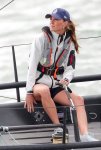
Be like the Duchess of Cambridge! Use a Backtow LJ!
(no connection to the company, but a very satisfied customer).
 
Last edited:
TNLI is spot on.................
I would add the following:
Reef from the cockpit.............I use a simple double line system.
Think through and plan your out of cockpit moves step by step in advance. Limit the number of these moves as far as possible.
I do a fair bit of exposed coastal singlehanding, my endurance is getting less as I get older so I must plan ports of refuge according to endurance and forecast.
Where I sail a minimum endurance of about 10-12 hours is essential.
Plan adequate food and hydration before each trip.
Keep warm, use adequate sun protection.
Be conservative with weather risk.
Dont be adverse to turning back or seeking refuge if necessary.
Apologies for repetition of any points already raised.
 
QUOTE="Wing Mark, post: 7829162, member: 188767"]
Are we allowed to discuss duchesses' crotch straps on here?[/QUOTE]

That is properly a matter for consideration by The Moderators (whom God preserve!)???

QUOTE="Wing Mark, post: 7829162, member: 188767"]
What kind of 'very satisfied' are you? (I can't get no.....)
Confused of East Devon.
[/QUOTE]

The customer kind, as stated above.?
 
Re going overboard. I wear an automatic lifejacket with a PLB, but rarely use a safety line. It will be almost impossible to get back onboard whilst singlehanded. If sailing at 6 knots and teathered to the boat you will be dragged along and guaranteed to drown. Untethered you will see your boat sail away but once the PLB is triggered your position is notified within 50 seconds to emergency services to facilitate a rescue. The PLB will be used to locate you. This at least raises your chance of survival from 0% from being tethered or not having a PLB to about 50%. One great friend never used to wear a lifejacket when singlehanding and now follows my advice of a lifejacket with PLB, he also lost a friend of his when he slipped off a boat without a lifejacket a few years ago.
You argue from the false assumption that the tether will cause you to drag in the water.
  • With properly located jacklines (inboard and stopping well short of the bow ans stern) you will not be in the water.
  • Use the short tether.
  • With a furler there is very seldom a reason to go all the way to the bow.
  • Don't walk forward on small boats, scoot on you butt. It's safer and allows you to use a very short tether (you can double the short tether around the jackline, making it ~ 18").
Then you assume a PFD will help. Since you are singlehanding, help is not coming soon, even with a PLB.
  • You are offshore and...
  • the water is cold.
I would argue that any plan that involves you being in the water has a very low probability of success for the cold water singlehander, not unless you are wearing a dry suit. Far less than 50%. On the other hand, a proper tether configuration has nearly 100% chance of keeping you on board. Obviously, this is easier on larger boats and multihulls.
 
You argue from the false assumption that the tether will cause you to drag in the water.
  • With properly located jacklines (inboard and stopping well short of the bow ans stern) you will not be in the water.
  • Use the short tether.
  • With a furler there is very seldom a reason to go all the way to the bow.
  • Don't walk forward on small boats, scoot on you butt. It's safer and allows you to use a very short tether (you can double the short tether around the jackline, making it ~ 18").
Then you assume a PFD will help. Since you are singlehanding, help is not coming soon, even with a PLB.
  • You are offshore and...
  • the water is cold.
I would argue that any plan that involves you being in the water has a very low probability of success for the cold water singlehander, not unless you are wearing a dry suit. Far less than 50%. On the other hand, a proper tether configuration has nearly 100% chance of keeping you on board. Obviously, this is easier on larger boats and multihulls.
When I am sailing I spend at least 98% of my time in the cockpit or below, even when setting a spinnaker singlehanded. So the chance of going overboard is very slight. In the past I used to be the foredeck hand of an offshore race boat when hanks and the first foil forestays were the order of the day, so furling headsails reduce deck work enormously.
 
Amused by the idea that if you are singlehanding you should wear a life jacket, for what purpose?
Surely it is only prolonging the agony.
To me the moast dangerous parts of a trip are just leaving port, retreiving lines, getting fenders in & sails set . Then, even harder, is the reverse entering port which by now could involve me being sea sick or just being in a big rolly sea.
Now in the scenario that I might go over the side in, say, Cherbourg outer harbour, entering ostend, Boulogne, Dover etc then I slow down so that if I go over the side whilst clipped on I have a chance of not being knocked out on the hull side whilst working out how to grab my MOB line & slipping aft. Then wait until the boat hits the dock wall & someone comes to investigate.
Alternatively, I can cut myself free & being inside a big port or close by I can activate my PLB & possib;ly let off one or two of the mini flares I carry in the LJ pocket
Most of my trips involve being within 5 miles of the shore for 30% of the time so someone might just notice a yacht running aground with no one on board. Or even sitting in the shipping lane with the sails flapping.
I have even had Dover CG call me up when off Ramsgate & ask if I was OK because someone on the shore noticed that I was in extremely rough weather & making little progress. I have had a similar thing when passing Cap Griz Nez heading N in F8 when the CG asked if I was OK.
That proves that people do look out & they do report odd goings on
So I consider the wearing of a lifejacket very sensible when SH. It has the advantage that it has the hook point for my harness line as well, plus the wallet for PLB & flares
 
If sailing at 6 knots and teathered to the boat you will be dragged along and guaranteed to drown.
Well do not do 6kts when you go on deck. Slow down. If i have to do deck work I see no point in having the boat pound up & down so slowing down eases the motion for starters.
So if- for instance- I am motoring into the wind to gather in the mainsail into the lazy bag I do it at a speed that the autopilot can just keep control.
On my LJ I have a 6 inch tether as well as the main one. Hopefully I can clip to the MOB line & cut the main tether & slide to the back of the boat & get dragged along without bashing against the hull if I cannot get aboard the stern.
 
Ahem! Not all of us are guaranteed to drown!

Be like the Duchess of Cambridge! Use a Backtow LJ!
(no connection to the company, but a very satisfied customer).
Can you share with us your experience of falling overboard and the satisfaction of using the BacktowLJ?

Personally, I use a CrewSaver and have been thinking about fitting the Duncan Wells MOB Lifesaver.

MOB Lifesavers | MOB Retrieval for lifejackets
 
Can you share with us your experience of falling overboard and the satisfaction of using the BacktowLJ?

Personally, I use a CrewSaver and have been thinking about fitting the Duncan Wells MOB Lifesaver.

MOB Lifesavers | MOB Retrieval for lifejackets

Sandy, I fitted these this year to all my lifejackets. I also bought the retrieving block and pulley with the leg sling for horizontal lifting. Considering only the lifesaver, at about £16 each, an absolute bargain and a device that works extremely well. I have tested the system with my wife onboard, she being less experienced and having less powerful arm muscles than me. In the water, the lifejacket inflated, the line floated free and my wife hooked the line with the boat hook and clipped it to the mid ship cleat. Job done securing the MOB with no hassle or drama, very, very easy. Recovery with the block and sling was equally easy. Some folks may want to use halyards etc, but the block and tackle allows my wife to lift me and guide me over the stanchions and even manoeuvre me to to the fore deck of companionway hatch while adjusting the block and tackle system. It really is very easy.

I do recommend the whole caboodle, it works, its easy, it very likely contributes significantly to saving a life.
 
I'm sorry to disagree but an autopilot is not, and should not be, essential.
Well.........for the first time since 2016, I find that I'm not in agreement with the honourable member ;)

On my boat the autopilot is essential, simply because I do not have three hands. This sailing malarkey is supposed to be pleasure, not hardship. I need one hand for the mug of coffee and another for the piece of cake. The boat has to take care of itself.
 
Can you share with us your experience of falling overboard and the satisfaction of using the BacktowLJ?

Personally, I use a CrewSaver and have been thinking about fitting the Duncan Wells MOB Lifesaver.

MOB Lifesavers | MOB Retrieval for lifejackets
I also have a Backtow life jacket, as it seems a very worthwhile investment.
Like my car airbag, I have not personally tested it and don’t plan to do so. But the videos of the tests done by the manufacturers do suggest it is a very worthwhile improvement (devised after a UK skipper drowned though attached to the boat by his lifeline).
Clearly as ever not falling OB is Plan A
 
I singlehand most of the time because I can get time off when my friends have to be at work, Even when they are not working, trying to agree on a date and time to suit everyone is a pain in the butt.

From a safety perspective, I always a had life jacket with a spray hood and a VHF clipped to it, a PLB in the innards and survival suits on board. Clipped on in any dodgy weather.

I had a lot of help from this forum when it came to mooring on your own. Firstly, a centre cleat is really useful and there is more than one way to skin a cat with respect to roping the pontoon cleat. Secondly, motoring gently against a spring from the centre cleat stops you being blown off the pontoon.

When I'm out day sailing, I can point into the wind and raise the mainsail before the bow gets turned. My old Sadler 25 hove to nicely if you rolled the jib in a bit.

For longer sails I used a tiller pilot. Great for motor sailing and for shorter period, depending on wind variability, under sail. Once, when anchored in an estuary on a fast flowing ebb, I couldn't pull the anchor rope against the flow. However, I could motor up to the anchor and then maintain position with the TP and the motor on low revs while I pulled the anchor up. Similarly, when short on sea room, have maintained position in the same way while I took down and flaked the sail.

I've now got rid of the Sadler and have a Bayraider Expedition on order. No electrics, by choice. I'll need to learn some new strategies.
 
I also have a Backtow life jacket, as it seems a very worthwhile investment.
Like my car airbag, I have not personally tested it and don’t plan to do so. But the videos of the tests done by the manufacturers do suggest it is a very worthwhile improvement (devised after a UK skipper drowned though attached to the boat by his lifeline).
Clearly as ever not falling OB is Plan A

Exactly; meanwhile, they are well made, comfortable, lifejackets.

I may be an advanced case of MOB phobia.

Besides the Backtow lifejackets we have a 6:1 purchase with Harken blocks, copied from Duncan Wells, which goes on the staysail halyard, a MobMat, which I like better than the sling set up, and, to cap it all, a Jonbuoy.
 
Top