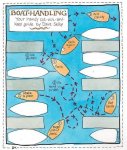
How to start single handing

And one supposes that, like all good skippers , you have tested all that theory, to check that it will work on a yacht doing 6 kts in a big sea ( Are we still single handed for this by the way?)
Yes, BUT, every boat is different and some folks like to use rubber bands to hold the loopy lines and scramble net up near the cap rail. If you need to run out a friends credit card, there are some very good made to measure loopy systems and scrabble nets, (Drowning is in the Oxford English dictionary),
The system I described is a real good one for single handed, single footed sailors, ( One infamous US sailor stepped on a banger in the far East, so he is a single footed & handed sailor), or Gin Palace skippers.
It does help to slow down from 6kts, and big seas are big seas. My own plan is to stay in my coffin berth, start the donkey and just use my tiller pilot toggle switch to steer through a group of survivors, whilst using the A frame mast head cameras to look down on the target group). Do make sure you have some real powerful search lights on both port and starboard areas of the bow, plus additional lights covering the rescue deck and stern boarding ladder. Some rescue boat skipper also trail a floating Polyprop line with a small light on the end. That trailing warp system gives a POB a second chance.

It is also a good idea to have a significant number of old cheap commercial passenger lifejackets, (They get dumped when the commercial regs change), so that in a bad case you can just dump them around a big group of floaters. if they look like potential trouble. I use them to help the self righting figures, like the flooded vanishing point angle. One word of caution, cheap lifejackets made from what I suspect is Polystyrene, and covered with nylon, burn rather well and the Polystyrene gives off toxic fumes, so should be stored in a sensible place where there is no chance of someone dropping something unhelpful into the locker or other storage area. That area should also be free from any electrical devices, or even wiring designed to short out and set fire to a vessel if it's involved in a collision.

It really is much safer to stay in your bunk during a disaster at sea if the sea state is a tad sporting!
 
Last edited:
I'm sorry to disagree but an autopilot is not, and should not be, essential.

It should indeed not be essential, but having some means of keeping the helm centralised whilst doing " other things" is pretty important and an autohelm/ pilot is a useful bit of kit. You do need some other strategy for when it's broken however.

How to start single handing ? Easy...push the other feller overboard ?
 
With my current boat single handing was not the plan. I had sailed my other boats SH, but this was a bit bigger. However, on the way to the med as part time "live aboards" we were half way down the Bay of Biscay & quite honestly, fed up with the French.
For various reasons we soon realised that liveaboard was not all it is cracked up to be. My advice would be to ignore the books, or read between the lines when deciding to have a go.
So suddenly my wife said." I have booked a plane. I am going home. You do what you like" & 48 hours later she was gone.
I looked at the options & decided the Med was not for me. Without a crew I wondered how I would get home. But after the first sail it was Ok & I actually enjoyed sailing for me & not for the wife- I have to admit that "Oh lets not go today it is windy, or Can we not just motor?" was getting on my nerves.
The sail home was fantastic & now I sail SH 95% of the time.
So if you want to start SH sailing find yourself abandonded somewhere warm & have to make your own way home. Just go out & try it.
 
I am not talking about dinghies. I also have a squib & that heaves too OK. I have just sold my Phantom after 12 years of ownership of 3 & I could just let the main right out & sit there
However, my Hanse, Like most Hanse of the similar era will not heave too. Even the 60 ft version would not, according to one very experienced owner.
I think I know how to handle the boat after 18 years. I tend not to do many trips over 100 miles each year but lots of 60-90 miles so I have to leave the helm most of the time. I get through a few autopilots.

Agree about the Squib. Very well behaved little boat. My ancient plastic Nicholson heaves to very sweetly also.
 
With my current boat single handing was not the plan. I had sailed my other boats SH, but this was a bit bigger. However, on the way to the med as part time "live aboard'" we were half way down the Bay of Biscay & quite honestly, fed up with the French.
For various reasons we soon realised that liveaboard was not all it is cracked up to be. My advice would be to ignore the books, or read between the lines when deciding to have a go.
So suddenly my wife said." I have booked a plane. I am going home. You do what you like" & 48 hours later she was gone.
I looked at the options & decided the Med was not for me. Without a crew I wondered how I would get home. But after the first sail it was Ok & I actually enjoyed sailing for me & not for the wife- I have to admit that "Oh lets not go today it is windy, or Can we not just motor?" was getting on my nerves.
The sail home was fantastic & now I sail SH 95% of the time.
So if you want to start SH sailing find yourself abandoned somewhere warm & have to make your own way home. Just go out & try it.

I would point out to those used to sailing as part of a team, that SH, (Single Handed), sailing is a very different game, and before you give it a go, make sure you have spent some time in port, preferably in a marina, (Falling overboard from a mooring or anchorage subject to significant tidal currents can ruin your whole day). figuring out how to do all the tasks involved in sailing your pride and joy, WHILST CLIPPED ON, to your safety line or safety track system. That practice time will allow you to figure out if you need to do something like lead the sail controls aft, or fit a pee tube to save using the sink or cockpit drains.
The real tricky part of SH sailing, is picking up a mooring, playing with an anchor, or changing the mast head navigation light bulb. I've made a real fork up of all three over the years.

Now for the real important part: Buy three top of the range loud kitchen timers, 120 minute kitchen timers
 
Last edited:
The real tricky part of SH sailing, is picking up a mooring, playing with an anchor, or changing the mast head navigation light bulb. I've made a real fork up of all three over the years.
Now for the real important part: Buy three top of the range loud kitchen timers, 120 minute kitchen timers
Picking up a mooring - Yes I agree. However---
Do you really think that someone just learning to SH is going to need to change the masthead bulb at the start. Especially as he/she would have deck lights for motoring. Similarly sleeping underway will be quite a long way off. Starting early after a nights rest one can sail for 18 hours without having to sleep quite easily. At 5 kts that is 90 miles. It is mostly a daylight sail in the summer.
Not many SH sailors will be going that long on their first few sails. More like 3-4 hours , I would suspect.
Then why would they want THREE kitchen timers . (Surely they can boil the eggs before they leave :rolleyes:) One will wake them easily enough IF they manage to get to sleep in the first place.
 
View attachment 124969

This book is available as a free download on a few sites.

He is "Foolish Muse?" On Sailing Anarchy forums and posts in the Shorthanded forum. Lots of his stuff on YouTube.

The printed version seems to be somewhat superior - a poor choice of fonts makes the PDF download hard to read IMO.

I think I checked the printed edition using Amazon's "look inside" function and it was much clearer.
 
How to start singlehanding?
I'm surprised it is a question that needs to be asked!

You sit on your sofa for an eveing or two (or in your bath if you prefer) and work through, blow by blow, how you'd get your boat on and off it's mooring solo in decent weather under power. Not too taxing - surely? How you'd cope with an unexpected swing or a snagged mooring line you thought was going to slip etc.

Then you do the same for how you'd get the sails up afterwards. And down again. (motoring into wind under autopilot perhaps?) Move by move. What could go wrong? How would I cope if it did? Think all the options through. How serious would an error be anyway? (not very, in decent weather). What would I do if it got a bit out of hand? (Is the anchor ready to drop by gravity - quickly?). How do I cope with steeering and sail-work simultaneously? Use of autopilot (I'd be stuck without one). How do I reef solo? (Easy! You heave-to and reef there. Foolproof) So learn how your boat likes to heave-to, it's a lifesaver in more ways than one for singlehanders. Can I balance her to sail with the tiller lashed without the autopilot? Find out how.
Then go out do it in a F2/3 and do it to prove you can. And heave to. And reef - yes, even in a F2/3. Then sail around a bit and heave-to again to unreef.
And anchor and unanchor. Try raising the main at anchor before setting off - it's one less thing to do once underway if conditions permit.
Then do it all over again next time there's a F4.
Then undertake a 30 mile solo coastal trip to prove you can navigate and sail alone.
Pretty soon you'll find all of this is just a matter of an organised mind, an organised boat and a well rehearsed sequence - and there is great pleasure and satisfaction to be found in it.
Then one day you'll get 'caught' by more wind than you wanted and find yourself heaving-to to reef for real with spray flying is just the same as doing it any other time and it works just the same - heave-to and the mayhem magically abates, you get on with the job and behold - all is under control again! I CANNOT over-emphasise the usefulness of heaving-to for a singlehander, even if only to make a sandwich, a cup of tea or take a dump if it's all getting a bit much, and you'll soon be away, shouting at the wind as the spray flies with 2 reefs in, half the genny out and the lee-rail under wondering what all the fuss was about.

Later comes managing fatigue, sleep etc after 18hrs etc. That's another learning curve.

It's all a progression. Take it step by step and learn to recognise the difference between your ability and potential over confidence, but if you've taken it progressively as suggested you'll not be likely to overreach yourself unexpectedly.
And if in doubt; heave-to and have a re-think in slow time!

But for me, a decent autopilot is a must. Call me a wimp if you will.
 
Last edited:
How to start singlehanding?
I'm surprised it is a question that needs to be asked!

You sit on your sofa for an eveing or two (or in your bath if you prefer) and work through, blow by blow, how you'd get your boat on and off it's mooring solo in decent weather under power. Not too taxing - surely?

Then you do the same for how you'd get the sails up afterwards. And down again. (motoring into wind under autopilot perhaps?) Move by move. What could go wrong? How would I cope if it did? Think all the options through. How serious would an error be anyway? (not very, in decent weather). What would I do if it got a bit out of hand? (Is the anchor ready to drop by gravity - quickly?). How do I cope with steeering and sail-work simultaneously? Use of autopilot (I'd be stuck without one). How do I reef solo? (Easy! You heave-to and reef there. Foolproof) So learn how your boat likes to heave-to, it's a lifesaver in more ways than one for singlehanders. Can I balance her to sail with the tiller lashed without the autopilot? Find out how.
Then go out do it in a F2/3 and do it to prove you can. And heave to. And reef - yes, even in a F2/3. Then sail around a bit and heave-to again to unreef.
And anchor and unanchor. Try raising the main at anchor before setting off - it's one less thing to do once underway if conditions permit.
Then do it all over again next time there's a F4.
Then undertake a 30 mile solo coastal trip to prove you can navigate and sail alone.
Pretty soon you'll find all of this is just a matter of an organised mind, an organised boat and a well rehearsed sequence - and there is great pleasure and satisfaction to be found in it.
Then one day you'll get 'caught' by more wind than you wanted and find yourself heaving-to to reef for real with spray flying is just the same as doing it any other time and it works just the same - heave-to and the mayhem magically abates, you get on with the job and behold - all is under control again! I CANNOT emphasise the usefulness of heaving-to for a singlehander, even if only to make a sandwich, a cup of tea or take a dump if it's all getting a bit much, and you'll soon be away, shouting at the wind as the spray flies with 2 reefs in, half the genny out and the lee-rail under wondering what all the fuss was about.

Later comes managing fatigue, sleep etc after 18hrs etc. That's another learning curve.

It's all a progression. Take it step by step and learn to recognise the difference between your ability and potential over confidence, but if you've taken it progressively as suggested you'll not be likely to overreach yourself unexpectedly.
And if in doubt; heave-to and have a re-think in slow time!

But for me, a decent autopilot is a must. Call me a wimp if you will.
Once again apologies
this post arose from a earlier post relating a tale of a voyage with a crew and suggested that the OP was likely to end up on his owh if he did not include his family in sailing the boat but was taken at face value on how to learn how sail single handed and then degenerated Into a critique of the merits of auto helms
 
Once again apologies
this post arose from a earlier post relating a tale of a voyage with a crew and suggested that the OP was likely to end up on his owh if he did not include his family in sailing the boat but was taken at face value on how to learn how sail single handed and then degenerated Into a critique of the merits of auto helms
I guess the answer so is the words "I do".

I know at least 4 sailors who were encouraged and supported by their spouses to buy yachts, with hints that they would come along and learn to sail...

subsequently boat changed from " the boat" and becomes "your boat" and "are you going sailing?"...

And so they became singlehanded sailors...
 
Once again apologies
this post arose from a earlier post relating a tale of a voyage with a crew and suggested that the OP was likely to end up on his owh if he did not include his family in sailing the boat but was taken at face value on how to learn how sail single handed and then degenerated Into a critique of the merits of auto helms
Your title said you were looking for advice on "How to start singlehanding". Yet your post was poorly worded and all subsequent posters missed your point, hence your title became the subject of discussion, along with the usual thread drift.
 
I guess the answer so is the words "I do".

I know at least 4 sailors who were encouraged and supported by their spouses to buy yachts, with hints that they would come along and learn to sail...

subsequently boat changed from " the boat" and becomes "your boat" and "are you going sailing?"...

And so they became singlehanded sailors...
I never had to go through this transition as my wife suffers from bad motion sickness.
 
I have single handed a fair bit in a variety of vessels up to 50'.

Truth be told, I never gave it much thought, though I did start at an age when one is still immortal. It was done sans AP, on and off a mooring, cruising over distances and nights in my Dad's short keel C&C 25, with a somewhat less than reliable engine and docking under sail. Its what one did if you couldn't find crew and it was a natural progression from sailing a small dinghy.

How do you start to singlehand? By leaving the crew ashore and casting off, I suppose?

We are now at 115, well 117 now, posts into pointing out that you need a thermos and a urinal to slip the mooring. How did I ever manage? That falling overboard while the boat went on it's merry way could potentially spelled trouble, I always thought was a given.

Not having to worry about or be responsible for a crew (something I take very seriously) has always been much more relaxing.

As in many threads, very simple or straightforward things are wildly overthought with, quite often, surreal suppositions. Its a miracle that anyone still dares to go sailing at all.
Statistically, more people manage to get themselves run over by a bus than are lost at sea while sailing. For all else, carry insurance.
 
Top