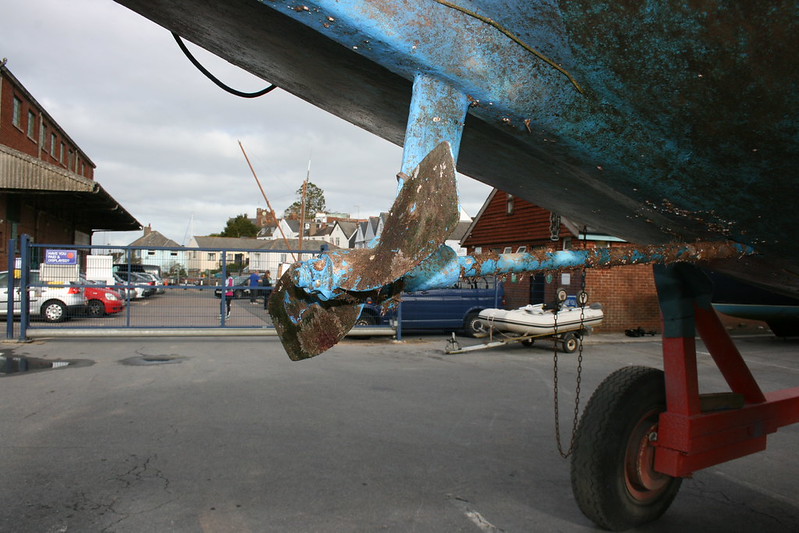
How the heck do I get antifoul to stick to the prop?

+1 for the hammerite special metals primer. I use the velox primer two years ago and it didn't stick too well to the prop despite by best attempts to prepare it (Darglow Featherstream, mix of stainless and bronze). I used hammerite special metals primer this year and, on last inspection in the water, the antifoul seems well attached to the primer (and prop!)

Rival,

Vyv has mentioned that Hammerite have reformulated and their current primer is water based. Vyv's success has been based on the old formulation, before water based, but now only the water based primer is available. Can you advise which primer did you use?? - as there are no reports of success, or lack of success, with the water based primer. From the timing you seem to be using water based - but maybe you had old stock!

Jonathan
 
Whenever I antifouled the propeller the antifouling always washed off for an obvious reason it spins at high speed the hull doesn't.

I've had the boat for 12 years, and with the old fixed prop used to know what to expect - about half the AF gone. This issue is specifically happened since I've changed to an Autoprop 3 years ago, so I'm trying to get back to a similar experience at least...
 
Rival,

Vyv has mentioned that Hammerite have reformulated and their current primer is water based. Vyv's success has been based on the old formulation, before water based, but now only the water based primer is available. Can you advise which primer did you use?? - as there are no reports of success, or lack of success, with the water based primer. From the timing you seem to be using water based - but maybe you had old stock!

Jonathan

I used the new formulation
 
Some pics of my Velox history. All taken as we were lifted out before pressure washing

1. First season, Hammerite primer, four coats of Velox. Chipping in the typical cavitation locations where presumably impact velocities are higher
IMG_2766.jpg


2. Second season, Two coats of Velox
Velox2ndseason_zpsafce8ccd.jpg


3. 2014 end of season, third year of Velox. Primer is still the original, two coats of Velox, about 150 hours of motoring
PA200418_zps1ukirnol.jpg


3. 2015 end of season, as 2014
P9290005_zpssrux9jvp.jpg
 
Just as an alternative to antifouling, you can always polish the prop.

These are photos of the Max prop' on my boat taken in April and then October, after a summer sailing and then on a swing mooring on the West Coast of Scotland. We had quite a bad season for fouling, the CopperCoat had a fair crop of barnacles and green slime.

View attachment 60512
before launch

View attachment 60514
Taken when the boat was lifted

The main disadvantage I can see, is that all that exposed metal leads to high anode consumption.
Painting obviously reduces the area of exposed metal and should extend anode life.
But polishing is relatively cheap and easy to do.
 
That doesn't work in the nitrate rich locations around the East Coast, and particularly West Mersea.. my main issue is lack of adherence to the prop. Trilux works well on my shaft, at the moment the only problem is getting the stuff to stick... This winter it'll be Hammerite under Trilux.
 
Thanks Rival,

I'll go and buy some. We are booked to complete our own AF in 3 weeks - good timing! :)

Jonathan

Spot of feedback: the image below is after liftout a few days ago, the white is Velox antifoul after 9 months in a saltwater tidal marina - looks like it works; the flecks of read are the current formulation of the special metal primer peeking through nicks in the Velox, the prop is a mix of bronze core and stainless blades. This is the first time I have found an antifoul and primer combination that does what it is meant to :):):)

 
+!

As per Velox instructions - I assume you are simply going to, clean, abrade back, touch up with primer if you can see bare metal and then apply, one or two top coats of Velox.

I agree it seems to work (which is what Vyv has been saying all along!!) and is much less work than anything else.

Our props did not look quite as good as yours - but we achieved 21 months, in a high fouling area. I have abraded back, topped up the primer and applied 2 new coats. We too used white, it is easy to see if there is anything on the props. We used Velox on the saildrives as wel, equal success.

My anode wear was minimal - just an added bonus (though this might be caused by other changes).

Jonathan

Edit: When we came to buy Velox, here in Oz, I found they will only sell as a 2 pack, Primer and top/active coat. I also found Hammerite is only available in restricted retail outlets (and its water based here as well). We took the easy and cheaper option, which is how we applied Velox previously. We used the Velox primer, 2 coats, and 2 top/active coats. The first coat, of active, over the primer 'dissolves' the green primer and you get a pale green finish which is covered with subsequent coats. We took Vyv's advise that too many top coats are subject to chipping and only applied 2 top coats (I think Velox mention 2 or 3 top coats). We will beach (easy with a cat) at 8 months and maybe apply a further coat then). I'm looking to get 2 years before we need to treat for touch up primer.

Part of the route to success is preparation - ensuring the prop and sail drive is abraded as suggested and not touched with bare hands, fingers. Contrary to recommendations - I did touch the bare metal after abrasion and it feels rough, nasty - I then washed and re-abraded where I had touched. I spent a lot of time abrading - I've had AF on our props, Interprotect and Trilux, strip off after only a few hours of motor use - and I don't want to go through that again! Close edit
 
Last edited:
I just slap some some of the cheapest antifoul I can find, usually Gaelforce own brand, and job done. It is usually gone by the end of the season, but that what eroding antifoul is supposed to do

 
I have an Autoprop, and sail on the West Coast of Scotland. I clean my prop with a wire cup-brush, and just before launching, slather on stuff called "Vickers Underwater Oil", which is really a water resistant grease, which I happened to have from a previous boat. I have no idea how long it stays on, as there is no sign of it at lift out after six months, but also no weed or barnacle growth. May or may not be significant, but after six months the anode is practically eroded away. On the hull I use a copper rich antifouling. Is that significant?
 
Question to Vyv Cox - looking at your photos looks as if you have only put Velox on prop and P bracket, not the shaft; I'm planning to include the shaft and the Stripper (which I assume is s/s) in my velox application - is there a reason not to do this? (I do get huge lumps of tube worm/barnacle on the shaft in current location).
 
Last edited:
Norman - Ours are 3 bladed folding Volvo's and anodes used to last 12 months, though there would be not much left at the 12 months.

Since we started using Velox anode life has increased dramatically and we had most, well - better than half, of the segmented anode left after 21 months. It is not worth the risk and we put new anodes on. Unfortunately when we started using Velox we also started to use Jotun's SeaQuantum Ultra - why the hull AF should impact anodes I don't know. I don't know how long the saildrive anodes would last we are changing every 4 years, currently.

A suggestion is that sealing the props off (with the Velox), reduces anode wear.

When I first noticed the low wear of the anodes my immediate though was that if the anodes are not corroding - what is? but this fear was unsubstantiated as the props and saildrives are fine.

My focus was on finding an AF to give 2 years life, the J SQU is pretty near. I then thought this was a waste of time as the props still need to be painted and the anodes need replaced at 12 months - but serendipity is at work and by default AF for the props and the anodes appear to be neatly matching hull AF life.

We also compared Velox with Prop Speed. There was not much difference - except we did get some hard shell growth on the Prop Speed, maybe where the coating was damaged by hitting something in the water. Prop Speed needs ground back to base metal each time you need to re-coat - whereas Velox just needs patched up and fresh top coat added. Prop Speed is reputedly carcinogenic - which is a major turn-off. We will be using Velox for the next 2 years, at least.

Edit - We are using Velox on both the props and saildrives to good effect (with as mentioned, earlier post - the Velox primer). close edit

Jonathan
 
Last edited:
Spot of feedback: the image below is after liftout a few days ago, the white is Velox antifoul after 9 months in a saltwater tidal marina - looks like it works; the flecks of read are the current formulation of the special metal primer peeking through nicks in the Velox, the prop is a mix of bronze core and stainless blades. This is the first time I have found an antifoul and primer combination that does what it is meant to :):):)


I have the same prop and using the Velox primer it didn't stick very well at all. Can I ask how you prepared the prop before applying the Hammerite special metal primer as I will try this next year.
 
Top