How small can a solid fuel stove be?

Greenheart

Well-Known Member
Joined
29 Dec 2010
Messages
10,384
Visit site
I found a Youtube channel in which a chap rides a bicycle across the chilly Minnesota countryside towing a rough wooden 'cabin' on wheels, with his dog. Pleasant quiet rustic wandering in an unpopulated area - nobody objects to him stopping, cutting fallen wood for his campfire and settling down for another night in the cabin.

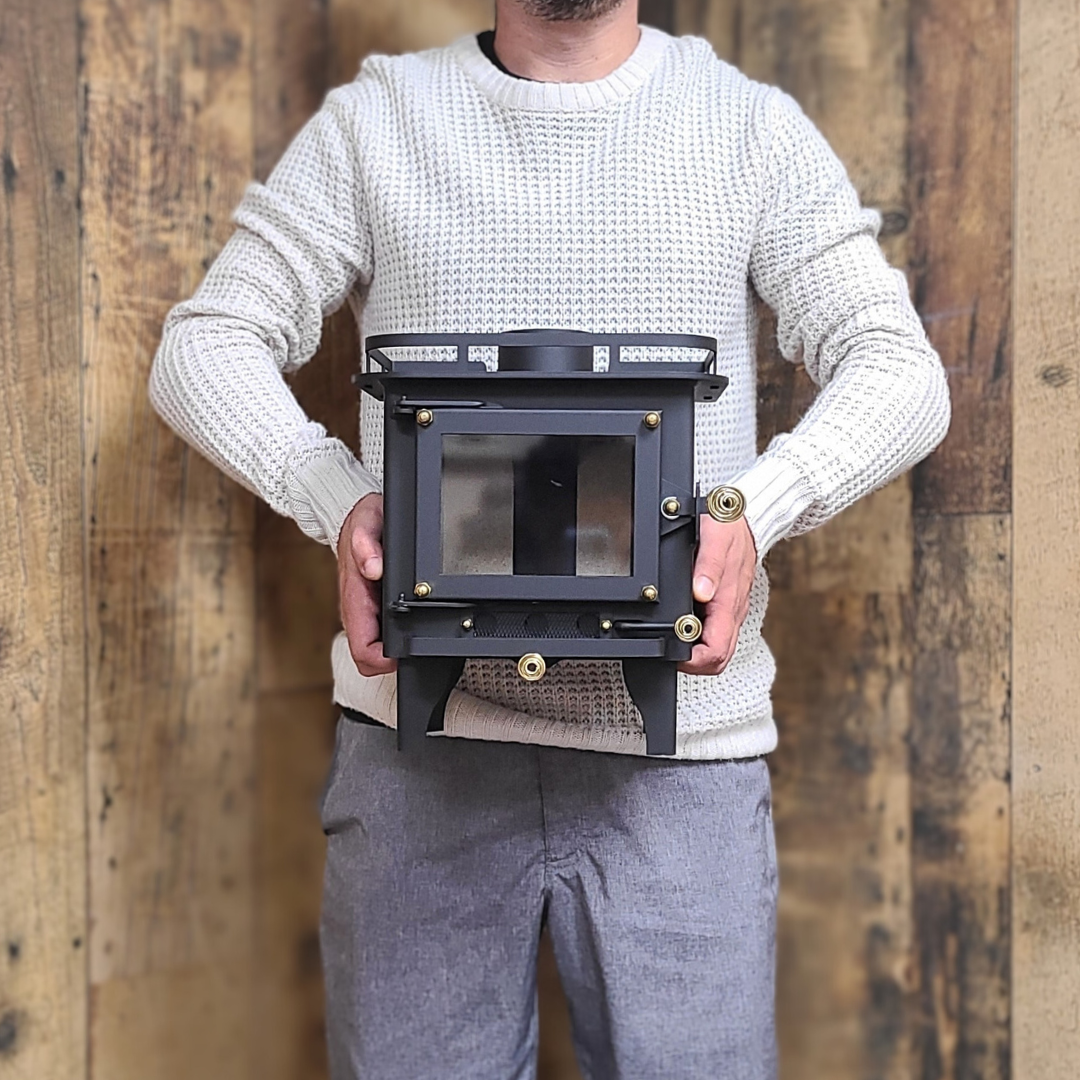
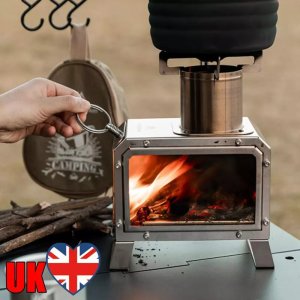
But most interestingly (given how cold the weather is there) the chap has a very effective woodstove about the size of a domestic toaster, inside the cabin.
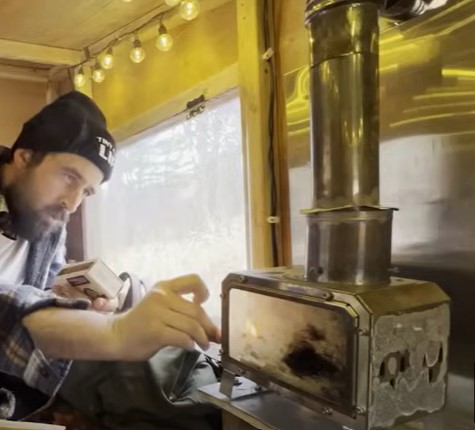
54071677076_9c2310d1e8_o.jpg


It has a flue and seems to operate without setting the cabin alight, and it made me think how welcome the warmth and simplicity of such a hot-box might be in a small yacht.

Does one simply get busy with welding gear and plate steel and make one, or are such things for sale somewhere?

I know Tom Cunliffe's boat is easily big enough to have a ruddy great diesel heater with ducts to every cabin, but he likes the solid fuel glow too...


I hope safety concerns can go unspoken here, given that it all ought to be obvious and the daft will heed no warnings anyway.
.
 
Well, you could make a really, really tiny one easily enough, but it wouldn't put out enough heat to be worth the bother.

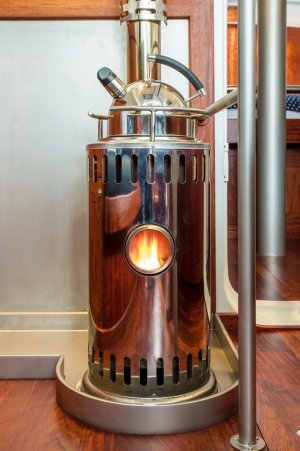
There used to be quite small ones commercially produced, such as the (Atkey?) Pansy and one by Bengco (both bulkhead mounted). The latter was stainless steel IIRC, about maybe four inches square looking down on the top of it, and perhaps something like 14" tall, with the bottom three inches taken up by the ash pan/fire lighter. I've never seen a Pansy in the flesh, but imagine it to be slightly smaller. (I've read that the narrow chimney of the Pansy made the stove a little difficult to get, and could be overcome by warming the chimney with a blowtorch or similar.)

I had for a while, in the hope of installing it in a boat one day but never actually did, a small rather nice old 'free-standing' cast iron stove, on a pressed metal base, that was just slightly bigger than the Bengco.

I can certainly attest to the merits of a solid fuel stove on a boat. A friend had one about twice the width of the one in the thumbnail of the Tom Cinliffe vid above. it was just great in the winter, really toasty in a way you never get with blown air or electric etc. heaters. Lovely combination of warm, dry air and serious radiant heat, and beautifully quiet with it. You'd get it alight, and as it warmed up you'd stop shivering, relax, then progressively remove your wooly hat, then your pullover, then roll up your sleeves. I seem to vaguely recall a line by Denny Desouter, or someone like that, about sitting in the front of the stove in your vest while there's ice and snow ion the decks above.

Of course you do need somewhere to keep the fuel for it, plus kindling or fire lighters, etc. My friend's stove used coal, stored in part of the bilge under the cabin sole. The Benco and, I think , the Pansy, used charcoal (which reminds me I still have some in the shed!). Wood would be a bit bulkier to store.
 
I had a Pansy charcoal stove, can't say it was a success. Mine only had a 25mm flue and it just refused to draw properly. You could blast a gas blowtorch up it to get the air flowing the right way, but the slightest gust of wind and it would blow back. Or you could leave the fore hatch open which helped, but defeated the purpose of the whole exercise.

I eventually solved the heating problem by installing a Chinaspacher for £80, and then rather more satisfactorily by sailing a few thousand miles south.
 
I had a charcoal heater on my 28' boat for years. It put out a lot of heat and wasn't expensive to run in the evenings.

It was a home made one of 3/16" s/s plate. It was a bit messy, and when the top flap was opened for refueling a fair bit of smoke came out so we developed a technique of filling brown paper bags (scrounged from a greengrocer) with charcoal. One of us would open the flap for a few seconds (wearing a leather gauntlet because it was b----y hot!) and the other hurled in a bag of charcoal!

I sold it to a Scotsman who installed it in an old wooden boat. He burned peat in it. He told me his dog liked it. It must have been a very fragrant atmosphere on board - peat smoke, the odour of dog and, I assume, the pleasant smell of whisky!
 
In my Mashford 23 footer I had a small enameled stove that warmed up the cabin and dried clothes worked best with coalite, on my other boat I bought a Portuguese stove for 20eros that chucked out too much heat but kept the Galiciandamp at bay ,burnt drift wood…….Ihave seen stoves that have very effectivedraft system that they can consume a single small log at a time
 
I had a charcoal heater on my 28' boat for years. It put out a lot of heat and wasn't expensive to run in the evenings.

It was a home made one of 3/16" s/s plate. It was a bit messy, and when the top flap was opened for refueling a fair bit of smoke came out so we developed a technique of filling brown paper bags (scrounged from a greengrocer) with charcoal. One of us would open the flap for a few seconds (wearing a leather gauntlet because it was b----y hot!) and the other hurled in a bag of charcoal!

I sold it to a Scotsman who installed it in an old wooden boat. He burned peat in it. He told me his dog liked it. It must have been a very fragrant atmosphere on board - peat smoke, the odour of dog and, I assume, the pleasant smell of whisky!
A friend of mine had a benco on a boat in Lake Geneva. It kept the boat warm and comfortable in minus 10c.

I used to bring out turf to burn in it to achieve that wonderful smell of peat burning...

Many happy days of sailing with the boat on its ear, smell of turf burning, warm air from the cabin, tiller in one hand and a glass of Jameson in the other..surrounded by snowcapped mountains...
 
There are marinas that do not allow solid fuel (dropping ashes on other boats).
Marinas might be the least of you problems - whole cities impose restriction on burning solid fuel that generates smoke and ash.

In any event - if you are in a marina you have electricity on tap (the cost of which is in the nightly charge - or it is in Australia), so why not a simple electric heater.

Jonathan
 
Have a look at the drip fed diesel heaters such as the Reflex models. These are very effective and simple compared to most fan forced heating systems.

You could make a DIY version. Basically they only drip diesel into a tray so there little complex engineering. Simplicity is often the key to reliability.

There is no wood to store, or restrictions on operation.

Below is a photo of the Reflex heater on our yacht. Smaller versions are available:

You_Doodle_2024-10-16T23_17_55Z.jpeg
 
Last edited:
Iwould imagine that the problems of a tiny solid fuel heater are that with small capacity for fuel it would need refilling often. Possibly also difficulties with a flue of appropriate size. It does seem that a diesel drip feed might be best. ol'will
 
If you want a stove to keep going overnight, it needs to be a decent size and it needs to be set up to burn coal, ie lined with fire brick and with an open grate with space underneath. Otherwise you'd need to feed it every couple of hours.
But small multi-fuel stoves used to be standard equipment on UK yachts - reading any older yachting books you can find loads of details.
 
On a previous (large) boat, we used to have a wood burning, or more accurately multifuel stove. A Morso Squirrel to be precise. It was great. We carried a chain saw, and had fun logging. The real problem is storing a sufficient amount of dry wood.
On our present boat we have an Eberspacher, which isn't as much fun, but is soooo much more efficient.
 
Thanks for all these answers. With autumn speeding in I hope there'll be many more.

...if you are in a marina...why not a simple electric heater
If electric heating was really practical aboard small yachts away from a marina, I mightn't have asked about solid fuel. Independence from power hook-ups (in fact, needing only what may be lying on a beach above the high tide mark) is part of solid fuel stoves' appeal.

I suppose one could run an excellent little 500w/1kW stand-up quartz heater from a suitcase generator without revving it intolerably; and it would only use fuel from the yacht's auxiliary. But depending on the season, I don't believe I'd want to if I had a log/coalburner instead.

While I'm without a boat it's strictly theory, but as I won't own another cabin boat without at least one form of heating, everything possible is under consideration. Minimising reliance on electrics generally is appealing, so the simplicity, reliability and silence of a coal or wood stove is very attractive.

...it was just great in the winter, really toasty in a way you never get with blown air or electric etc. heaters. Lovely combination of warm, dry air and serious radiant heat, and beautifully quiet with it. I seem to vaguely recall a line by Denny Desouter, or someone like that, about sitting in the front of the stove in your vest while there's ice and snow on the decks above.

I want one. :)
.
 
I have seen several solid fuel stoves built from Calor gas bottles. I imagine one from a Camping Gaz bottle would be big enough to provide decent heat. A door cut in the side, on hinges, with a vent in the lower half varied by a simple slide. Hole in the top for a flue welded on. Grate about 1/3 up the bottle .
 
I have seen several solid fuel stoves built from Calor gas bottles. I imagine one from a Camping Gaz bottle would be big enough to provide decent heat. A door cut in the side, on hinges, with a vent in the lower half varied by a simple slide. Hole in the top for a flue welded on. Grate about 1/3 up the bottle .
I have seen one based on a section of 5inch square tube
 
Top