How Safe are Windows in the Hull

Sometimes reasonable propositions get taken to giddy extremes by the pressures of fashion and you would not want to take some of these boats offshore in poor conditions. However windows are not totally useless, structural engineers would dearly like to omit windows from aircraft but the punters like them.


1699872154838.png

.
 
I would think with modern structural knowledge and adhesives there should be a high level of confidence in those topside window. Not so sure about the claim to have windows stronger than the hull structure around them in the long term..

They are however hideous to my eye in most installations I’ve seen - a marketing tool like the designer sharp edged ikea like interiors, twin wheels on most new boats - even mid 30 footers FGS.
 
Only because the ar$e end is so big.
That is correct, but there is nothing wrong in that, more the opposite. Boats with wide sterns often suffer because they have single rudders, and life for the helm can be restrictive with a single central wheel. Also such boats have the advantage of easy access through the transom either for boarding or swimming and twin wheels enhances that.

So form follows function - narrow deep sterns don't require twin wheels (or rudders.

What could be more logical than that?
 
I think he meant new boat buyers, since almost all new boats are that shape.
Yeah, probably. I guess the marketing wonks need something to fill in all that space and a tiller would just confuse them.
Or maybe they’d spent a few nights on board their new space ship and were sleep deprived due to the slap-slap under their bunk all night long?
 
Plenty of wide sterns with tillers, sometimes even two.

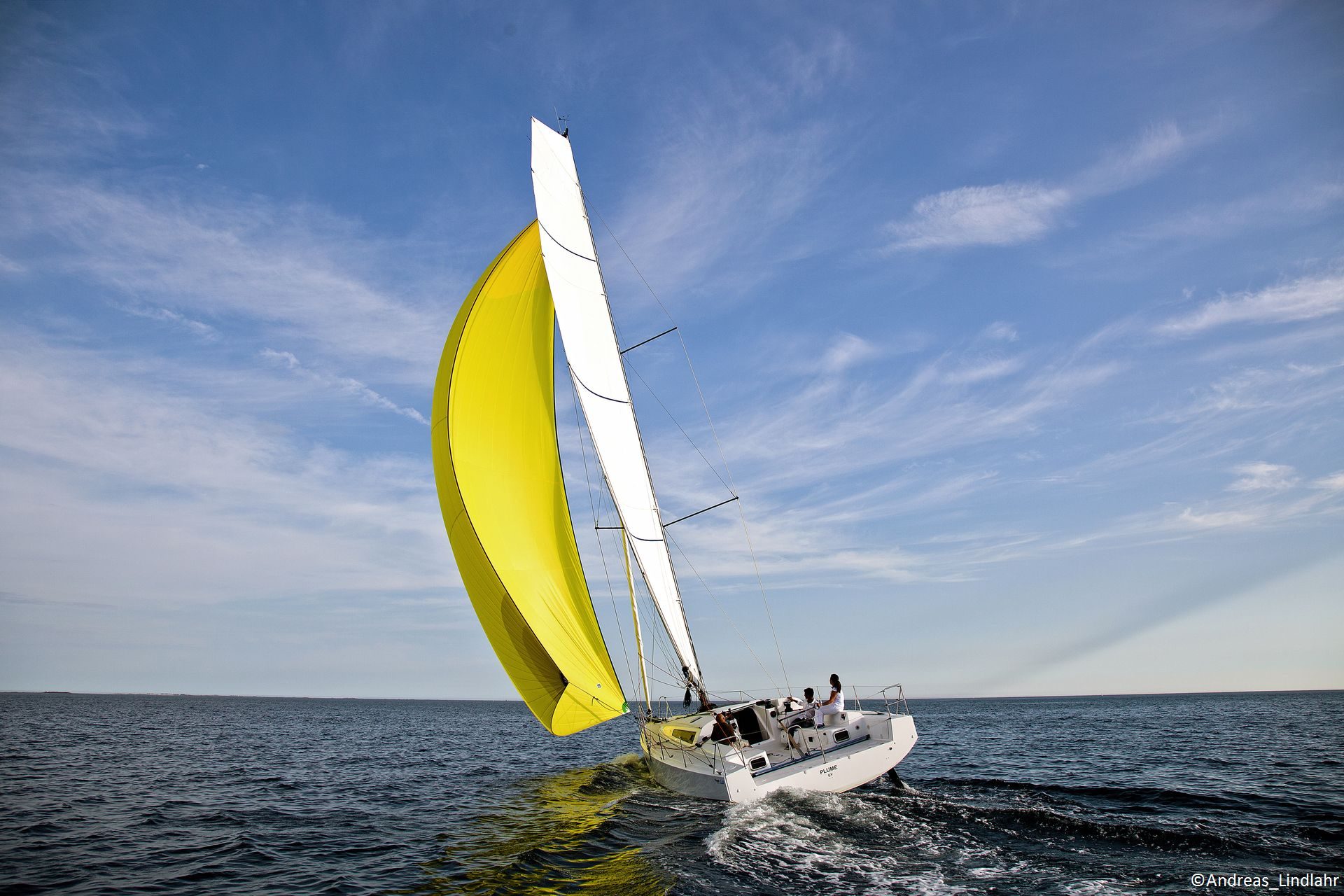
MG_5851-1-1920x1280-1.jpg
 
So why are they so big transommed? Twin cabins aft? The desire to plane downwind? To look like a racing sled? To create a patio (bathing platform)? Quite simply I think big transommed boats sell and possibly easier to build. Why because you can get lots of berths in them, they are spacious they appeal to sailors and non sailors alike. You can still buy narrower transommed boats new but they appeal to the sailor who is not looking to charter or accommodate lots of people.

Each to their own. I’m not a big fan of AWBs but I think I’m a minority
 
So why are they so big transommed? Twin cabins aft? The desire to plane downwind? To look like a racing sled? To create a patio (bathing platform)? Quite simply I think big transommed boats sell and possibly easier to build. Why because you can get lots of berths in them, they are spacious they appeal to sailors and non sailors alike. You can still buy narrower transommed boats new but they appeal to the sailor who is not looking to charter or accommodate lots of people.

Each to their own. I’m not a big fan of AWBs but I think I’m a minority
Do you sail and voyage much or stick to your local area?

I only ask because most warm water sailors who sail to unfamiliar waters seem to like these kind of boats to live on and look after them in rough offshore waters.
 
So why are they so big transommed? Twin cabins aft? The desire to plane downwind? To look like a racing sled? To create a patio (bathing platform)? Quite simply I think big transommed boats sell and possibly easier to build. Why because you can get lots of berths in them, they are spacious they appeal to sailors and non sailors alike. You can still buy narrower transommed boats new but they appeal to the sailor who is not looking to charter or accommodate lots of people.

Each to their own. I’m not a big fan of AWBs but I think I’m a minority

All of the above plus more. The design gives less drag and greater form stability, hence parasitic losses are reduced compared to other hull designs. The result is a lighter, faster, more stable boat,

Wide stern racing hulls are empty in these areas, but for leisure boats the shape allows designers to optimise for leisure.

Personally I am a fan of older designs based on aesthetics and certain handling attributes. However, the wide sterned boats I have chartered had much greater utility for leisure use compared to my own 41’ boat from the 70s.

For example two families on my boat, can have the couples in separate cabins and the kids in the saloon. On a 41’ BenJenBav they can all sleep in cabins, leaving the saloon free. In my cockpit we can all sit around the table being mindful of elbows and knees, in the BenJenBav there is room to spread out or slouch. Kids will dive off any hull shape and climb back in, but the drop down sterns are exciting and easy to use, especially if transferring BBQ stuff or shopping to, from dinghy.

As for saloon living, there is not much in it. Both families can lounge around in the saloon, cook and clean up, much the same. The big difference between both styles is the work top lockers, more and larger on the the fat stern designs.

The advantages are obvious when I berth along side a modern 31-40 footer. My boat looks small, lower freeboard, narrower decks, less beam. It is pretty obvious that there is greater utility for leisure on modern hull forms.

I have both vintage and modern motorbikes, I have gone off my vintage bikes as they handle like crap, brake abysmally and have all the performance of a sticky turd on a rusty shovel. While my MAB is endearing, the numbers don’t stack up when compared to a modern yacht against any metric, except maybe force to shred fibreglass at end of life.

Stuff has just got better over the years.
 
Do you sail and voyage much or stick to your local area?

I only ask because most warm water sailors who sail to unfamiliar waters seem to like these kind of boats to live on and look after them in rough offshore waters.
No I sail locally in a small boat with little in the way of luxuries. I get the attraction of the modern style boats and see why people like them. I didn’t mean to be critical of them, just expressing a preference, which for me is based on the rather fickle, subjective and unscientific basis of row away factor.
 
No I sail locally in a small boat with little in the way of luxuries. I get the attraction of the modern style boats and see why people like them. I didn’t mean to be critical of them, just expressing a preference, which for me is based on the rather fickle, subjective and unscientific basis of row away factor.
That I understand. There is no row away factor to my boat, which is a rather scruffy old AWB. I miss that but love the places it’s taken us in moderate comfort, so try to enjoy some of the scenery including very pretty local boats when I see them.
 
As the OP of this thread I feel honoured that a post questioning the veracity of the Beeb's RNLI docusoap and enquiring as to the frequency of hull windows failing should have reached 158 responses and almost morphed into an AWB/MAB thread without passing through denigrating the RNLI or commenting on the anchor choice of the original subject.
I still do not know how the integrity of hull windows is tested or even how they are fixed. My car windscreen is laminated glass with a black ceramic border (frit) which is designed to aid the urethane bond and protect against UV damage. After 8 years there are small (a couple of mm) opaque inclusions appearing around the edge which may or may not indicate debonding. How do you fortunate wide-arsed with hull windows boat owners check those windows or are they just assumed to be fine (like brass sea-cocks and fin keels)?
 
Top