How perfect my hull should be for antifoul (Coppercoat)?

Gedimin

Well-Known Member
Joined
12 Mar 2015
Messages
109
Location
London
Visit site
This spring my boat's hull was stripped of old layers of antifoul - down to old Coppercoat. Most of the surface is really smooth now, with lots of older filler patches exposed, but totally flush with coppercoat. I'm about to buy Coppercoat and apply it myself. However, I do have quite a few imperfections that I'd like to hear opinion on. I don't have much experience of hull maintenance.

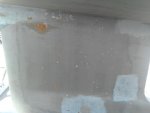
1. There is a thin (1 mm) and hard line going all the way around the hull, parallel to the waterline. In some places it has a depth of 0.5 mm, in others just a trace of it. Actually looks less horrible than the photo. What is it and how do I treat it before Coppercoat goes on?

20210502_111452_low.jpg

2. Keel has lots of thin cracks without particular direction. Is it just old copper cracks? Why did it happen? I guess should be filled like the above?

20210502_112445_low.jpg

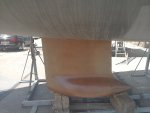
3. Seacocks have very little old sealant left around them. Do I just remove leftovers and seal again? Or shall I invest much more time and replace the seacock just in case? (unknown age)

20210502_112522_low.jpg

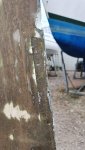
4. My rudder was 'fixed' by someone in the past - a piece of wood was inserted. Do I need to glass it in before I cover it with anything else? And ideally I need to make good damage above it.
20210502_112025_low.jpg

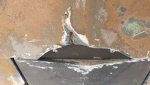
5. Similar story here, some damage around the hole for outboard engine. Fill and glass fibre?
20210502_112002_low.jpg

6. What do I do with some leftover rust on the keel? It was sanded flush in most cases, but sometimes rust forms small cavities. How do I treat it?

20210502_111644_low.jpg

7. The last one. I had a lot of dot-like cavities on the hull in old eroding antifoul. Almost none of them left. Do I need to fill in the remaining? They are mostly hair depth. Also, a few slightly bigger ( 1 cm diameter) uneven patches, but their depth is again just a hair.

 

Attachments

  • 20210502_111452_low.jpg
    20210502_111452_low.jpg
    507.5 KB · Views: 3
Lot more work to do before good enough for Coppercoat. Fill the cracks and that gouge with an epoxy filler such as International Watertite and fair. If you are going to replace the skin fittings, remove them (grinding the flange off is easiest) and fit new ones after Coppercoat. The keel does not look anywhere near suitable for Coppercoat. Getting it to stick to iron is not easy and only sure way is to blast, immediately epoxy and then Coppercoat. The rudder needs epoxy coating over the repairs.

Suspect that the whole hull would benefit from epoxy coating before Coppercoat, but suggest you ask AMC for advice.
 
Coppercoat is like a paint & is not a filler. When I did my boat it was sand ( not soda) blasted so the operator did not go too hard on it leaving some thin patches of antifoul paint on the hull. The manufacturer said that my hull should look like a" sheet of A4 paper" so i spent some time sanding the patches off..
I confess that did a poor job of properly priming the keel ( insufficient primer coats) & this has meant cutting out & re priming & patch repairs & later a total re coat of the keel. I suggest that any rust spots need cleaning & several coats of preventive primer prior to coating.
Without being disrespectful, i would suggest that your hull needs considerably more attention to removal of old paint & to filling & fairing of voids etc.You are spending a lot of time & effort, you may as well go the extra mile & do it properly :)
 
Last edited:
As others have suggested. A lot of work needed to get anywhere near ready for Coppercoat.
Once you have the hull filled and faired, an application of at least one barrier coat of epoxy would be sensible. The Coppercoat seems to adhere well to a moisture free hull. Moisture can be a problem if you have a wet hull ( high moisture readings). It is also a problem if you apply it to a hull with condensation on it. Either of these scenarios will lead to blistered Coppercoat at a later date.
If you can apply an epoxy barrier coat one day then follow on with Coppercoat the next day, you may benefit from a chemical bond between the different epoxies. I am not certain of this but our Coppercoat was done like this in winter, outside, and we have never had a blistering problem.
 
Re the condensation-- i did not get blistering , but the first application failed miserably. The manufacturer stated that I had done it when there was a lot of moisture in the air at night after I had finished applying. Evident from some streaks on the surface. In the end they supplied enough to re coat the boat at a discounted cost & i had to overcoat the whole lot again. One needs to be sure of a good temperature & have good sheeting all round the boat. i used correx sheets taped to the hull above the waterline the second time.
Still does not work, as we all know. However, I launch at easter, sail for half a season, Have the boat lifted & jet washed then put back in the water until November when it is lifted & washed & laid up for the winter.
I reckon that the £ 120-140 for the mid season jet wash ( & prop anode change) is far better than the cost & hassle of antifouling each year which always makes me ill & is a miss use of my time anyway. At least i get a clean hull for some of the time.
 
Many said that the boat is nowhere near ready for coppercoat - not offense taken at all, happy to take advice! As I said, I'm not very experienced at this yet.

So following the advice above and own thought, my actions will be the following (and do correct me please!):

1. Speak to Coppercoat (waiting for reply already)
2. Get rid of remaining rust (wire brush on a drill?), future proof old damaged places (a piece of fiberglass sheet on top of older wooden inserts), use epoxy filler to fill any imperfections
3. Using some flexible sealant where keel attaches to the hull (there is a visible line - externally only - with a bit of rust currently)
4. Sand and wash latest repairs. Let the surface dry.
5. Measure moisture. What readings are acceptable? My boat is 40 year old and did not have fantastic readings when I bought 2 years ago (survey called them acceptable). But it is on the hard since November.
6. Two layers of epoxy barrier coating. Coppercoat has earlier adviced that I can lay new copper over the old one if I use 2 layers of their pure resin in between - is it instead of a barrier coat or in addition?
7. Now is time for Coppercoat
 
I would be very wary of applying Coppercoat to the keel, even if you do manage to clean out the rust. I had my iron keel Coppercoated from new with very careful grinding as preparation. First repairs were needed after only 2 years and second 4 years. Last year (year5) blasted back and started all over again. Before and after in

photos. Lifted a couple of weeks ago andIMG_20200623_150038.jpgIMG_20200605_180124.jpg
so far so good.

I think you will be doing repairs every year as the rust comes back through. This is not easy or cheap and in my view better to use conventional AF for the keel.
 
Many said that the boat is nowhere near ready for coppercoat - not offense taken at all, happy to take advice! As I said, I'm not very experienced at this yet.


2. Get rid of remaining rust (wire brush on a drill?), future proof old damaged places (a piece of fiberglass sheet on top of older wooden inserts), use epoxy filler to fill any imperfections
A wire brush will be inadequate; it will a) polish the rust and b) embed particles of the brush in the iron. The ideal is grit blasting, followed IMMEDIATELY by epoxy coating. Even that will not be perfect; as others have said, applying Coppercoat to a cast-iron keel is difficult and likely to have flaws. The problem is that cast iron is highly likely to have inclusions of all sorts - slag, oxides etc., and only grit blasting will remove these - though you may be alarmed to see the state of your keel after blasting! Even grit blasting doesn't guarantee the removal of such inclusion, but it will do a better job than anything else. But if you don't remove as many such inclusions as possible - followed by fairing with thickened epoxy - they'll just form nuclei for rusting and damage to the coating.
 
Honesty, I've never seen a boat with copper on the hull and regular antifoul on the keel. I understand the concern about the keel, but in this case, I'd question the purpose of using Coppercoat at all then. Do only people with perfect new boats use it? Maybe I should just fair the hull, put a couple of barrier layers and then use regular hard antifoul?
 
The keel issue is not a problem with Coppercoat per se, but a problem with iron keels. They often rust, even after grit blasting and epoxy. I’ve found you just need to keep on top of it by grinding back the worst bits, using rust converter and epoxying every season or two. It’s quite common not to bother with Coppercoat on iron keels as a result.
 
Honesty, I've never seen a boat with copper on the hull and regular antifoul on the keel. I understand the concern about the keel, but in this case, I'd question the purpose of using Coppercoat at all then. Do only people with perfect new boats use it? Maybe I should just fair the hull, put a couple of barrier layers and then use regular hard antifoul?
The choice is yours. I had a long discussion with the Coppercoat people at the Southampton Boat Show several years ago. Yes it is a product designed for DIY preparation, but the conclusion I came to was there are far more experienced people who apply it to >10 hulls a year how will do it far better than me.

In the end I took the boat down to Mylor on the Fal as they have a shed for doing the work. Thus there was no chance that moisture would get anywhere need the hull during the process and I had it done in July to ensure a higher ambient temperature. I am convinced the secret in the process is good hull preparation and a controlled environment during application.

Considering that the boat is afloat and has hardly moved since Lockdown I there is little fouling. I'm being lifted at the end of the month for a pressure wash, anode change and sort out a problem with a through hull and she will be as good as new.
 
The choice is yours. I had a long discussion with the Coppercoat people at the Southampton Boat Show several years ago. Yes it is a product designed for DIY preparation, but the conclusion I came to was there are far more experienced people who apply it to >10 hulls a year how will do it far better than me.

In the end I took the boat down to Mylor on the Fal as they have a shed for doing the work. Thus there was no chance that moisture would get anywhere need the hull during the process and I had it done in July to ensure a higher ambient temperature. I am convinced the secret in the process is good hull preparation and a controlled environment during application.

Considering that the boat is afloat and has hardly moved since Lockdown I there is little fouling. I'm being lifted at the end of the month for a pressure wash, anode change and sort out a problem with a through hull and she will be as good as new.
I did it myself, and providing you follow the instructions, especially regarding preparation, it isn't that difficult. I had the hull prepared professionally, though. Also, depending on the size of the boat, you need a minimum of two people to apply the Coppercoat and one to mix it. But mixing it is a full-time job; the copper can fall out of suspension very easily.
 
The keel issue is not a problem with Coppercoat per se, but a problem with iron keels. They often rust, even after grit blasting and epoxy. I’ve found you just need to keep on top of it by grinding back the worst bits, using rust converter and epoxying every season or two. It’s quite common not to bother with Coppercoat on iron keels as a result.
If I have to do grinding and antifouling to keel, then it makes little sense to overpay for Coppercoat. I liked the idea of simply pressure washing 1-2 times per year, but if it's not like that because of the keel - I might be better off with regular antifoul.
 
My boat is under 30ft and I'm not afraid of getting my hands dirty. My only concerns - lack of experience with copper, and now another one - doubt about keel rust.
 
I had my boat professionally Coppercoated six years ago. A jet wash once a year is all it needs. They advised against doing the cast iron keel as it wouldn’t last. All that got last year was a jet wash as there was almost no rust and the AF was still good. This year I shall come out for a couple of days, whizz off any rust with a flap wheel, prime and AF. Perhaps go over the copper with a scrub pad. It’s been worth the money, much of which has been saved on lift outs And AF let alone my back ache.
 
Coppercoaat is definitely worth doing IF you are going to keep the boat a reasonable time as you can avoid annual liftouts ashore. That was the reason I had my new boat done in 2015 - at a cost of more than £4k. I intend to keep it 10 years, plus at my time of life I don't want to be antifouling every year. As you can see partially successful and fortunately our club haulouts are cheap compared with commercial rates so I have had her out 4 times in nearly 6 years, two of which were to try and repair the keel.

Bit the bullet last year and had the keel blasted and did the epoxy (apart from the first coat) and the Coppercoat myself. Total cost about £600 for blasting and materials. Confident it has worked and I can go back to my original plan of just a lift and powerwash once a year.

Back to your situation. The secret is all in the preparation and with an iron keel I would not even try without having it blasted - I am not alone with my experience. Many boats do end up with Coppercoat hull and conventional on the keel because of the failures. It is much easier to deal with the inevitable rust patches as required with conventional coatings and you still get the benefits (for most situations) of less fouling and easy cleaning on the hull. On your boat there is little difference in the preparation from where you are now for either conventional or Coppercoat and the extra cost of the materials will pay for itself in 3-4 years. It is not difficult to coat a relatively small hull like yours with 2 people and a nice warm dry day - I did my keel on my own.
 
Top