How much of an operation is it to get the mast up and down on the average 20 foot or so sailing boat?

Getting the mast forward to stow either for towing on the road or simply to stow ina safe manner is quite a problem. More so than just lowering mast for bridges. I fitted a roller to the aft "crutch" support to make it easier to slide mast forward but this was of limited success as shrouds got in the way./ (fractional rig) with shrouds 3/4 height. My mast of course is a lot lighter and I do have helpers.
I have been involved helping others with mast stowage and yes mast can be quite heavy for several people to lift it forward.
If you want to do it yourself. Seems like an A frame as used to lower the mast if stayed fore and aft could be used to lift the middle of the mast. (once it is down into the crutch) If you then allow A frame to slope forward it would take the mast with it. (perhaps 1.5m) Lower the mast to deck then take another bite at lift point. Would take a bit of juggling and a lot of fore thought to do it single handed. Not too easy with bad back. But keep on planning. Something to do over winter. ol'will
 
My mast needs to be lifted clear of the aft crutch - as the spreaders sit outboard of it. They need to be lifted high enough to pass over the crutch.

I've tried working out if the A frame with an extra line creating a bridle could stay in its lowering position to bring mast fwd .... but the angles and probably forces / moments incurred are probably too much. The A frame will need to be moved aft at least 50% of the ideal distance.
Because actually lifting and moving mast along boat for stowage or to shore is primarily a Home based affair - I am looking into having a 'derrick' or similar construction installed on the channel bank. I already have a second heavy grade steel tube I can rig as a derrick boom. It needs a base and guy anchor points bedded into the ground.
 
My mast needs to be lifted clear of the aft crutch - as the spreaders sit outboard of it. They need to be lifted high enough to pass over the crutch.

I've tried working out if the A frame with an extra line creating a bridle could stay in its lowering position to bring mast fwd .... but the angles and probably forces / moments incurred are probably too much. The A frame will need to be moved aft at least 50% of the ideal distance.
Because actually lifting and moving mast along boat for stowage or to shore is primarily a Home based affair - I am looking into having a 'derrick' or similar construction installed on the channel bank. I already have a second heavy grade steel tube I can rig as a derrick boom. It needs a base and guy anchor points bedded into the ground.

Hi All again. ?
I have fitted a roller to my rear targa bar which when the mast is lowered onto it is still above my spreaders. Despite being a fairly heavy section 30 foot mast it is just easy to pull the pin on the mast base connection and lift the mast base rolling it towards the bow on this rear mounted roller to sit the base on a padded timber support I made spanning my pulpit.
Given then the around 8.5meter gap between the rear targa bar roller support and the pulpit support and I have also made a central support and cradle that plugs into the mast base and supports the mast roughly in the middle.
The spreaders then each tie down to the top lifelines around a stanchion further stabilising the mast which is also neatly up against the length of the baby stays precluding it sliding forward in heavy braking or a collision.
The two primary side stays each side also remain attached and lightly folded and secured back onto the mast. As the lower sections of these are encased in a plastic tubes they don’t scratch the gel coat.
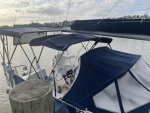
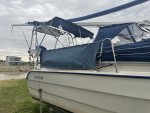
The whole supported mast just clears my Dodger and Bimini allowing these to still be used when the yacht is on land and performing its role as a caravan between cruising destinations.
Many thanks to Imexus for part of the systems described (along with the fabulous built in A Frame mast raising system) the rest being the result of many years playing these games over now 14 previous trailer sailers! ( yes I am a glutton for punishment!)
Photos below show the targa bar roller with catch guides and then the lowered mast clearing Dodger and Bimini.
The back stay crane sits neatly up against the back edge of the solar panel when this is in it’s locked horizontal position and the mast is moved forward for the base to rest on the bow pulpit support.
C0446118-800C-4890-B12C-D80C1BB3FC2B.jpeg3D4B0FA5-631E-48A9-8D9E-3A123E49E149.jpeg
 
Nice videos The Q What a devil of a bridge so low. I could not see any form of A frame or gin pole on forestay to ease the lowering and raising of the masts. Do they really just do it with muscle power ? The last lowering was a thing of beauty just in the nick of time. Incidentally paddling the boats is very laborious compared to rowing with a rowlock from cockpit. ol'will
 
I found the easiest way to propel a boat through the bridge was to use a quant pole, we had a 2 section one, which we could put away under the foredeck, the waters only about 4 to 5 foot deep there.
The problem with rowing is if there is a boat going through with you or against you there's nowhere for your oars, you need the "verticalness" of a paddle. The bridge is approximately 6ft high in the middle and 20ft wide at water level.

I've sailed several different boats in that race .
The Yare and Bure one design has a tabernacle with the mast foot swinging up through the fore deck, that doesn't need lead on the bottom of the mast, but the larger broads cruisers do have a substantial counter weight fitted.
The Yeoman has a tabernacle fitted on top of its "dome" , I've sailed a Yeoman in that race with an A frame and without. The A frame certainly made it easier though it too had to be lowered to get under potter bridge.

Although not shown on those videos. If there's a method of lowering your mast some one will have tried it. At another bridge on the course, at Acle, it's around 12ft high and 50ft wide. Smaller boats used to capsize ish and then right themselves with all sail up, to keep going.. bailing furiously afterwards. until that got banned as they didn't want wet crews out all night....

The 3 Rivers Race is 50miles on tidal waters and you have 24hours from your start time to do your choice of route round the 4 turning points. The record is around 8 hours, the worst year only 13 boats finished. Around 100 boats normally enter , from 14ft to 40 ft... One river is only 50ft wide, which is interesting tacking in a 40ft boat.
 
Last edited:
Top