How much anchor chain?

Take two Sigma33s.
Sail upwind in choppy water.
Put 50kg on the bow of one of them.
See the difference.

Unfortunately, I'm not in a position to do that.

What exactly is the difference? Is it speed? motion through the chop? What are the advantages/disadvantages relating to cruising?

Genuine questions to anyone who can answer them.
 
Very strange statement. As the shackle is free to swivel so the pull is in line with the chain, and as the anchor - with a considerably bigger cross-section than the shackle - has already penetrated the seabed, I fail to see any realistic circumstances where the shackle cold lie anything but in line with the rest of the chain once any moderate pull comes on it.

If you have evidence to the contrary I would be very curious to see it.

- W

Having anchored many times in Solent and dried out ... I can with total conviction state clearly that line of pull of the rode has 'naff-all' to do with angle of orientation of shackle .... shackles are designed to allow a non rigid connection ...

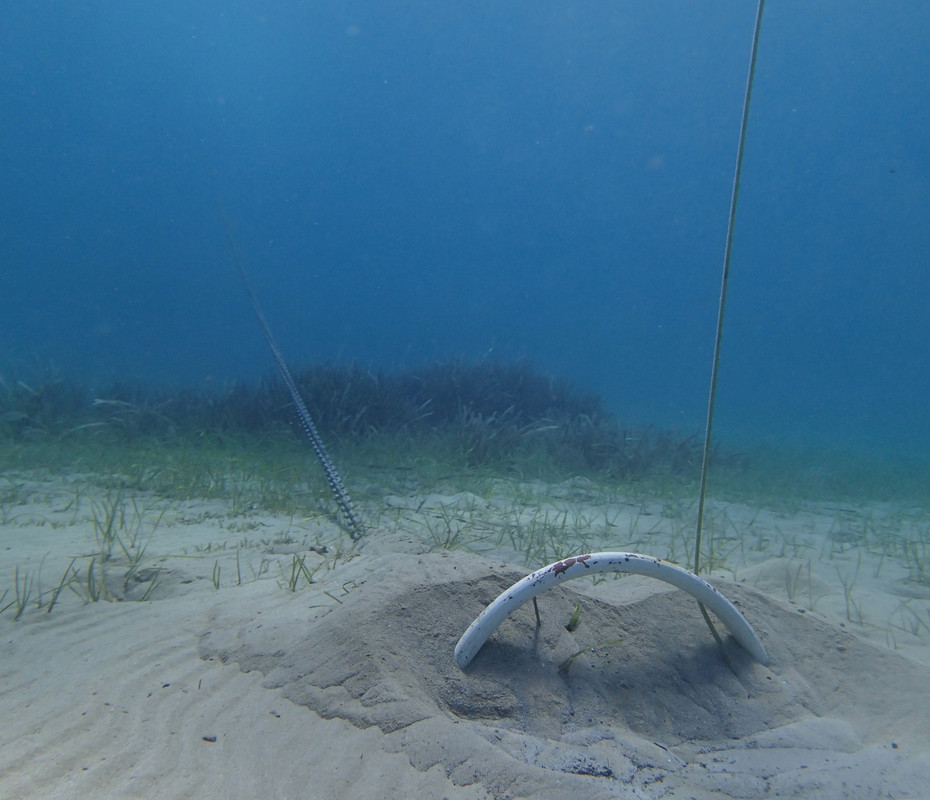
Just to prove that I did dry out ... here's SA at Priory Bay in Solent ... you can see the anchor and the chain laid out beneath .. It also illustrates nicely the chain and how its in a curve - even though the boat was actually moving quite a lot as she approached settling ...

 
Having anchored many times in Solent and dried out ... I can with total conviction state clearly that line of pull of the rode has 'naff-all' to do with angle of orientation of shackle .... shackles are designed to allow a non rigid connection ...

Just to prove that I did dry out ... here's SA at Priory Bay in Solent ... you can see the anchor and the chain laid out beneath .. It also illustrates nicely the chain and how its in a curve - even though the boat was actually moving quite a lot as she approached settling ...


This discussion feels like some sort of time warp! I thought we had finished with catenary as a valid means of rode elasticity more than five years ago. Here is a photo of my Rocna with 8 mm chain in wind of around force 6. The scope here is about 4:1 but I have witnessed all the almost-straight chain off the bottom with a scope of 10:1 in similar winds. That was in rather exceptional conditions, very shallow water with less than half a metre under the keel but I have watched exactly the same situation many times with a wide variety of scopes and depths.

 
This discussion feels like some sort of time warp! I thought we had finished with catenary as a valid means of rode elasticity more than five years ago. Here is a photo of my Rocna with 8 mm chain in wind of around force 6. The scope here is about 4:1 but I have witnessed all the almost-straight chain off the bottom with a scope of 10:1 in similar winds. That was in rather exceptional conditions, very shallow water with less than half a metre under the keel but I have watched exactly the same situation many times with a wide variety of scopes and depths.


How are you defining "almost straight"? Obviously if you are anchored in such shallow water that there's less than half a metre under the keel, there is very little opportunity (I nearly said scope) for a useful catenary. If you anchor in a reasonable depth, say more than five metres at LW, and you have a decent size of chain, relative to size of boat, your chain will develop a useful catenary. There are only two ways to achieve a straight chain. One is having it lying on the ground, the only other way is to have it vertical.
 
How are you defining "almost straight"? Obviously if you are anchored in such shallow water that there's less than half a metre under the keel, there is very little opportunity (I nearly said scope) for a useful catenary. If you anchor in a reasonable depth, say more than five metres at LW, and you have a decent size of chain, relative to size of boat, your chain will develop a useful catenary. There are only two ways to achieve a straight chain. One is having it lying on the ground, the only other way is to have it vertical.

The photo was taken in 5 metres of water with a scope of around 4:1. The chain looks pretty straight to me and I think even you will agree that none of it is on the bottom. No doubt you have seen Peter Smith's photos taken at anchor in South Georgia (I think) with his 12 mm chain just about perfectly straight in a lot of wind.
 
Welcome to the forum, Sprout.

The composition of the rode is heavily dependent on the cruising area you wish to visit and understandably you have probably not decided this yet.

In your home waters very minimal chain and a short rope rode is needed, but you have some wonderful cruising grounds not too far away so anchoring gear that was a little more versatile would be wise.

8mm chain is normally recommended for your boat size. There are a number of tables that are all in general agreement. There is an alternative view point that since chain breakages are very rare, perhaps these traditional recommendations have been too conservative, suggesting 6mm chain would be fine. Only time will tell if these suggestions are appropriate.

Forces on the anchor rode differ widely depending upon whom you believe. The ABYC guidelines suggest for a 30 foot boat in 50 knots of wind the load would be 900kg. The ABYC figures are widely thought to be representing the very worst case with some wave action etc. An alternative widely adopted formula was proposed by the late Professor Knox. A 30 foot yacht in 50 knots would experience a force of 418 kg according to his formula (kg of force is not an ideal unit, but is understood better than N m).

6mm Grade 30 chain has a SWL of about 400kg and grade 40 about 675 kg. If you plan on anchoring frequently, like most others that have posted in this thread I would recommend 8mm chain. The exception is if you purchase grade 70 where 6mm would be fine from a strength point of view. Grade 70 chain has some problems though, and 6mm galvanised grade 70 (or higher) is very difficult to obtain, usually requiring arranging the galvanising separately.

In terms of length of chain, while little is needed for your home cruising ground, as you have abitions to anchor further afield, particularly places such as Norway I would start with around 40-50m. As you are accustomed to sailing performance without any chain it should be easy to assess the impact. If this proves to be a little too heavy (40m of 8mm chain weighs 56kg) it easy to shorten. The extra chain will always be useful. As well as the chain, around 30m of octoplait should be carried.

I would also give some thought to your anchor. The Danforth is excellent in soft substrates and will have high holding power in your home ground. However, it does not “shuffle” or respond to a change in the direction of force as well as other designs and its performance in hard and weedy substrates is poor. Modern designs such as the Mantus M1 (which gets my vote for the best general primary anchor), Rocna and steel Spade are all good choices.

Good luck.
 
'Just about perfectly straight' is perfectly meaningless.
Here is a calculator I found:
http://abc-moorings.weebly.com/catenary-calculator.html

It suggests to me that catenary is often significant in everyday mooring situations.
The curved section of chain is significantly longer than the straight line for sensible values, which shows that the ship can move back in response to an increase in wind or wave force.
In a dynamic situation, the catenary will therefore be smoothing out the forces to some extent.
 
'Just about perfectly straight' is perfectly meaningless.
Here is a calculator I found:
http://abc-moorings.weebly.com/catenary-calculator.html

It suggests to me that catenary is often significant in everyday mooring situations.
The curved section of chain is significantly longer than the straight line for sensible values, which shows that the ship can move back in response to an increase in wind or wave force.
In a dynamic situation, the catenary will therefore be smoothing out the forces to some extent.

I don't think Peter Smith was going to jump overboard with his straight edge. He says, and I agree, that it looks straight.
 
Just a point of accuracy

The tension on the anchor is not dictated by the scope but by the angle of orientation of the shackle. The shackle angle is dictated by the burial depth of the anchor and the shear strength of the seabed. The shackle angle has little to do with scope.

Now that should raise a few comments :)

Jonathan

I agree with your statement. However, the bit that says: "The shackle angle is dictated by the burial depth of the anchor and the shear strength of the seabed" is correct in theory, but in practice, the shackle will quickly align in the direction of the chain. There will be instances where the boat swings around and therefore the chain is not in line with the anchor/ shackle and the sum of forces may not be equal to zero to provide an equilibrium but that's another story.
 
I don't think Peter Smith was going to jump overboard with his straight edge. He says, and I agree, that it looks straight.

How it looks is not very relevant.
Straight things can look curved when photographed on land, let alone under water.
If you want to buy an anchor off the back of some crass simplifications, fill yer boots.
 
How it looks is not very relevant.
Straight things can look curved when photographed on land, let alone under water.
If you want to buy an anchor off the back of some crass simplifications, fill yer boots.

Have you looked at the maths and understood what it is telling you? Catenary believers have a special evidence free faith so you are in good company.
 
Unfortunately, I'm not in a position to do that.

What exactly is the difference? Is it speed? motion through the chop? What are the advantages/disadvantages relating to cruising?

Genuine questions to anyone who can answer them.
Weight in the bow is, in waves,
Noticeably, horribly uncompetitively slow.
Whether that matters for cruising is a matter of opinion, we all make compromises.
I prefer a rope rode as I didn't marry a weightlifter.

I'm very happy to push the buttons for the windlass on other people's boats.
 
Have you looked at the maths and understood what it is telling you? Catenary believers have a special evidence free faith so you are in good company.

Yes I'm reasonably familiar with the maths, have a look at the online calculator I posted a link to.
ISTR seeing a better one which directly varied the things we are interested in, but I couldn't immediately find it earlier.

For yachts, it's a gross simplification because yachts are often not hugely bigger than the waves they anchor in, real life is dynamic not static.
A few weeks ago I was stand on a beach looking at a small yacht anchored in some incoming swell. Might have been a Centaur? waves about 2ft peak to trough?
It was moving around a lot, but wasn't dragging as far as i could see.
I don't know exactly what the windspeed would have been, but OK for me to sail a Laser, but I'd not be surprised to have a swim or two. Maybe that's F4-F5 in metric?
It occurred to me that it was perhaps the kind of anchoring where we might need to understand whether it will work, but way harder to analyse in a useful way than any steady state constant wind stuff in still water.
Lots of stuff going on.
Rode stretching with each wave.
Rode deflected by wave action.
Boat moving up/down and forward/back.
Wind and gusts not in line with waves.

Analyse that and I'll be impressed!
 
Unfortunately, I'm not in a position to do that.

What exactly is the difference? Is it speed? motion through the chop? What are the advantages/disadvantages relating to cruising?

Genuine questions to anyone who can answer them.

FWIW, on my IOR-based 40ft I went from 30m of 10mm chain to 70m (roughly near 100kg increase), I lost an average of one half knot (difference averaged on significant thousands of miles) and the boat appeared wetter (a lot more difficult to quantify). Would I do that again, for my type of cruising yes no doubt.
Ceteris paribus, the same added anchor chain weight on say a J-boat would probably "kill" it, on a Hans Christian/Island Packet would possibly go unnoticed.
 
Very strange statement. As the shackle is free to swivel so the pull is in line with the chain, and as the anchor - with a considerably bigger cross-section than the shackle - has already penetrated the seabed, I fail to see any realistic circumstances where the shackle cold lie anything but in line with the rest of the chain once any moderate pull comes on it.

If you have evidence to the contrary I would be very curious to see it.

- W

I do note a comment was also made slightly later in the thread.

When a, most, modern anchor sets, Spade, Rocna, Supreme, Excel (aluminium or steel) The toe and shackle point bury at about the same time and at the same rate. When the anchor is about to disappear the toe and shackle are at a similar depth. Consequently the shackle is buried quite deeply and puts down some chain at the same time. It is common, if you mark your chain to allow the measurements, to bury 2m of chain.

Seabed poses an impediment to burial, it has shear strength, and this impediment increases with depth, by the square of depth. As the shackle is buried there are a number of conflicting forces, the anchor pulling it down, the seabed pushing it up and the tension in the rode. As the shear strength increases with depth those forces vary with time and an inverse catenarary develops causing the shackle to slowly rotate 'upwards' as the depth increases. The tension 'on the anchor' is dictated by the angle of the shackle, which can be quite high, say 30 degrees, even though the rode is flat on the seabed.

The phenoiman is well know - the US Navy and oil rig operators have a fomula to compute shackle angles - because it determines anchor performance. If you look at the Vryhof manual and check their images of set anchors - the rode is always depicted with a reverse catenary (a slightly upward curve - and that curve is at its most noticeable at the shackle). If you look at the Bruce website they actually make devices called boosters, sort of mini anchors attached to the rode, in an attempt to reverse the reverse catenary - they think it that important.

But the idea that scope determines the angle of the tension on the anchor is, wrong.

Fortunately many modern anchors perform perfectly satisfactorily with a high shackle angle, as evidenced by the lower frequency of dragging.

There exceptions to the shackle burying - the classic being Fortress and Danforth where the shackle buries last.

Now what happens with time - the anchor will continue to bury with increased tension - the deeper the anchor and more chain buried the better chance you have to resist yawing and hobby horsing (pitching). If the yacht is yawing violently - you will try to do something about it as wild yawing is uncomfortable. Now whether yawing and pitching totally remove the uplift of the shackle angle I don't know (and nor does anyone else) but if the yawing/pitching is sufficient to completely straighten the rode then your anchor will also be moving - and a moving anchor is hardly 'safe'. A moving anchor, constantly twitching, reduces the shear strength of the seabed within the seabed within which it is buried - and this means hold is reduced. As modern anchors do not drag, much, I suspect the twitching is low and the shackle angle remains high, though it may lower from a peak.

Coincidentally I have been measuring shackle angles during the last month - and I can confirm that the angle of a shackle for a freshly set anchor does NOT reflect the angles of the rode where it enters the seabed. So I'm not guessing, I'm not relying on gut feel - the technology of the US Navy et al - is similar to ours.

Jonathan

I might add - if you have a swivel (and I appreciate some people genuinely need a swivel (possibly most do not), large shackle, large chain - these will reduce the ability of any anchor to dive and bury deeply. Any impediment to allowing the anchor to dive will result in an increased angle of the shackle - reducing the ability of the anchor to perform to its maximum effectiveness.

None of these actions weight in the bow, smaller shackle (of the required strength) absence of a swivel - by themselves will make a noticeable difference - cumulatively you will notice. Its part of a philosophy - if you can - keep weight out of the ends, minimise the 'size' of your rode, use an anchor that is most effective in that seabed......, keep your chain clean and dry

Every little helps.
 
Last edited:
I don't bother with all these worries and calculations. I just chuck the anchor over and let the anchor do what anchors do. :D

But I do have adequate anchors and adequate chain, and a boat which isn't too concerned about an extra few kilos.
 
I don't bother with all these worries and calculations. I just chuck the anchor over and let the anchor do what anchors do. :D

But I do have adequate anchors and adequate chain, and a boat which isn't too concerned about an extra few kilos.

Norman - you demonstrate you know what you are doing and have a 'track record' (sailing in Scotland's Outer Isles) to support your practice. I'm actually sure you don't simply 'chuck' your anchor and don't check etc etc.

However people do simply chuck their anchor off the bow - and disappear (presumably to have a glass of a relaxant). I see this happen, they don't appear to check - and then I am sure they wonder why they drag. I try to ensure I'm not downwind of them (though where we go, like you, its unusual if there is anyone in the same anchorage.

Jonathan
 
On comparing ships to yachts - large bulk carriers queue up outside Newcastle (Australia) and anchor whilst waiting their turn to load coal to take to Asia for power stations. The vessels are large, or relatively so - they look VERY, large when you sail past and are of the 100,000t size.

As a result of a number of accidents (ships on beaches) they are all ordered off the anchorage and it is demanded they 'cruise' under power whenever the wind is forecast to be over 25 knots. If that very real fear for the integrity of the ground tackle (and many use modern anchors, AC14 with Classification Society approved chain sizes and length) were expressed for yachts - many of us would be unable to anchor at all in our chosen cruising grounds.

I see little comparison with the anchoring practices of commercial vessels and yachts.

Jonathan
 
Modern designs such as the Mantus M1 (which gets my vote for the best general primary anchor), Rocna and steel Spade are all good choices.

Good luck.

Perhaps you might like to qualify your support for your chosen anchor (and add some background, and pertinent information).

Rocna might recommend a 33kg anchor for your yacht but you have so much confidence in your choice that your anchor is 50kg - and maybe even bigger. Choosing a large anchor is very common - usually associated with use of a lighter chain, as advocated by Dashew - I don't recall your using a lighter chain.

You could also qualify your recommendation by mentioning that the anchor has never been tested for holding capacity (buyer beware) - either by the manufacturer (I wonder why?) nor independently.


The other anchors you mention, Spade and Rocna (not forgetting Supreme and Excel) have all been tested independently, for hold, and have been Proof Tested (which is indicative of manufacturing and design strength integrity).


Finally - both Peerless and Campbell (of America) make a galvanised G70 and it is available off the shelf, Peerless from stock in Germany and available in metric sizes. Gunnebo also make a galvanised G100 (something for you to check - and then quote - just recall where you red bout it :) ), freely available in Europe and internationally through Crosby and the international Gunnebo offices. I have been unable to define if the link size fits a common windlass gypsy - this may not be an issue for the OP if he retrieves by hand. There is no need to 'make your own 'high tensile' chain - plenty of choice.

Jonathan
 
Last edited:
FWIW, on my IOR-based 40ft I went from 30m of 10mm chain to 70m (roughly near 100kg increase), I lost an average of one half knot (difference averaged on significant thousands of miles) and the boat appeared wetter (a lot more difficult to quantify). Would I do that again, for my type of cruising yes no doubt.
Ceteris paribus, the same added anchor chain weight on say a J-boat would probably "kill" it, on a Hans Christian/Island Packet would possibly go unnoticed.

I have read that higher displacement to length ratios combined with higher hull curvature fore to aft (rocker) produces hulls that are more prone to hobbyhorsing (pitching) than boats with lower D/L ratios and flatter hulls - basically the difference between more traditional designs compared to modern flat hulls and fat sterns. Constant pitching would definately slow a boat down considerably, and I can understand that if you put weight in the ends of a boat prone to pitching this is a bad idea and would affect performance ...

However, what I have found is that my boat (a middle of the road 11,5m AWB from 1999 - a Bav36) has a tendency to slam rather than pitch - the wider stern resists pitching but the flat bow slams in the right conditions ... the slamming also affects performance, but it is remarkably reduced when the forward water tank (under the berths in the forward cabin) is full. This adds 150Kg of weight just behind where the bow meets the water (by modern standards my boat has a long overhang). Add to this the weight of 60m, 8mm chain, anchor and windlass and I normally have almost 270Kg sitting in the bows. I cruise under sail at 6-7 knots normally with roller furling main and genny, if I start going consistently over 7 knots, I reef because it is more comfortable.

My gut and my experience tells me that my boat sails better like this - slamming is reduced as the weight seems to help keep the bow down and cut through waves, pitching or hobbyhorsing is not something I've ever really experienced - laden or unladen.

I think hull design has a big influence on the effects felt by having more or less weight in the bows, and my personal experience is that my boat feels better with a bit of weight up front - it reduces slamming to almost nil and doesn't appear to slow my progress. Perhaps the accepted wisdom to avoid weight in the bow is not so significant in more modern hull designs?

I really don't know, would be interesting to hear others opinions. I know I will be keeping my anchor on the bows because it works for me and my boat.
 
Top