How good is your solar?

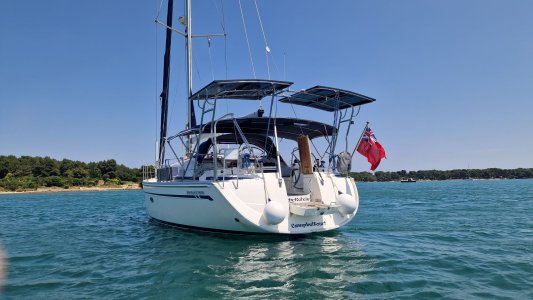
We have 900W on a stainless frame above the cockpit enclosure. Boat is all electric and runs off of the 3Kw Victron Multiplus inverter/charger on a permanent basis. Being based in the UK we're not quite self sufficient, even during the Summer, so the Multiplus is programmed to switch over to charge mode when the batteries are down to 50% SOC and then back to inverter mode at 60%, stops them (280Ah LFP @24V) from getting too low but leaves plenty of "space" for solar yield.

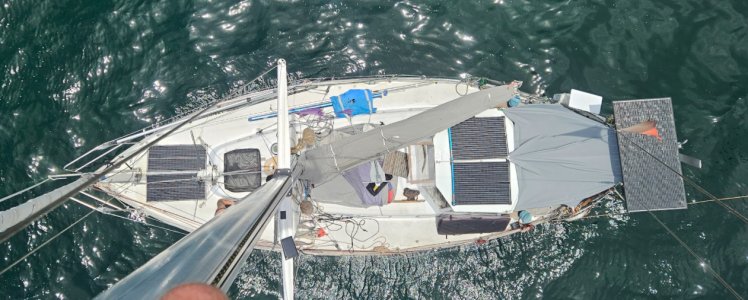
The panels are very discrete from ground level, but you can obviously see them from above.

WhatsApp Image 2025-09-09 at 21.19.14_6af00036.jpg
 
Previous boat- 39ft mono- had 1200w and 280Ah lithium. No alternator charging, no generator. This powered most of our cooking and other loads, but after a cloudy day we sometimes had to revert to gas cooking to let it catch up again.

Current boat has three brand new bifacial panels for a total of 1350w. The output is incredible. We've also increased our lithium to 550Ah. We basically don't have to think about power any more. We run about 300l of fridge space and a 3kva inverter which we don't generally bother turning off at night. Likewise the Starlink stays on permanently. Admittedly we're not running a high capacity watermaker, but I think we probably could, and still not run out of power.

We had a 2kw suitcase generator on the boat when we bought her- fired it up once to check it worked, then sold it.
There's a 400w wind gen on the back. That's coming off this winter, all it does it cast a shadow on the panels.

I've owned a few flexible panels and all have been utterly awful. They last maybe a couple of years before they start to delaminate, they start to corrode inside, and even on day one they don't seem to produce much power. Rigid is the way to go. The panels I'm using could be bought in the UK for a total of easily under £200. I sold the generator for double that.

I do now have rudimentary alternator charging at 18A via the smallest DC-DC I could find. I've used it a handful of times when were motoring anyway, but I wouldn't dream of ever running the engine just to charge the batteries. We still have the option of cooking on gas as a backup... I think we've resorted to that perhaps once, during a prolonged period of poor weather.

The current boat has never been connected to shore power since we launched it. We can't anyway, it's a 240v boat and we're in the US.

To say I'm a convert to solar/lithium would be a bit of an understatement. We're spending this winter back in our house and one of the projects on the list is to add solar, and possibly storage, there.
 
Previous boat- 39ft mono- had 1200w and 280Ah lithium. No alternator charging, no generator. This powered most of our cooking and other loads, but after a cloudy day we sometimes had to revert to gas cooking to let it catch up again.

Current boat has three brand new bifacial panels for a total of 1350w. The output is incredible. We've also increased our lithium to 550Ah. We basically don't have to think about power any more. We run about 300l of fridge space and a 3kva inverter which we don't generally bother turning off at night. Likewise the Starlink stays on permanently. Admittedly we're not running a high capacity watermaker, but I think we probably could, and still not run out of power.

We had a 2kw suitcase generator on the boat when we bought her- fired it up once to check it worked, then sold it.
There's a 400w wind gen on the back. That's coming off this winter, all it does it cast a shadow on the panels.

I've owned a few flexible panels and all have been utterly awful. They last maybe a couple of years before they start to delaminate, they start to corrode inside, and even on day one they don't seem to produce much power. Rigid is the way to go. The panels I'm using could be bought in the UK for a total of easily under £200. I sold the generator for double that.

I do now have rudimentary alternator charging at 18A via the smallest DC-DC I could find. I've used it a handful of times when were motoring anyway, but I wouldn't dream of ever running the engine just to charge the batteries. We still have the option of cooking on gas as a backup... I think we've resorted to that perhaps once, during a prolonged period of poor weather.

The current boat has never been connected to shore power since we launched it. We can't anyway, it's a 240v boat and we're in the US.

To say I'm a convert to solar/lithium would be a bit of an understatement. We're spending this winter back in our house and one of the projects on the list is to add solar, and possibly storage, there.
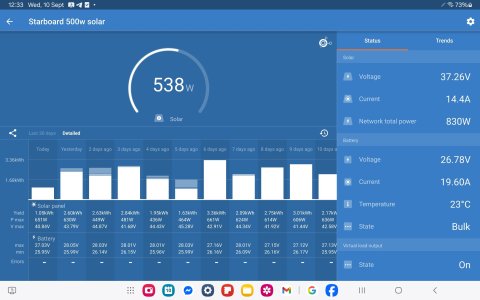
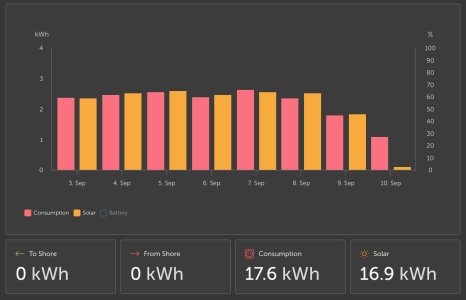
What sort of kWh are you harvesting? You have slightly more capacity than me but I would be interested to see how much the ability to tilt my bifacial panels compares to you horizontal bifacial panels. My 500w of bifacial on the port side has peaked at 3.22kWh in a day and the peak instantaneous output has been 603W in the last 30 days. The starboard 500W of tiltable bifacial panels have harvested 3.36kWh and peaked at 661W so pretty consistent. By comparison, my none bifacial horizontal panels see more shading being under the boom at anchor. These have a peak harvest of 1.24kWh and peaked instantaneous 263W
 
Last edited:
From cockpit, relatively discreet ... panels not visible unless sitting behind wheels and looking up.
20250618_070218.jpg

From outside, slightly more visible - fitted above the arch with the antennas, arch also provides dinghy davits and engine crane.

20250620_141906.jpg

The panels unfortunately had to be relatively high to allow the bimini to be folded back against the arch - after fitting the arch, I have'nt noticed any change in the boats handling or motion - if anything, she's a bit more directionally stable at anchor than she used to be. Being bifacial, I've seen instances where they have delivered well beyond their 315W rating.

Port and Starboard sides have 2 panels in series (630W) with a port and starboard MPPT - both MPPTs will be Victron SmartSolar 150/35 MMPTs which will shortly be feeding a 200Ah, 48V Lithium bank.
The MPPTs are specced such that if one dies, I can put both Port and Starboard strings in parallel through the remaining MPPT with no capacity loss. (35A @ 48V)
If a panel fails, I can put the remaining 3 panels in series through one MPPT.

I'm keeping the 540Ah 12V bank which will be charged from the Li bank via the MPPTs in the previous post. (Victron 100/30s) In total there will be 10,2 kWh of Li and 6,6kWh of LA. I've left the boat DC system at 12V as the electric winches, electric furling, windlass, bow thruster, and everything else DC is 12V.

After much discussion with various installers, and in the absence of a decent Victron 48-12V charger, I've been assured that the 100/30 MPPTs will be fine with a fused input from the 48V bank effectively being the solar panels. If they die, then so be it - I'll have to look for another solution.

To top it all off as a backup I am also fitting an Integrel E-Power 9 SE which should give the Lithium bank a big boost in the time it takes me to lift the anchor, motor off and get sailing. I am leaving the current 130A 12V alternator charging the 12V bank.

This whole project should have been completed by now, but alot of the parts are still sitting at home waiting for me to find time to fit them - next season should be well and truly off-grid though, even in marinas.
 
From cockpit, relatively discreet ... panels not visible unless sitting behind wheels and looking up.
View attachment 199199

From outside, slightly more visible - fitted above the arch with the antennas, arch also provides dinghy davits and engine crane.

View attachment 199200

The panels unfortunately had to be relatively high to allow the bimini to be folded back against the arch - after fitting the arch, I have'nt noticed any change in the boats handling or motion - if anything, she's a bit more directionally stable at anchor than she used to be. Being bifacial, I've seen instances where they have delivered well beyond their 315W rating.

Port and Starboard sides have 2 panels in series (630W) with a port and starboard MPPT - both MPPTs will be Victron SmartSolar 150/35 MMPTs which will shortly be feeding a 200Ah, 48V Lithium bank.
The MPPTs are specced such that if one dies, I can put both Port and Starboard strings in parallel through the remaining MPPT with no capacity loss. (35A @ 48V)
If a panel fails, I can put the remaining 3 panels in series through one MPPT.

I'm keeping the 540Ah 12V bank which will be charged from the Li bank via the MPPTs in the previous post. (Victron 100/30s) In total there will be 10,2 kWh of Li and 6,6kWh of LA. I've left the boat DC system at 12V as the electric winches, electric furling, windlass, bow thruster, and everything else DC is 12V.

After much discussion with various installers, and in the absence of a decent Victron 48-12V charger, I've been assured that the 100/30 MPPTs will be fine with a fused input from the 48V bank effectively being the solar panels. If they die, then so be it - I'll have to look for another solution.

To top it all off as a backup I am also fitting an Integrel E-Power 9 SE which should give the Lithium bank a big boost in the time it takes me to lift the anchor, motor off and get sailing. I am leaving the current 130A 12V alternator charging the 12V bank.

This whole project should have been completed by now, but alot of the parts are still sitting at home waiting for me to find time to fit them - next season should be well and truly off-grid though, even in marinas.
Why didn't you opt for 24v lithium batteries? Victron MPPTs would then be compatible, 24v solar is available. Lots of 24v equipment can also run off 24v such as LED lighting, fans, inverters, autopilot, etc
 
I bought a 36w panel a while ago for something over £500. It has worked perfectly well and has been useful, though it doesn’t quite keep up with the fridge. However, this works out at something over £15,000 per kilowatt. Is this a record?

That's cheered me up, our original 43w Kyocera framed panels were €250 each, about 17 years ago. I hear they're still working well on another boat.
 
What sort of kWh are you harvesting? You have slightly more capacity than me but I would be interested to see how much the ability to tilt my bifacial panels compares to you horizontal bifacial panels. My 500w of bifacial on the port side has peaked at 3.22kWh in a day and the peak instantaneous output has been 603W in the last 30 days. The starboard 500W of tiltable bifacial panels have harvested 3.36kWh and peaked at 661W so pretty consistent. By comparison, my none bifacial horizontal panels see more shading being under the boom at anchor. These have a peak harvest of 1.24kWh and peaked instantaneous 263W
I don't really keep an eye on it, sorry.
The other day we'd had some poor weather and SWMBO had done a bunch of cooking, so we were down to 38% by the morning. We were then off the boat for the whole of the next day, including dinner. Came home to full batteries. We harvested about 6 kWh total that day, but I don't know how much more we would have harvested if the batteries had been even lower.
That's the lowest the batteries have been in ages.
The highest yield in the past month was about 8.49kwh in a day for the three panels. We must have done a lot of cooking that day.
I think we're comparatively over-panelled in relation to our battery size. But panels are incredibly cheap and batteries aren't.
 
Why didn't you opt for 24v lithium batteries? Victron MPPTs would then be compatible, 24v solar is available. Lots of 24v equipment can also run off 24v such as LED lighting, fans, inverters, autopilot, etc
Integrel E-Power 9 SE is 48V and I wanted it. :ROFLMAO: :ROFLMAO: :ROFLMAO:

... I assume you meant 12V equipment can run off 24V? ... true, but with the existing, problem free 12V system I have, I decided not to touch a running system. When it comes up for replacement maybe.

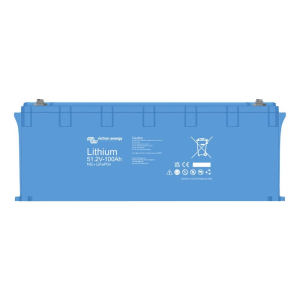
I basically ended up with a 48V alternator on steroids married to an existing and functional 12V system, having a third, 24V system didn't make a lot of sense to me - so 48V Lithium it is, in the guise of two of these in parallel
1757504107890.png
Redundancy again ... and before anyone tells me I could have built my own batteries for a fraction of the cost, I know, I could have, but I didn't want to, and I like the colour blue - it matches all the other electrical stuff. 😁
 
Last edited:
I don't really keep an eye on it, sorry.
The other day we'd had some poor weather and SWMBO had done a bunch of cooking, so we were down to 38% by the morning. We were then off the boat for the whole of the next day, including dinner. Came home to full batteries. We harvested about 6 kWh total that day, but I don't know how much more we would have harvested if the batteries had been even lower.
That's the lowest the batteries have been in ages.
The highest yield in the past month was about 8.49kwh in a day for the three panels. We must have done a lot of cooking that day.
I think we're comparatively over-panelled in relation to our battery size. But panels are incredibly cheap and batteries aren't.
It's in the history on each Victron mppt. You just click on 'detailed'. It gives you the last 30 days info
Screenshot_20250910_123358.jpg
 
At the risk of thread drift, my solar is currently feeding lead acid batteries, they love it, and spend most of their life on float.

I'm about to fit the Lithium bank and wire the solar to Lithium ... I am worried about the solar charging the Lithium to 100% and holding it there permanently when I'm not on the boat,

Questions are ....

Is that what the posters on this thread see from their systems?
Does being permanently charged to 100% shorten battery life?
Is there any way to stop charge at around 80% or even cycle between say 30% to 80%?

Not investigated myself yet, but would be good to have some pointers from the resident experts.
 
At the risk of thread drift, my solar is currently feeding lead acid batteries, they love it, and spend most of their life on float.

I'm about to fit the Lithium bank and wire the solar to Lithium ... I am worried about the solar charging the Lithium to 100% and holding it there permanently when I'm not on the boat,

Questions are ....

Is that what the posters on this thread see from their systems?
Does being permanently charged to 100% shorten battery life?
Is there any way to stop charge at around 80% or even cycle between say 30% to 80%?

Not investigated myself yet, but would be good to have some pointers from the resident experts.
Just set the bulk voltage down to 3.5v per cell. Start balancing at 3.45v per cell. Float at 3.35v per cell. If your battery has an active balancer, then a 5 min absorption period should be fine. If it's a passive balancer, you may need to experiment with longer absorption time.
We are living aboard so we set sufficient load such that we don't charge every day. There is no point in stressing the cells for no reason. If you are leaving the boat unattended, either turn off the solar or drop your bulk voltage to the float voltage.
if we leave the boat for a few days we just leave the panels vertical. If I was leaving it for a few weeks, I would discharge to circa 60% and turn off the solar
 
We have 1040W of solar on our 31ft double-ender. 740W of this is fixed:
  • 300W bifacial panel on the solar arch
  • 2x120W panels on the hard dodger
  • 2x100W panels on the foredeck, deployed on top of the dinghy when under way
IMG_1832.jpeg
In addition we have a 300W FLINsail that we can hoist up the mast:
IMG_1833.jpeg
For the rainy days we have a hydrogenerator on passage, and a rigging-suspended Superwind for while anchored.

Here in the tropics our typical daily yield is 2.5kWh from solar (and 0.6kWh from wind when it's windy). This is mostly limited by our capability to consume the power before chargers go to float.
IMG_1834.jpeg

At the moment we don't cook on electric, but plan is to get a bigger inverter from Colombia where Victron prices are good.

Big consumers are watermaker, fridge, Starlink. and the occasional recharging of our electric outboard, or running the dehumidifier. When we didn't have a fridge for three months (logistics here in the Caribbean sometimes!), we'd go to float typically at 10am. Now it's more like 1pm.

We get all of our electricity from renewables. The last time we ran the engine to make power was in Scotland over a year ago.
 
What sort of kWh are you harvesting? You have slightly more capacity than me but I would be interested to see how much the ability to tilt my bifacial panels compares to you horizontal bifacial panels.
As your results suggest, shading makes a huge difference to solar panel output. It is difficult to find shade free locations on a sailboat, but choosing locations as shade free as possible will produce a significantly higher output.

Locating solar panels in positions sometimes subject to shade will not do any harm; they will still produce some output, but you should significantly lower your expectations for the energy output.

The extra performance from tilting the panels is harder to quantify. On our previous yacht, the whole 380W solar array was tiltable in one axis over about 130°. The cruising yacht before this also had tiltable display (mounted on the guard rails and pulpit) . We found that the difference in output between adjusting the array to track the sun and leaving the array flat was overall only small. In areas away from the trade winds, the array needed frequent adjustments to compensate for wind changes at anchor, and there were times when the array angle was totally wrong, especially when leaving the boat for trips ashore.

It did provide more benefit in winter when the sun angles were lower, and these were the times when optimising the solar output was more important, so there was some advantage, but it was not great.

In the end, we concluded that installing a flat, slightly larger array was a better solution and this is what we have done for current boat. It removes the need to constantly change the solar panel angle and, more importantly, can be designed so that it can withstand any wind strength and wave impacts. It is difficult to engineer a tiltable display that can be left up in any strength wind or seastate. If it is parked in a stowed position the output will often be poor and this tends to be the times when the maximum output is desirable it also means you have to anticipate when conditions will require the solar panels to be put in their safe position.

Following this experience, we designed the solar array for the new boat to be in as shade free a location as possible but kept the panels flat. This has worked well.
 
Last edited:
As your results suggest, shading makes a huge difference to solar panel output. It is difficult to find shade free locations on a sailboat, but choosing locations as shade free as possible will produce significantly higher output.

Locating solar panels in positions sometimes subject to shade will not do any harm; they will still produce some output, but you should significantly lower your expectations for the energy output.

The extra performance from tilting the panels is harder to quantify. On our previous yacht, the whole 380W solar array was tiltable in one axis over about 130°. The cruising yacht before this also had tiltable display (mounted on the guard rails and pulpit) . We found that the difference in output between adjusting the array to track the sun and leaving the array flat was overall only small. In areas away from the trade winds, the array needed frequent adjustments to compensate for wind changes at anchor, and there were times when the array angle was totally wrong, especially when leaving the boat for trips ashore.

It did provide more benefit in winter when the sun angles were lower, and these were the times when optimising the solar output was more important, so there was some advantage, but it was not great.

In the end, we concluded that installing a flat, slightly larger array was a better solution and this is what we have done for current boat. It removes the need to constantly change the solar panel angle and, more importantly, can be designed so that it can withstand any wind strength and wave impacts. It is difficult to engineer a tiltable display that can be left up in any strength wind or seastate.

Following this experience, we designed the solar array for the new boat to be in as shade free a location as possible but kept the panels flat. This has worked well.
We are in the trades so boat is pointing the same way all day. The panels need minimal adjustment.
Being ketch rigged, fitting an arch is not an option I was willing to pursue. We have way more solar/lithium than we need so it works really well.
No gas onboard and I have to take long hot showers to use up some energy so we have something to load up the system with the next day😁
(220v watermaker and immersion heater)
Guardrail mounting the panels was the obvious choice if you don't want a solar arch. Tilting ability comes as part of the solution.
The 300w on the hardtop comes into its own when sailing. We could move the boom out of the way at anchor, but since we have a surplus of energy, there is no need. It all works well.
 
We have 180w permanently installed, with another two 50w panels, which are slung over the mizzen boom when at anchor. The system works well when the sun shines. The cold reality, here and now, on the West Coast of Scotland, is that the sun hasn't been seen for days. 😒
If we'd needed it, we could have collected plenty of rain water. 🙂
 
Top