HOW DO YOU SEE THE FUTURE OF leasure boating &fuel taxation due to climate change,from sailing

There are a lot of small craft with electric propulsion in the Netherlands, short distances, round town on the waterways etc. Day hire boats are most likely to be electric, and a lot of the tourist tour boats are now electric, we have been on a few in the Netherlands, after a couple of hours taking the tourists out on their joy rides they are plugged in to recharge so there is a constant turn over of boats in use and on charge.

There are some bigger cruisers of the 9m to 12m size they seem to be able to go for most of the day but do need plugged in, in the youtube channel Gone with the Wynns did a feature on them,
This was from a couple of weeks ago, at least it was not so busy for them, but when we were there in 2020 it was jam packed with electric boats and one or two with small outboards
 
I think the biggest threat will be a change to taxation on red diesel.

It’s such an easy target to raise more ££ quickly and effectively. Once that happens, the market will be forced to adapt to alternative propulsion methods.

Battery tech is getting better and cheaper and petrol power has a bad rep in boating due to the perceived additional cost to the owner. In reality, most leisure boats do less than 50 hours per engine run time, so the additional cost over a season isn’t that bad.

I ran a Mercruiser 350 on a nearly 3 tonne sports cruiser over 2 seasons inland and than coastal. We didn’t thrash it that much and did about 30 hrs when on the coast. We spent around £700 or so in fuel across that season. No doubt had I raced up and down the coast, the cost could have been much worse.

Getting to a nice spot, dropping the anchor and spending a few hours away from it all was perfect and at that cost, well worth it!
 
These two statements seem to contradict each other:
Once that happens, the market will be forced to adapt to alternative propulsion methods.
In reality, most leisure boats do less than 50 hours per engine run time, so the additional cost over a season isn’t that bad.
“Forced” would only make sense if the cost of switching to new tech exceeded the increased cost of fuel. Most people could double their fuel bill and still not make investing in alternatives a financially sensible option.
 
Surely emissions from pleasure boats are insignificant in the overall scheme of things.
Red Diesel for boats replaced by Red HVO would be an easy win from an emissions perspective if only the cost per litre was comparable.
 
Surely emissions from pleasure boats are insignificant in the overall scheme of things.
Red Diesel for boats replaced by Red HVO would be an easy win from an emissions perspective if only the cost per litre was comparable.
I suspect it is, but that will ruin the government and others narrative on rich boat owners, etc ruining the environment for their pleasure.
 
Surely emissions from pleasure boats are insignificant in the overall scheme of things.
Red Diesel for boats replaced by Red HVO would be an easy win from an emissions perspective if only the cost per litre was comparable.
If you read the papers in the links to the Department for Transport Call for Evidence, post #16, emissions from Small Craft (which is everything below 300GT) currently are a pretty small proportion of total emissions.
But once they have tackled the bigger sources, if nothing were to be done about Small Craft and everything else reduced, then the Small Craft emissions start to become disproportionately high and hence, they believe, something needs to be done.
 
DfT won’t do anything without running a consultation first, plus an economic assessment. This is what they do. The RYA and BMF will be in constant dialogue with DfT. They will share with us when there is something of substance to feedback.
The current DfT Call for Evidence is effectively the first part of that Consultation process. The RYA, British Marine the CA etc are aware and responding.
 
I can see this is an issue for larger boats, but for the typical outboard powered boat you can either use jerry cans or portable fuel tanks and buy cheap supermarket petrol.

I converted my inboard/outdrive petrol boat to use portable fuel tanks after the built in steel tank started rusting. This has the added advantage that no fuel is left on board when the boat isn't being used. No chance of the petrol going off either as I can just use it in my car if necessary.
A Williams takes 60 litres! Med fuel stations all have petrol.
 
Interesting discussion.

My home marina switched to white (taxed) diesel this year. Not that much price difference.

If I was looking for a future proof motorboat (and moving from sailing) then a displacement hull travelling at hull speed or less would use a fraction of the fuel costs for a planing hull. But journeys take longer limiting destinations.

The pressure will be on new boats to conform to increasing regulations and standards. Retrofitting modern standards to older boats would be a huge undertaking, first requiring a register of all owners and boats....

Perhaps the greatest challenge will be if marinas are forced to impose standards on bertholders.
 
Surely emissions from pleasure boats are insignificant in the overall scheme of things.
Red Diesel for boats replaced by Red HVO would be an easy win from an emissions perspective if only the cost per litre was comparable.

I think there will be big advances in the next decade in "sustainable" liquid fuel. Aviation is already doing a lot of work on SAF (sustainable aviation fuel) - F1 is going to sustainable fuel next season (IIRC). I suspect/hope that within a decade these will be widespread and of comparable price to what we currently spend on fossil fuels.

So we can hope our ICEs will be around for a very long time - even if they no longer burn fossil fuels
 
……

If I was looking for a future proof motorboat (and moving from sailing) then a displacement hull travelling at hull speed or less would use a fraction of the fuel costs for a planing hull. But journeys take longer limiting destinations.

……
I do think that displacement speed boats will have a big role to play.
But not sure they need to “limit destinations”. They tend to have longer range. And slow moving sailing yachts often cover massively longer voyages than planing power boats. It is a change of mindset and having patience to relax and enjoy the longer voyages than time.
 
I think there will be big advances in the next decade in "sustainable" liquid fuel. Aviation is already doing a lot of work on SAF (sustainable aviation fuel) - F1 is going to sustainable fuel next season (IIRC). I suspect/hope that within a decade these will be widespread and of comparable price to what we currently spend on fossil fuels.

So we can hope our ICEs will be around for a very long time - even if they no longer burn fossil fuels
At first I thought aviation are taking all the non fossil fuel leaving none for boats. But aviation could well support the growth of HVO or other non fossil liquid fuel production which can then be used in diesel engines. I am sure I read that Mr Diesel use peanut oil in his research so nothing new in using vegetable oil providing it is sustainable.
 
I do think that displacement speed boats will have a big role to play.
But not sure they need to “limit destinations”. They tend to have longer range. And slow moving sailing yachts often cover massively longer voyages than planing power boats. It is a change of mindset and having patience to relax and enjoy the longer voyages than time.
Agreed.

I meant the limitation imposed by, say, an hour's cruising radius from a home base. Not everyone will tolerate sailing speed passages. The proliferation in some areas of jetskis and powerboats will continue with existing or new power systems.

Is relaxing and taking longer to do things really the way the world is going? I see shorter attention spans and instant gratification. But I fully agree that the satisfaction of a full days journey, with tides planned, weather respected and a good destination, takes some beating.
 
I think the biggest threat will be a change to taxation on red diesel.

It’s such an easy target to raise more ££ quickly and effectively. Once that happens, the market will be forced to adapt to alternative propulsion methods.

Battery tech is getting better and cheaper and petrol power has a bad rep in boating due to the perceived additional cost to the owner. In reality, most leisure boats do less than 50 hours per engine run time, so the additional cost over a season isn’t that bad.

I ran a Mercruiser 350 on a nearly 3 tonne sports cruiser over 2 seasons inland and than coastal. We didn’t thrash it that much and did about 30 hrs when on the coast. We spent around £700 or so in fuel across that season. No doubt had I raced up and down the coast, the cost could have been much worse.

Getting to a nice spot, dropping the anchor and spending a few hours away from it all was perfect and at that cost, well worth it!
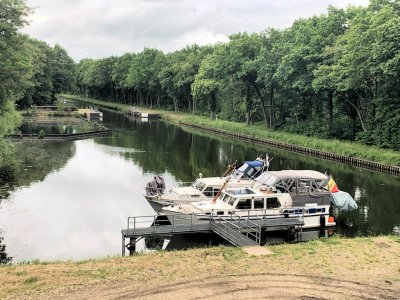
Not allowed to use red diesel in our leisure boats here, still at €1.20 (£1.04) per litre for white diesel it is not that expensive compared with road diesel, far more boats on the inland waterways here than you would think, and we are on a pretty much a back water at the Kanaal naar Beverlo.

So far this year we have put nearly 100 hours on the boat and travelled about 700km, 99.9% at displacement speed, this coming week will be doing a short run of about 30km - 35km with friends, and then following weekend we will be doing a round trip of at least 150km to an event, berths are booked for the haven and we will be in company of another 4 boats.
Our boat is semi displacement and quite economical to run at displacement speeds. finding unoccupied jetties along the canal and just chilling out.
IMG_2334asm.jpg
With friends from our club
 
At first I thought aviation are taking all the non fossil fuel leaving none for boats. But aviation could well support the growth of HVO or other non fossil liquid fuel production which can then be used in diesel engines. I am sure I read that Mr Diesel use peanut oil in his research so nothing new in using vegetable oil providing it is sustainable.
I think it will depend a lot of the technology. Bio fuel (HVO) is likely to require a lot of space to grow which will compete with food production, wildlife etc and that will limit the scalability of the solution.

Something more intensive that uses a more industrial process may be both cheaper and more scalable - but I don't think anything is beyond the early concept stage yet. (artificial photosynthesis or microbes)
 
Agreed.

I meant the limitation imposed by, say, an hour's cruising radius from a home base. Not everyone will tolerate sailing speed passages.
Interestingly there seems to be a slight increase in the number of performance sailing vessels - perhaps those in a hurry or seeking thrills will actually end up in sailing boats!
The proliferation in some areas of jetskis and powerboats will continue with existing or new power systems.
My gut feel is jetskis will move to electric. They benefit from the high acceleration, don’t usually get used for huge continuous periods (they guzzle too much petrol) and are taken out the water each day so home charging is viable. By reducing their noise impact (and playing a “no pollution card”) they might find they are more socially acceptable too!
Is relaxing and taking longer to do things really the way the world is going? I see shorter attention spans and instant gratification. But I fully agree that the satisfaction of a full days journey, with tides planned, weather respected and a good destination, takes some beating.
I don’t think it has to be one or the other. For a start without the roar of an engine a longer trip might not be so bad. And in the wider market there’s definitely plenty of talk of “midfulness” and escaping from the rush - so those who motorboat today may not welcome the switch but it might appeal to a new market.
 
Top