How common is it for boats to be unsinkable? ie. has built in floatation

The Anderson 26 also has built in buoyancy and is supposedly ' unsinkable ' - though I never heard of any tests to prove it, Andersons went bust very soon after the A26 was marketed, as they lost their main MOD business.

I have seen a few posts from people with various boats having problems with trapped water / condensation in double - hulled designs with closed cell polystyrene bouyancy, but I know someone slowly refitting an A26 to Rolls Royce standards, he hasn't found this problem and he's ultra fussy - quite nice to know as he designs nuclear power plants !

Your comment about loss of MOD business explains a lot, I often wondered why a company that produced such a well built and successful yacht went down. But to be honest I didn’t think the 26 was ad good a design.
 
I am always surprised that dedicated cruising monohulls, especially the premium brands do not make more use of watertight bulkheads and doors.

Amel are the only production boatbuilder that I am aware of that have done this.

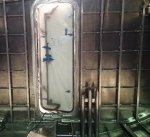
This is the watertight door on our Bestevaer during construction. With the separate lazerette and forward sail locker it gives us 5 separate sealed areas.
 

Attachments

  • 7EC33BCC-3914-4D52-A324-FC7B1B4BED50.jpg
    7EC33BCC-3914-4D52-A324-FC7B1B4BED50.jpg
    489.7 KB · Views: 1
I am always surprised that dedicated cruising monohulls, especially the premium brands do not make more use of watertight bulkheads and doors.

Amel are the only production boatbuilder that I am aware of that have done this.

This is the watertight door on our Bestevaer during construction. With the separate lazerette and forward sail locker it gives us 5 separate sealed areas.

There is something to be said for this. I vaguely remember that the service Victoria 34s had something like it. In the forecabin of my HR 34 I specified opening fronts for the underberth lockers, a listed option. I hadn't though about it but I was later told by the agent that this bulkhead was a collision-barrier but the opening doors would not allow more water to escape than I could easiy pump. I haven't tested it.
 
Before expanded polystyrene foam was invented, to make a boat more unsinkable people filled bags with Table Tennis Balls and stowed them away. If you were worried about a particular boat you could always go round with a modern foam gun and fill inaccessible places.
Yes, you could but extreme care is needed when doing this as excess foam will expand and damage or crack bulkheads.
 
My photo of a 34 above was the consequence of a collision with a ship. The Dorothy Hackforth, massively holed with a piece about a metre square torn from the port quarter. Subsequently repaired and I believe still afloat.

The really big benefit of foam filling is the insulation it provides. In winter in northern Europe we are almost totally condensation free.

That was repaired by the Sadler yard and sold on. Friends of mine bought her a few years later and cruised for many years including a trip round Ireland.
 
Re the statistical likelihood of a yacht sinking...
Just because something doesn't happen often doesn't mean that there is no merit in guarding against it. We don't question the provision of fire extinguishers in every public building, or insurance against various unlikely events.

It's pretty hard to ascertain how likely it is that a boat would end up relying on inherent buoyancy. But the Sadler 34 offers a data point: one incident known, out of 260 boats produced. So we're not talking 'hit by lightning' or lottery winning odds.

If you take the decision that an unsinkable boat doesn't require a liferaft (questionable of course, due to the risk of fire), then your foam-filled boat is saving you a few hundred pounds a year, which is not to be sniffed at.

The only real downsides would be the loss of storage and the possibility of structural problems down the line.
 
I am always surprised that dedicated cruising monohulls, especially the premium brands do not make more use of watertight bulkheads and doors.

Amel are the only production boatbuilder that I am aware of that have done this.

This is the watertight door on our Bestevaer during construction. With the separate lazerette and forward sail locker it gives us 5 separate sealed areas.

You're quite right; ever since I've had an Anderson 22 I have thought about a watertight door to the forepeak, which the design lends itself to; there is an A22 set up for the ' Jester ' which has this to a degree, but if I ever get around to it one winter it will be a serious job.
 
I never managed to fit a watertight door on my Invicta, but what I did do was create a set of washboards that could separate the for cabin from the main cabin. These wouldn't be watertight but would slow any ingress if holed up front giving time to do something.
 
Re the statistical likelihood of a yacht sinking...
Just because something doesn't happen often doesn't mean that there is no merit in guarding against it. We don't question the provision of fire extinguishers in every public building, or insurance against various unlikely events.

It's pretty hard to ascertain how likely it is that a boat would end up relying on inherent buoyancy. But the Sadler 34 offers a data point: one incident known, out of 260 boats produced. So we're not talking 'hit by lightning' or lottery winning odds.
.

That is unsound reasoning. the population is not just 260 boats of the same design but all the boats in use at any one time. That is what makes the odds in the hit by lightening region. It is however true that some boats are at more risk than others either because of the location they sail in, the type of boat or mileage sailed.

That is what risk assessment is about - assessing the risk that you are taking, not others and then deciding how to deal with it. There is much preparation you can undertake to deal with a hole in the hull - and you may decide like our friend Brent that a harder to breach hull skin of steel is the answer, or have watertight compartments as suggested above. Built in buoyancy sufficient to keep the boat habitable in a boat weighing several tonnes results in a substantial loss of usable volume in the hull.

The fact that few boats - even custom built for ocean voyaging go down this route suggests that it is not a viable course of action, either because buyers have decided the risk of needing it is so small, and there are alternative ways of dealing with the possibility, or they are not prepared to bear the cost and lose the space.
 
I think this discussion needs to be divided between boats in the 22ft and down range compared to larger boats. The smaller a boat is the stronger relatively the hull is in resistance to holing. Partly because GRP is thicker relativee to size and partly because the mass of the whole boat is much less so reducing impact damage. A smaller boat of course has much less keel mass the greatest incentive to sink.
The usual layout for a small sail boat is bunk/seats down each side of the cabin and possibly across the bow area. These can very easily be made water tight by screwing down lids. They can be used for stowage if you accept tedium of unsealing the lid. My own kind of boat in later models has a water tight bulkhead right across the stern behind the feet area of the quarter berths. I think not easy to retrofit however. All of these air tanks have the advantage of being easily opened checked and dried. The other big advantage of side under bunk buoyancy is that the boat will tend to maintain self righting even when swamped.
I have not seen any small sail boats sunk around here over a long time. However I have seen 2 boats at the top end of small category 24 and 27ft (both light weight) sunk by being broached and being swamped. Obviously front hatch and main hatch open. Even then in both cases the boat did not really sink with an air bubble in bow or stern keeping it on the surface. The 24ft (Farr727sport) was interesting in the teenage son taking friends out on a twilight cruise from the club on Swan River estuary. 17 knots of breeze he fitted largest genoa and no main sail. He had 10 friends on board. Boat was hit by a gust and lay over. Boat was too crowded for him to let go jib sheet and no one else quick enough to do so water entered the main hatch with boat horizontal and so many people on low side. The other M27 was simply driven under by spinnaker in winds too strong with front hatch open. The madness of racing.
Larger boats more inertia in collision greater keel weight less relative hull thickness all make hull less easily made unsinkable so sinking more likely.
One last comment re boat manufacturers going under in the 80s. It happened here too. Mostly I believe because the market was filled and the boats simply did not need replacing. They are still going strong. Rise in cost of resin at the time did not help. ol'will
 
Built in buoyancy sufficient to keep the boat habitable in a boat weighing several tonnes results in a substantial loss of usable volume in the hull.

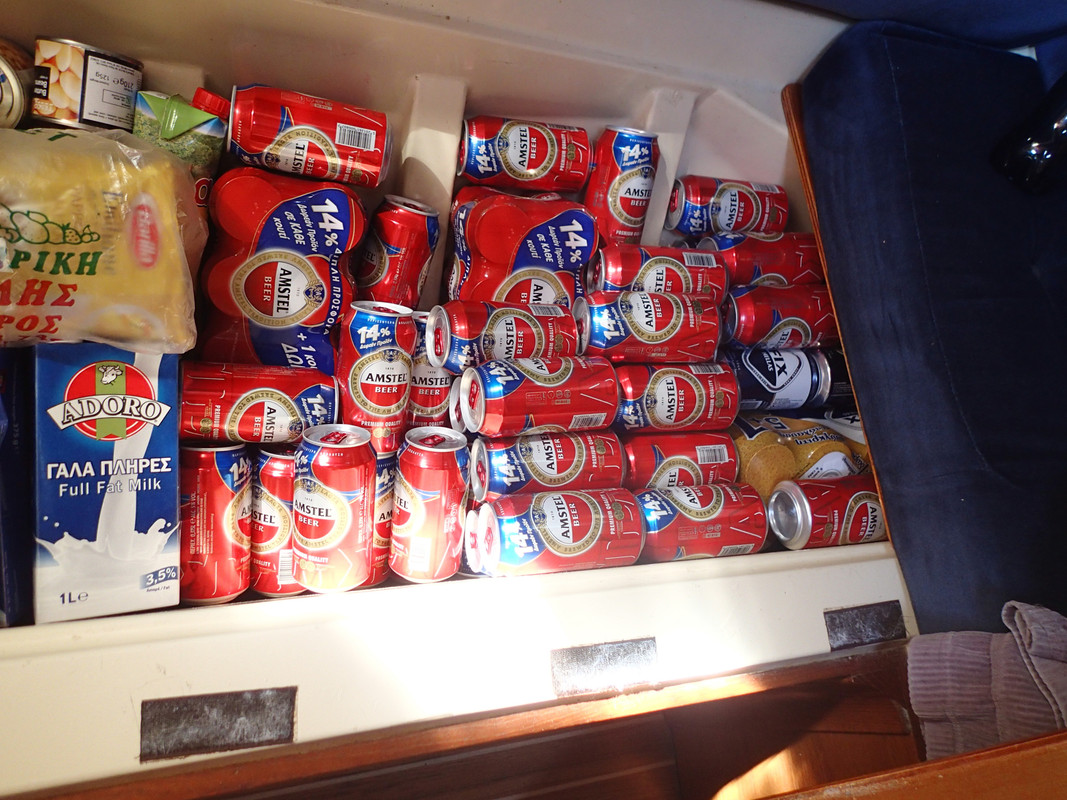
The loss of internal volume in a Sadler 34 is not too onerous. The topsides have about 40 mm of polyurethane foam, there are large blocks of it around the battery box in the aft cabin and between the heads of the berths in the forecabin. the floor of the hull is partially filled in the structural ribs and there is foam in the spaces around the lockers. Given that the boat's dimensions are relatively modest by modern standards, beam only 3.1 metres, the loss of stowage is barely noticeable. We have lived on ours for half the year since 2004, carrying many tools, folding bikes, plenty of beer, all the usual stuff. We always carry fenders stowed in lockers yet live quite comfortably.
 
The loss of internal volume in a Sadler 34 is not too onerous. The topsides have about 40 mm of polyurethane foam, there are large blocks of it around the battery box in the aft cabin and between the heads of the berths in the forecabin. the floor of the hull is partially filled in the structural ribs and there is foam in the spaces around the lockers. Given that the boat's dimensions are relatively modest by modern standards, beam only 3.1 metres, the loss of stowage is barely noticeable. We have lived on ours for half the year since 2004, carrying many tools, folding bikes, plenty of beer, all the usual stuff. We always carry fenders stowed in lockers yet live quite comfortably.

But as you illustrated in post#10 that amount of foam only gives you neutral buoyancy in lightship mode. Add on all that beer and the other stuff you cram in plus water, fuel etc adds up to well over another tonne to the basic 5.7 tonnes displacement. According the Kay (who Andrew quotes in his PBO article) you need 1.5 times the displacement in foam to achieve enough freeboard to make the boat habitable and capable of sailing.

That would really reduce the interior volume available for stowage.
 
Do we need to let Pogo know that they have been going the wrong way?

Are not many of the Open40's that go round the world built this way?

Don't know about the Open 40s, but from what I can see Pogo do not use double skinned hulls, but vacuum infused GRP/Foam composites - just like Bavaria and many other production builders. This leads to a hull around 10-20% lighter than a conventional hand laminated hull - probably even lighter in the case of Pogo because their aim is to produce a very light displacement boat, typically about 60% of a "conventional" cruiser of the same size.

The foam does not make it unsinkable. it is used to stiffen the laminate.
 
I alighted on this thread after just completing some work moving jib tracks on SWMBO's Flying Fifteen, which of course is a keelboat that has dinghy style buoyancy bags which are supposed to allow a holed boat to float at roughly gunwhale height. (had to deflate bags to avoid drilling through). Admittedly only hull weight of c170kg plus 186kg keel weight but I wonder whether rolled up/folded bags would work on a yachts inflated in an emergency by compressed gas?
 
I alighted on this thread after just completing some work moving jib tracks on SWMBO's Flying Fifteen, which of course is a keelboat that has dinghy style buoyancy bags which are supposed to allow a holed boat to float at roughly gunwhale height. (had to deflate bags to avoid drilling through). Admittedly only hull weight of c170kg plus 186kg keel weight but I wonder whether rolled up/folded bags would work on a yachts inflated in an emergency by compressed gas?

That has been done in the past - articles in long ago PBO and YM explaining by an Australian called Andrew Bray who did it. Exactly the same problem as foam - the volume required is high and even in collapsed form intrusive, plus the complication of plumbing the gas system.
 
There was a system called ' Unsink ' consisting of inflatable bags under the bunks; it was expensive and subject to wear, and had the great failing of many safety systems - one couldn't test it until using it for real...
 
But as you illustrated in post#10 that amount of foam only gives you neutral buoyancy in lightship mode. Add on all that beer and the other stuff you cram in plus water, fuel etc adds up to well over another tonne to the basic 5.7 tonnes displacement. According the Kay (who Andrew quotes in his PBO article) you need 1.5 times the displacement in foam to achieve enough freeboard to make the boat habitable and capable of sailing.

That would really reduce the interior volume available for stowage.

Yes, the boat is far from sailable but is at least afloat. Some time ago I calculated the amount of additional buoyancy available, in fenders, half full tanks, even beer cans which have positive buoyancy, and the result was surprisingly high.
 
Top