Horseshoe lifebuoy

I thought the reason (in the regulations) for having two was that one could be immediately deployed as a marker, like Refuelled says...

And that when you return to the area and spot the MOB, the second could be deployed pretty much direct to the person in the water.
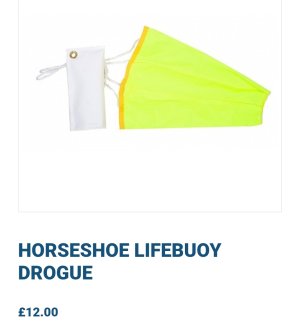
Do you think that the 1st one would be easier to see than an orange marker flare which would just drift away without a drogue?( how many do you see with drougues fitted?) Would spread out & be really easier to throw in the right direction without being blown off course in any strength of wind?
I know the thread is about lifebuoys , but we have already mentioned dan buoys so thread drifts are possible.
 
Last edited:
With a drogue on each horseshoe, the horseshoe shouldn't be affected by the wind (and would drift with anyone already in the water).

Screenshot_20240808-111040_Samsung Internet.jpg

Although, it's all theoretical.
 
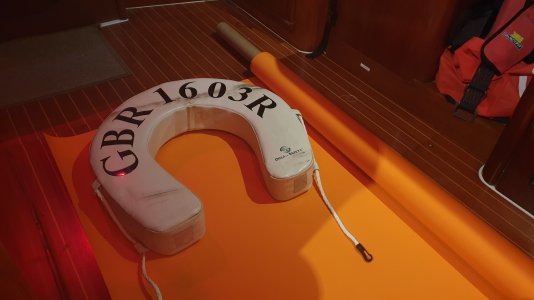
Regarding covers... It didn't take long to make some up with some spare Sauleda canvas...

20240808_111713.jpg

Fully open on the inboard side, and just an elastic around the hem of that side to hold them on..

20240808_111740.jpg

I thought that they'd keep the horseshoe lifebuoys nice and clean inside. No such luck. One pull, they come off and the lifebuoys are probably more manky looking than if they'd not been covered :(
 
Can you throw it accurately over any distance, with that flapping about?
The first is just an immediate throw to be somewhere close.. Then the second one is so that you can drop right onto the casualty when you get back to them..

(Or so we were taught).. If there are more recent recommendations on their use then let us know
 
The first is just an immediate throw to be somewhere close.. Then the second one is so that you can drop right onto the casualty when you get back to them..

(Or so we were taught).. If there are more recent recommendations on their use then let us know
One can be taught all sorts of things. But ideas evolve
I am not making any recommendations. Just asking questions.
One I want to ask is how near will one be able to get the first to a casualty, if a boat is initially doing 5kts & the crew ( the helm is helming) have to get to the transom, unhook the buoy & throw it.?
Then how easy is the buoy to see in the water, compared to the casualty wearing a LJ ( we assume)?
Would it not be better to drop a dan buoy with flag
I do accept that something is better than nothing. But just asking.
 
With due respect. That shows that you do not understand how the full use of a life buoy should be deployed.
See later about the drogue.
You're right. I had never thought of a drogue. My DS course was a while ago, but I don't recall any discussion about lifebuoys with or without drogues, just the bucket and fender exercise. A drogue will certainly make the lifebuoy stay put but, looking around your marina, how many have them?
 
One can be taught all sorts of things. But ideas evolve
I am not making any recommendations. Just asking questions.
One I want to ask is how near will one be able to get the first to a casualty, if a boat is initially doing 5kts & the crew ( the helm is helming) have to get to the transom, unhook the buoy & throw it.?
Then how easy is the buoy to see in the water, compared to the casualty wearing a LJ ( we assume)?
Would it not be better to drop a dan buoy with flag
I do accept that something is better than nothing. But just asking.
The old skool idea from RORC last century was pretty much that the horseshoe must be capable of being chucked within (single numbers of ) seconds, by the helmsman.
It goes over the side with dan-pole, light and drogue.

Boat and swimmer then have something to aim for.

If you're doing ten knots, that's 5 metres per second. If it takes ten seconds to launch the horseshoe, matey has a 50m swim.
Time is of the essence!

It's not the only approach to the issue, but it is coherent.
 
You're right. I had never thought of a drogue. My DS course was a while ago, but I don't recall any discussion about lifebuoys with or without drogues, just the bucket and fender exercise. A drogue will certainly make the lifebuoy stay put but, looking around your marina, how many have them?
You won't see a drogue on the lifering on my boat when it's on the mooring, because I leave the tatty old one out and swap to the nice one with light and drogue when we go out.

In a marina, you may one day want just the ring, to chuck to someone who's gone off the quay. You don't want to be running up the pontoon dragging a danpole and a drogue and all that.
 
1. Stop boat.

2. Go back to casualty.

3. As you pass them, give them the lifering.

4. Sort boat, go back and pick em up.

Have demonstrated this and got people to do it a lot. Its simple and it works. Being sailing, it's not the only way, but it's quick and it works!
 
I thought the reason (in the regulations) for having two was that one could be immediately deployed as a marker, like Refuelled says...

And that when you return to the area and spot the MOB, the second could be deployed pretty much direct to the person in the water.

Yes ... its why some reqt's state one Lbuoy to have a light and the other to have a floating line ....

No-one ever wondered about that ??
 
If you're doing ten knots, that's 5 metres per second. If it takes ten seconds to launch the horseshoe, matey has a 50m swim.
Time is of the essence!
Even with only a buoyancy aid I could not swim 50M. I know because I have capsized hundreds of times in my dinghies & sailboards. :rolleyes: That ( in more modern years) has been in wetsuit & light gear. I could probably struggle to make 5 M in full sailing kit whilst forced on my back by my LJ.
I think it is better for the MOB to do nothing, or at least as little as possible, until the recovery vessel is alongside. That preserves energy
You are right about time-- but not to the point of panic. That is where it all goes t..s up.
I have never tried getting back to an emergency wypt as my old GPS tend to work around 200 yds, but hitting the MOB button on the chart plotter, VHF or AIS seems a priority.
 
Last edited:
The (plastic) lights associated with them also suffer uv degradation over time, becoming brittle and cracked..... more quickly than the cover fails in my experience

My MOB light is also under the life buoy cover as is the floating line so all are protected by the life buoy cover
 
If you're wearing a lifejacket, your need for a lifering is somewhat reduced.
Away from seaschools and forums, not everyone wears a lifejacket.

Most boats are not doing 10 knots and it shouldn't take 10 seconds to chuck the ring.
So mostly the swim should be less than 50m, or the returning yacht knows the swimmer is less than 50m beyond the light.

If your strategy is to return to the swimmer before deploying any gear, then I think a Seattle Sling makes a lot more sense than free-floating liferings. Not so good in the marina though...
 
If you're wearing a lifejacket, your need for a lifering is somewhat reduced.
Away from seaschools and forums, not everyone wears a lifejacket.

Most boats are not doing 10 knots and it shouldn't take 10 seconds to chuck the ring.
So mostly the swim should be less than 50m, or the returning yacht knows the swimmer is less than 50m beyond the light.

If your strategy is to return to the swimmer before deploying any gear, then I think a Seattle Sling makes a lot more sense than free-floating liferings. Not so good in the marina though...

I googled Seattle sling and t came up with a cocktail drink or a camara strap/bag

Do you have a better link please


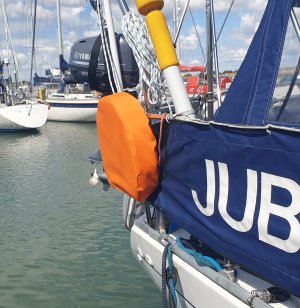
This is my lifebuoy cover and danbuoy just right of my outboard
 
Last edited:
Just like the OP I have a horseshoe hanging off my boat, with a MOB light, all attached to a floating line on a drum. I have a separate throwing line too. I have never in my 40 years of boating used them or seen them being used in anger.

As with all these things, the frequency of use is so small we can only make rough plans as to what we would do when someone goes over the side. Perhaps we can practice a few times too. .... but it's not really enough. To comfort ourselves, we create scenarios in our heads with little real-world experience and base our plans, and our equipment choice, on those scenarios.

When the sh!t hits the fan, more likely than not, there will be so many variables at play, weather, tide, waves, darkness, the person who actually went over, and the knowledge and skills of those left on board, that like Dwight Eisenhower wrote "Peace-time plans are of no particular value, but peace-time planning is indispensable." - so every situation will be slightly different.

The more you customise your kit based on your perceived scenarios, the less likely other crew members are to be able to use it effectively, and the more it is tailored to your favourite scenarios - you've baked your MOB Plan into your equipment. Bad idea IMO.

I try and keep it simple, don't customise my equipment or deviate far from the norm - IMO that's the best way to ensure that anyone on board with a modicum of experience will be able to understand and operate it without thinking "WTF, why is there a mini sea-anchor attached to the horseshoe!?" ... and spend valuable minutes trying to remove it.
 
Top