Honda BF50 4 stroke problems terminal or not?

greeny

Well-Known Member
Joined
15 Jun 2004
Messages
2,653
Location
Portugal
Visit site
Hi guys,
I'm normally on the sailing forums but thought this was the place more likely to have expertise in this field.
I was out in the rib yesterday, 20 knts, 4200 rpm when there was a sudden lock up on the engine. Then the starter then just clicked and wouldn't turn the engine over. I had to get a tow in eventually.
So today I took the top cover off to expose the timing belt and flywheel. With a spanner on the flywheel and no plugs in, the engine turns smoothly through approx 90 deg of its rotation then hits something solid inside. Rotate the other way and it hits the same solid stop. There is no "graunching" or scraping, it just stops dead at that point.
Took the rocker cover off and all seems good in there and all valves still there in place. I tried to put a cheap boroscope into the cylinders through the plug holes but couldn't see much detail. Shining a torch into the cylinders I can see a level of oil (I think its oil) in the no3 cylinder.
I've dropped off the bottom leg off and the symptoms are the same so its not to do with the gearbox.
At first I thought it was maybe the primary gear gone in some way causing the very solid locking up 90 deg apart. But now I've seen the oil in the cylinder I'm not so sure.
Maybe the only way to progress this now is a complete strip down but before I get get any deeper I'd just like to ask if there's any other ideas or thoughts out there that I might have missed.
Whilst I've played lots of engine years ago from cars, motorbikes, diesel generators and small outboards, I've not had the pleasure of one of these before and would like to ask advice first.
 
sounds like a broken piston ring stuck in one of the ports to me.
or a bit of a bearing jamming the con rod against the casing.
have another look with the boroscope starting shallow rotate it fully for a look , insert 10mm more repeat , rinse repeat etc till you hit the piston.
take a good look at the piston top if it looks rough then almost certainly a piece of ring has been bouncing around.

good luck

Clive
 
sounds like a broken piston ring stuck in one of the ports to me.
or a bit of a bearing jamming the con rod against the casing.
have another look with the boroscope starting shallow rotate it fully for a look , insert 10mm more repeat , rinse repeat etc till you hit the piston.
take a good look at the piston top if it looks rough then almost certainly a piece of ring has been bouncing around.

good luck

Clive
Thanks, I'll try that tomorrow. It's getting too dark now.
 
sounds like a broken piston ring stuck in one of the ports

It's a 4 stroke... they have valves, not ports ?
Stopping dead at 4200 rpm sounds like something must have broke/snapped.
Is the fluid in cylinder oil,petrol or water?
Sounds like a complete dismantle is in order ?
 
Yes its a 4 stroke. The way it stopped dead certainly felt like a mechanical failure that locked the engine solidly and instantaneously. Not sure about the liquid, It looks like oil but may be a mix. Maybe I can get a tube into it and suck some out. I'm hoping to avoid the full strip but its looking inevitable I think.
 
Just got a quote for a replacement engine out here. Almost 9000 euros for the Honda 50. And 7900 euros for a Tohatsu.
Both engines are on minimum 3/4 months waiting list with a predicted 5% increase for 2022. I asked if I ordered now for 2022 delivery could they match 2021 price and they said no.
I could buy a nice small car for that.
 
Can you see if each valve springs back up to eliminate a bent stuck valve?
How old is the engine as that can make a difference to coming apart without most bolts shearing off.
It's a tedious process to get the power head off to look at the bottom end or to check con rods.
I do fear stopping abruptly at 4200 rpm points to a major mechanical failure.
 
Can you see if each valve springs back up to eliminate a bent stuck valve?
How old is the engine as that can make a difference to coming apart without most bolts shearing off.
It's a tedious process to get the power head off to look at the bottom end or to check con rods.
I do fear stopping abruptly at 4200 rpm points to a major mechanical failure.
Unfortunately I can't rotate the engine enough to see all the valves go closed but looking inside the cylinders with a torch, the valves that are open, move with rotation of the camshaft and the others all look to be closed ok. I was focussed on the bottom end as this "feels" like where the "solidness" is. But when I saw the liquid in the cylinder it diverted my attention somewhat. Thinking about it, none of the pistons are at the top of the stroke when it gets to the locked position so its unlikely to be hitting something at the top end I would think. More likely bottom end but that doesn't explain the fluid in the cylinder. Head off is fairly easy and will rule out the top end for mechanical jamming.
I need to decide if I'm going much further with this one or put it in with a mechanic locally and take the hit.
 
Hi Greeny. Not familiar with your engine but coincidentally was taking a look at a friend's Honda bf5 this evening who encountered similar symptoms as you described. We started to investigate and discovered the flywheel key had sheared. It seems it allowed the flywheel to spin freely but every few rotations the 2 bits of the key would jam and stop it solid. So a cheap fix once we get one.
 
Thanks Robv,
Any suggestions are always welcome. The flywheel on mine is solid on the shaft so it's not slipping like your friends was. Wish it was.
I may take the head off today and look in the top end as an initial look just to rule out the top end. Then its the main block needs to come out. At this stage with a 14 year old engine, and the suggested rebuild cost of 2.5k plus, with no guarrantee, I am reluctantly beginning to think that a new motor at 8k is the best option.
 
Can you see if each valve springs back up to eliminate a bent stuck valve?
How old is the engine as that can make a difference to coming apart without most bolts shearing off.
It's a tedious process to get the power head off to look at the bottom end or to check con rods.
I do fear stopping abruptly at 4200 rpm points to a major mechanical failure.
Thanks for your help,
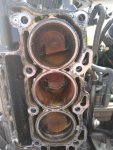
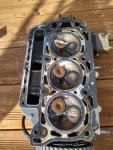
Got the head off today and all looks ok except that all 3 cylinders have water in them. Head gasket looked ok as far as I can tell and can't see any obvious cracks in the head. Now the head is off I still can't rotate the engine more than 80/90 deg. and it hits a solid stop at each end of that rotation. Pistons moving ok with no play in the stroke best I can tell. So it looks like a bottom end strip which entails stripping all the electrics off the block before actually getting at the hard lumps. Had enough bad news today so will start that tomorrow. :) :) Wine o'clock now.

p.s. I did read on an internet site that these engines are prone to thrust bearing failure. Maybe if that has broken up it's dropped into the primary gear and is jamming it. Or it could be a piece of bearing or even piston skirt down there.
 
I would think you need to lay your hands on a workshop manual to discover where all the bolts are hidden so you can remove the engine from its base.
I did a mercury 50 4t last year as the expanding grommet and blocking the cooling at the base of the powerhead issue arose.
A less than £10 part but around £1000 if you pay for it to be done as the whole engine/powerhead needs removing from the leg.
I built an outboard stand out of ply, 4x2 and a workmate. Knocked up a A-frame to lift the engine from 4x2 and use block and tackle. It worked well!
I would guess the powerhead weighs around 50kg.
 
Pictures of head and the block.
Is it possible the water got into the cylinders via the exhaust valves when I lifted the engine to check the prop hadn't picked up a rope when it first happened.
 

Attachments

  • IMG_20211209_111808853 (Small).jpg
    IMG_20211209_111808853 (Small).jpg
    346.5 KB · Views: 37
  • IMG_20211209_111818197_HDR (Small).jpg
    IMG_20211209_111818197_HDR (Small).jpg
    370.7 KB · Views: 35
Water can't get into the engine when you tilt it fully up. That would be a terrible design.
But all 3 cylinders getting water in them ? I'm still trying to figure that out.
Certainly interested to hear what happened to it when you find out.
 
Latest update..
Tried to get the flywheel off today but gave up after an hour as I couldn't move the 35mm nut on the end. Then I would have needed to use a strong back or puller to get it off which I didn't have. I made the decision at this stage to take the engine block out of the outboard and transport it in the car boot down to the boatyard where I can get the flywheel removed. :coffee:
To get the lower case off so I can get at the engine bolts I had to hacksaw the lower leg mounts off because they were so corroded there was no way they were coming off any other way, Hopefully I can reuse the mounts and just get some new bolts. Stainless steel through aluminium castings plus saltwater, when will they ever learn. :mad::mad:
I got the lower casing off, drained the oil which looked good with no water in it, and took off the oil pan and associated exhaust and oil pickup tubes. This gave me access to the engine block hold down bolts which I took out and then I removed the engine onto the floor. :coffee:
The engine sump also carries the lower bearing shells for the main crank bearings and I removed all the bearing bolts along with the sump bolts to allow the bottom to come off the engine. Then I discovered that the sump wouldn't come off because the flywheel (which I can't get off yet) was covering some bolts which are still holding it all together. Not mentioned in the manual at all. :mad:
By this time it was wine o'clock again so I decided to knock it in the head for another day. :) ????
Tomorrow, once I get the flywheel off, then the sump, all will be revealed. - There's nothing else to take apart after that!
I started with three areas of potential failure under consideration. Something under the flywheel, something in the sump broken off and jamming the crank or the primary gear drive having collapsed or jammed up somehow. Today I struck the primary gear off the list.
 
Last edited:
From the block to the bottom cowl is a rubber hose, about 100mm long, 5mm bore, it feeds water out through the tell tale.

The tell tale gets clogged.

That makes the hose pop off the fitting in the cowl.

The flow of water from the little hose now fills the space under the cowl, it cant drain fast enough.

It fills until the air filter swallows it.

Game over.

Happened on a BF40.
 
From the block to the bottom cowl is a rubber hose, about 100mm long, 5mm bore, it feeds water out through the tell tale.

The tell tale gets clogged.

That makes the hose pop off the fitting in the cowl.

The flow of water from the little hose now fills the space under the cowl, it cant drain fast enough.

It fills until the air filter swallows it.

Game over.

Happened on a BF40.

That's very interesting because when I first tilted up the engine to check the prop there seemed to be quite a lot of water around and some seemed to come from inside the control cable entry to the engine.
However when I was stripping the engine I didn't notice any of the hoses had previously come off.
And on start up the engine was peeing as normal so any blockage occurred in the 5 mins from berth to harbour mouth. The engine is also now locked up even with the head off so I guess your "game over" means that the cylinders hydraulically locked and caused damage of some sort in the bottom end which is now locking the engine rotation? I'm thinking bent con rod or similar?
Just interested to follow this suggestion through because up to now it's the only one that really makes sense to me and explains the water in the cylinders.
Hopefully I'll get the flywheel off tomorrow and then the sump and we'll see for real what the damage is.
 
I can't really say about yours of course.

Mine started to misfire, I looked round and there was water pouring out of the cover, I nursed the boat back to the berth, it konked out, took the lid and there was water everywhere.

I took the plugs out, dried them, spun it over a bit, mine seemed to run ok, I fixed the tell tale obvs.
 
Top