Help with NMEA wiring diagram - Please!

It would be better to separate the NMEA output +ve and -ve and tape them up neatly out of the way, just to remove any potential for interference if the VHF does decide to output something.

Pete

Now you mention it Pete, the VHF sometimes does lose its position signal and it bleeps a few times before it finds it again. I have noticed that whilst it's doing this the position looks fine on the C80 so I just thought it was some kind of "quirk". I will separate the NMEA wires and see if it cures this instability.

Many thanks

Richard
 
It's obviously wrong, but I would have been surprised if there was any data stomping, so I tried it. Data got through on both lines with no errors for the short time of my test. Only the very slightest ripples in the shape of the waveform on the scope. RS-422 is pretty robust at the speeds and short distances we use it for on boats.

Huh? So you effectively "multiplexed" two NMEA channels onto the same pair of conductors, with no actual multiplexing, and got a signal through? Both signals through? I'm perplexed.

Pete
 
No idea, but it seems that whoever wired the stuff together wasn't exactly on top of the job!

The diagram is reasonable as drawn, and it seems odd that a numpty would carefully produce such a thing. So my guess is that the boat was originally wired as per the diagram by a competent person, then at a later date (possibly two different dates) the plotter was added and the VHF replaced with a different one. The old VHF probably only had an NMEA input, the new one had both an input and an output, and the numpty installer was confused by this hence the shorting together of the two channels.

If we assume that the original design worked, and gave COG and SOG on the instruments before the plotter was ever installed, then the autopilot (either computer or controller) must be bridging the position from NMEA to Seatalk. There's no other source of position info for the Raymarine instruments.

Pete
 
Last edited:
Huh? So you effectively "multiplexed" two NMEA channels onto the same pair of conductors, with no actual multiplexing, and got a signal through? Both signals through? I'm perplexed.

Pete

Maybe I understood the problem incorrectly. I thought the 2 separate channels were just incorrectly twisted together rather than electrically connected so the only interference would be from electro-magnetic induction. That's what I tried. I had two pairs of wires. I twisted the two pluses together and the 2 minuses together rather than plus1 with minus1 and plus2 with minus2. There was no electrical connection between the 2 channels, just somewhat electro-magnetically coupled. There was slight interference apparent on the scope, but not much. I twisted only about 15cm of cable together so maybe much less than the OP.

I do realize that NMEA-0183 signals need actively multiplexing together, having made such a YAPP device to do just that.
 
Last edited:
Maybe I understood the problem incorrectly. I thought the 2 separate channels were just incorrectly twisted together rather than electrically connected so the only interference would be from electro-magnetic induction. That's what I tried. I had two pairs of wires. I twisted the two pluses together and the 2 minuses together rather than plus1 with minus1 and plus2 with minus2. There was no electrical connection between the 2 channels, just somewhat electro-magnetically coupled. There was slight interference apparent on the scope, but not much. I twisted only about 15cm of cable together so maybe much less than the OP.

I do realize that NMEA-0183 signals need actively multiplexing together, having made such a YAPP device to do just that.

Thanks for the input Angus but I'm talking about twisting together and then electrically connecting them so the input and output +ve connect to one NMEA wire and the input and output -ve connect to the other. I'm going to split them.

Richard
 
Our S2 computer multiplexes some nmea data onto Seatalk so there is a good chance the S3 would. I think the OP needs to learn the principles of the connections then he can readily work it out for himself. I would say he is half way there. Perhaps a new drawing of how it should be wired with colour coding of the wires will help work it out on board.
 
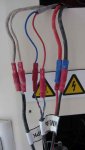
I've attached a photo of the wires coming out of the DSC VHF which out of shot at the bottom of the photo.

The leftmost two are the remote speaker, the rightmost two are 12v power and the middle four NMEA wires coming out of the radio show the odd 4-into-2 arrangement. The red and blue NMEA wires disappear into the wiring harness.

Richard
 

Attachments

  • VHF-IMG_2625.jpg
    VHF-IMG_2625.jpg
    40.8 KB · Views: 1
Just thought I would update this thread from last year as I finally got to the bottom of my NMEA wiring.

I gained access to the back of the Raymarine C80 Classic and found that I had connections to the Seatalk port and the NMEA 0183 port so I switched on all the electronics and when everything was settled I pulled the NMEA plug out of its socket and watched to see what happened. After a few minutes the Raymarine VHF started bleeping to indicate that it had lost its GPS signal.

OK, so now I know that the red and blue wires connected to the back of the VHF are connected to the C80 NMEA port ..... but NMEA uses 4 wires so where are the other 2?

I trace the NMEA connector and cable (which is the official Raymarine part so I know that it starts its journey across the boat with 4 wires) and, behind another panel, find that the four-core cable goes into a junction box. Inside the junction box the four wires going into a connector block with the output being a twin core cable which vanishes into the shrink-wrapped wiring loom obviously to appear on the other side of the boat behind the switch panel where the VHF is installed.

What a pity that the boat builder decided to save a few Pounds by not extending the 4-core cable with another length of 4-core right across the boat! :(

Anyway, I now know the answer to my problem is that I couldn't take the AIS output from the transceiver over to the C80 and have the VHF receiving its GPS signal from the C80 because (1) I don't have enough NMEA cores and (2) the speeds are mis-matched and my C80 cannot transmit at GPS speed and receive at AIS speed even if I had the cable.

I have therefore bought a NASA multiplexer on eBay. Brand new at half price. When I return to the boat I can take the GPS output from the AIS unit and the AIS output from the unit and multiplex the two with the AIS going down the 2-core into the C80 and the GPS going into the VHF.

It would be nice to have taken the NMEA output from the C80 across to AIS transceiver as I could then have broadcast that data over wifi. Probably that would be heading, boat speed, depth, wind speed etc i.e. everything which is transmitted through the Seatalk network, but unless and until I mouse-in a 4 core cable (or another 2-core!) I will never know.

Anyway, thanks to all those who contributed to the thread. I hope this might help others with a similar set-up.

Richard
 
Top