pvb
Well-Known Member
Ah - that would throw a spanner in the works. If it doesn't, though, why is the GPS connected to it?
No idea, but it seems that whoever wired the stuff together wasn't exactly on top of the job!

Ah - that would throw a spanner in the works. If it doesn't, though, why is the GPS connected to it?

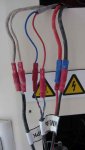
It would be better to separate the NMEA output +ve and -ve and tape them up neatly out of the way, just to remove any potential for interference if the VHF does decide to output something.
Pete
It's obviously wrong, but I would have been surprised if there was any data stomping, so I tried it. Data got through on both lines with no errors for the short time of my test. Only the very slightest ripples in the shape of the waveform on the scope. RS-422 is pretty robust at the speeds and short distances we use it for on boats.
No idea, but it seems that whoever wired the stuff together wasn't exactly on top of the job!

Huh? So you effectively "multiplexed" two NMEA channels onto the same pair of conductors, with no actual multiplexing, and got a signal through? Both signals through? I'm perplexed.
Pete
Maybe I understood the problem incorrectly. I thought the 2 separate channels were just incorrectly twisted together rather than electrically connected so the only interference would be from electro-magnetic induction. That's what I tried. I had two pairs of wires. I twisted the two pluses together and the 2 minuses together rather than plus1 with minus1 and plus2 with minus2. There was no electrical connection between the 2 channels, just somewhat electro-magnetically coupled. There was slight interference apparent on the scope, but not much. I twisted only about 15cm of cable together so maybe much less than the OP.
I do realize that NMEA-0183 signals need actively multiplexing together, having made such a YAPP device to do just that.


I think the display unit that connects to the course computer can convert NMEA to Seatalk.I'm not convinced that the S3 course computer bridges NMEA data on to SeaTalk.