RichardS
N/A
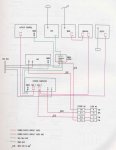
I have attached the systems wiring diagram for my boat as it doesn't make sense to me.
The box entitled "Course Computor" is my Raymarine C80 Classic chartplotter. It has NMEA, and two Seatalk ports. The manual shows that the NMEA port has 4 connections: NMEA Output +ve and -ve (common) and NMEA Input +ve and -ve (common).
The diagram shows an NMEA cable going to the DSC VHF radio. The cable is marked with two small arrows pointing out of the C80 and two small arrows going into the VHF.
I have removed the VHF and there are only two NMEA wires connected from the harness to the VHF, a red wire and a blue wire. However, there are 4 NMEA wires coming out of the back of the VHF: Gray NMEA IN +ve, Purple NMEA IN -ve, (both labelled as GPS) and Blue NMEA OUT +ve, Brown NMEA OUT -ve (both labelled as Chartplotter Display). I understand that the chartplotter connection is so the plotter can display the position of a DSC distress call which is sent by the VHF.
The 4 wires coming out of the VHF are twisted together into 2 pairs: Grey and Blue (NMEA IN +ve and NMEA OUT +ve) are twisted and connected to the red harness cable and Brown and Purple (NMEA OUT -ve and NMEA IN -ve) are twisted and connected to the blue harness cable.
I was thinking of connecting the NMEA output of my AIS unit to the red and blue harness cables to see if I can get the C80 to display the AIS data because the AIS receiver is located next to the VHF so the wiring is convenient.
I appreciate that without a multiplexer I would have to leave the VHF NMEA cables disconnected and change the NMEA input of the C80 to 38,400 but I am confused as to how the red and blue wires appear to carry data in both directions as is suggested by the fact the the input and output to the VHF seem to use only the 2 wires.
Can NMEA operate in both directions over two cables or I am misunderstanding the twisting together of the VHF NMEA wires?
Many thanks
Richard
The box entitled "Course Computor" is my Raymarine C80 Classic chartplotter. It has NMEA, and two Seatalk ports. The manual shows that the NMEA port has 4 connections: NMEA Output +ve and -ve (common) and NMEA Input +ve and -ve (common).
The diagram shows an NMEA cable going to the DSC VHF radio. The cable is marked with two small arrows pointing out of the C80 and two small arrows going into the VHF.
I have removed the VHF and there are only two NMEA wires connected from the harness to the VHF, a red wire and a blue wire. However, there are 4 NMEA wires coming out of the back of the VHF: Gray NMEA IN +ve, Purple NMEA IN -ve, (both labelled as GPS) and Blue NMEA OUT +ve, Brown NMEA OUT -ve (both labelled as Chartplotter Display). I understand that the chartplotter connection is so the plotter can display the position of a DSC distress call which is sent by the VHF.
The 4 wires coming out of the VHF are twisted together into 2 pairs: Grey and Blue (NMEA IN +ve and NMEA OUT +ve) are twisted and connected to the red harness cable and Brown and Purple (NMEA OUT -ve and NMEA IN -ve) are twisted and connected to the blue harness cable.
I was thinking of connecting the NMEA output of my AIS unit to the red and blue harness cables to see if I can get the C80 to display the AIS data because the AIS receiver is located next to the VHF so the wiring is convenient.
I appreciate that without a multiplexer I would have to leave the VHF NMEA cables disconnected and change the NMEA input of the C80 to 38,400 but I am confused as to how the red and blue wires appear to carry data in both directions as is suggested by the fact the the input and output to the VHF seem to use only the 2 wires.
Can NMEA operate in both directions over two cables or I am misunderstanding the twisting together of the VHF NMEA wires?
Many thanks
Richard