stelican
Well-Known Member
Thanks S, does that mean only a foot or so of the tank is accessible? Is there access to the middle / end?
When you open the hatch / lid the whole top of tank is accessable
Last edited:

Thanks S, does that mean only a foot or so of the tank is accessible? Is there access to the middle / end?

My 0.02 p worth
Pete dirty filters are a show stopper .
In an ideal set up it needs to be easy @ sea rolling around to access and change ---maybe quickly too .
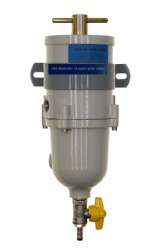
I find the Racor type canister those with a T bar and flat lid the best .FG 500/900'series
They centrifuge the fuel and the water and crud is spun to the bottom of the glass bowl underneath , making glass bowl thing usefull as intended to spot crud .
We also have Water In Fuel (WIF) sensors too .They allow about 3 inches at the bottom of the glass before the alarm on the dash goes off .
Now the critical bit having established which kit ,is how it's fitted .
Just bear with me --
Racor FG 500. S for your boat ( mine had FG900 ,s ) need to be lower than the tank (s) or as low as possible .
This means @ sea to do a quick change
Turn the tank cock off
Sipn off the T
Lift the lid
Grab the plastic handle lift out the cartridge ( ASAP 30 micron £7-8 a piece carry 6-8 )
Insert a new one ,replace the rubber O ring on the lid and T ( o rings come with cartridge )
Now answering your Q on "bleeding " ---place the lid on start to screw the T ,but just B4 the lid closes open the tank cock
Cos it's below the fuel level -as said mounted low it floods the canister as you tighten = no air lock. = no bleeding .
Ok potential for a bit of diesel spilage in the bilge -sort that later .
As mentioned put installing Racors on the upgrade list -timescale 12/12 ish .
In the mean time dummy run a filter change and carry spares .
I have 6-8 primary 30 microns and a set 4 secondary think 2micron on the engines .
WIF too .
$hit in the fuel and especially water is an injector killer ,which can go large and seriously damage the engine ,
How ever having said all this I realise as an ex owner -- in an outdrive boat ,tight engine room there just may not be enough space to fit low racors and be able to benefit from gravity to skip bleeding ,plus reach the bleed cock under them ,nevermind be able to observe the crud in the bowls.
There's also some obscure fire regs re the glass bowls distance ,heat and what type of fire protection is fitted .
That why some are all metal --in close confined E rooms .
How ever if poss and safe do consider upgrading ?
When the filter element is replaced, it should be steadily rotated while being carefully withdrawn from the housing. The new element is inserted by reversing this procedure. In addition to the standard 30 micron, there are options for both 10 and 60 micron replaceable elements. After replacing the element, always check the compression seal and cover seal (and replace if necessary). It is not necessary to air-bleed the system after draining water and dirt of after changing the element.
The seals required for an element change are integral, in other words, the element itself has the required seals. However, when servicing the KWA filter we recommend that the bowl and lid seals are inspected in case they need replacing. Biocides in the fuel, higher bio-diesel mixes and high water levels in the storage tank can cause the fuel to have a higher acidity level. This will mean the seals will require more frequent replacing.
When you open the hatch / lid the whole top of tank is accessable


Porto, I think the Separ KWA 50's (as I have) are the same as the Racor 500 units that you have on your boat (just with a different name). Mine also have centrifuges in the bowls, and a T-bar to clamp the lid down.
They look like this...
Fairline fitted their's with a metal bowl which I believe is to comply with BSS fire regs. Despite being obsolete, alternative bowls are available (glass with or without water sensors and metal with or without water sensors). There are also visible and audible alarm kits if someone wanted to retrofit one.
This is the write up on the Separ web site...
http://separ.co.uk/products2/diesel...r-separators/separ-filters/63-separ-kwa-range
There's a few point here that caught my eye (my highlighting):
The filters are in a very accessible position (bolted to the engine room bulkhead). I suspect they could actually be changed without climbing down into the engine room (in an emergency), by lying down on the cockpit floor reaching down into the cockpit. They're quite low, presumably below the tank, so longer arms than mine might be required.
So it would appear that hanging them is as simple as shutting off the fuel supply, removing the lids and filter, top up with any lost fuel, then re-open the fuel supply. Or am I missing something as another post seems to suggest that the filter should be drained before removing the filter (which might mean less risk of contamination)?

Very brave PeteBit of an update. Engineer came to check the tank today and says that the bottom looks pretty clear (some sediment but nothing abnormal). Certainly no caking or evidence of bug. He did say that the fuel lines look a bit perished which could cause similar symptoms (if they're letting in air).
Jez is on board tomorrow with one of my partners so I will see how they get on.

Very brave Pete
.
Don't worry, I've taken extensive photos of it in its current pristine state

Are the alternators belt driven?
How are the batteries arranged? Does it have seperate starting batteries and service batteries. Is the drive trim powered from the starting batteries or the service batteries?
Im guessing the trim uses the same batteries as the engine does for starting and running, in which case it could be either poor batteries/connection or a faulty alternator (or connection of alt to batteries)
How old are the batteries? If 5+ years then theyre probably shot and due for replacement
There's an alternator warning light ,bit basic but nether the less .
Nice to know if it comes on just with complete failure or broken belt or if the charge drops below a predetermined piont ?
Also wether Alts just go from working to dead in which case the light will come on
Or decay slowley in which case the light will eventually come on like a flicker with a loose belt until you rev it .
Yep whole wiring system needs a thorough check along with the batts and if poss alt check as well .
Struggling a bit with this Pete. Problems would be more obvious straight after start-up as the alternator has to bring the starter battery back up to capacity while supplying power to the engine and other services. Adjusting a drive trim is unlikely to give a "show-stopping" reduction in voltage. Sounds more like a sensor or connector issue when trim drive is demanded.Engineer thinks could be failing alternator.
I've suggested they switch off all unnecessary power drains; fridges / blower / A/P.
