Heading north in a small yacht.. boat suggestions, weather protection and systems advice please

SkipperWild

New Member
Joined
10 Aug 2021
Messages
7
Visit site
Hi all


Thanks in advance for your help. I am afraid this is a long thread but I wanted to give you all as much information as possible..

I am an experienced skipper who has made many passages south in yachts between 30-50 foot.

I am currently considering buying and refitting a small (sub 30 foot), budget (less than 30k fitted out), yacht for extensive cruising in the North Sea and Scandinavia. I will be carrying out the majority of the work myself.
l envisage many passages north - both with ‘the better half’ and single handed. But will not be taking any other crew.

One major concern for me is the consideration of ‘weather protection’ I know from experience how fatiguing weather can be in a small boat.

As with all things ‘sailing’ I understand the compromise… weather protection typically means inside helm and a motorsailor but I would really like a ‘boat’ that makes capable passage times under sail.

Another (very controversial) requirement is that it must be a bilge keel yacht.. I originally started my search looking at folk boats and their derivatives ( contessa, albin vega, halcyon, invictor, folk song etc). Whilst their proven ability is fantastic (and initially they seem ideal yacht for me) there are a number of considerations. Firstly I would like to be able to winter (cheaply) without the need of a cradle. Secondly I would welcome the extended cruising ground and anchoring/drying ability of the bilge keel - not mention the shorter distances to shore in the tiny wet tender I will be forced to carry.. I also have access to a cheap shallow water mooring..

I am currently considering a saddler 26. On the face of it - seems to fit the bill. In budget, reasonable sailing, bilge keel, foam sandwich hull (gives at least some insulation) and although not numerous there are a few about.

With all this in mind I would like to ask

1. Any other yacht suggestions ? Especially ones that might add in some weather protection to the mix

2. For the design buffs amongst you. Do you think it would be sensible/practical to add a ‘hard Bimini’ to this size yacht - thinking of windage, AVS etc. The main sheet is right in front of the companionway so a hard or extended spray hood may be a challenging build

3. Heating system suggestions - other than blown air I have no experience with these especially on such a small yacht.

4. Has anyone had practical experience of these cruising grounds and any other useful ‘improvements ‘ or ‘systems’

All thoughts, suggestions are very welcome. Thanks.
 
How far North? We have cruised at 60N in Scandinavian and Scottish summers and no special precautions needed, compared to October in the UK (some warm clothing). We do have a good spray hood however.
And to be honest a very good autopilot would be a better investment and keep you warmer than worrying about fixed Bimini etc, IMHO

However, if going properly North into ice etc gets rather different - polar bears etc
 
A few thoughts:
I've overwintered in Norway, living aboard, 34' LOD wood gaff cutter. Drip feed diesel heating is essential.
You don't need bilge keels (giving poor sailing and seakeeping) to over winter cheaply. It's more down to where you are, eg a central Oslo marina or a tiny fishing harbour with a trawlermens' co-op and one grocery shop.
A hard top in that size? I wouldn't, just use a spray hood and cockpit tent arrangement.
A variety of heating and cooking methods is wise, for back-up, the heater will be on 24/7.
Electricity is cheap or free in Norway, due to abundant hydro.
A 30' long boat would be the absolute minimum, you need more stuff in the cold weather.
 
I highly recommend the videos produced by a Norwegian chap called 'Juho'. (YouTube)
As well as stunning photography, amazing skiing (via yacht) and serious adventures north (in winter too) - he also goes into great detail about boat preparation and fit out with one particular episode going into the relative advantages and disadvantages of various heating / cooking methods.
Enjoy!
www.alluringsailing.com
 
Last edited:
A couple of points. Firstly read the books by Roger Taylor & Ming Ming. It shows that 80’ is possible on small boats - Ming Ming 1 was 20ft and #2 was an Achilles 24.

This shows that it is, technically possible however only made pleasant* by sailing from inside - all sail handling is done from the hatch without going outside.

The biggest challenge IMO will be what do you do with your wet foulies on a small boat. Bring them into cabin and everything including your bed gets wet with little hope to dry out.

I’d want a boat with a proper sheltered helm position / inside place tohold watch and be able to manage sails most of the time whilst staying dry or at the very least to have a very good transition area between”outside” with wet foulies where you can get changed before going into to a dry sleeping living cabin.

*I suspect roger Taylor’s definition of pleasant will be significantly different to most other people expectations of “pleasant”.
 
How far North? We have cruised at 60N in Scandinavian and Scottish summers and no special precautions needed, compared to October in the UK (some warm clothing). We do have a good spray hood however.
And to be honest a very good autopilot would be a better investment and keep you warmer than worrying about fixed Bimini etc, IMHO

However, if going properly North into ice etc gets rather different - polar bears etc

Hi

thanks
How far North? We have cruised at 60N in Scandinavian and Scottish summers and no special precautions needed, compared to October in the UK (some warm clothing). We do have a good spray hood however.
And to be honest a very good autopilot would be a better investment and keep you warmer than worrying about fixed Bimini etc, IMHO

However, if going properly North into ice etc gets rather different - polar bears etc


thanks dunedin. I absolutely agree with your autopilot suggestion, having been at sea for more than a few days with a failed one ! I will be fitting both tiller pilot and wind vane steering. This cost/ease of fitting was something I considered but didn’t mention as the post already seemed long - it is the reason In the perfect world I am looking a transom hung rudder ?
 
It really depends on how far North you want to go! But I'd echo those who suggest that good heating is essential, along with ensuring that water cannot get below except in controlled manners. Somewhere to leave wet outer garments without making the living area wet is a good idea. A sheltered watch-keeping position is useful; if you have wind-vane and autopilot, the need for a sheltered helm is less necessary, though a means of controlling the autopilot from a sheltered location would be a "nice to have"; it's unlikely you'll achieve that with a wind-vane, but it's something to consider.

The Scandinavians all say "There's no such thing as bad weather, only bad clothes". Make sure your clothing will a) keep you dry and b) keep you warm. But if you're expecting to encounter freezing conditions, it's ALSO important that you don't sweat inside your clothes; moisture can be wicked out through your clothing until it reaches a layer where it freezes, destroying the efficiency of the clothing. So multiple, readily adjusted layers are strongly recommended, and if you do get hot, make sure you cool down again.

Ensuring you can make hot drinks (at least) underway is important. If you anticipate weather where operating a stove would be hazardous, fill thermos flasks.

It doesn't sound like you're considering the real Arctic regions, but if you are, be aware that ice is dangerous. Even small lumps are much larger below the water, and they are unstable and liable to overturn without warning. Obviously, avoid hitting ice, but less obviously, give any that you see a wide berth.

Again, if you're heading into the true Arctic, be aware that there is, for practical purposes, no SAR facility. Self-sufficiency is essential, and in some regions, you may be required to carry a gun for defence against Polar Bears (Svalbard has this requirement).

A well-known saying amongst polar people is "Any fool can be uncomfortable in a tent". It isn't about roughing it - it's about ensuring that you maintain good living conditions, despite the challenge of the environment. Roger Taylor and Ming Ming embodied that par excellence!
 
I would perhaps measure anything suitable against the positives of a Sadler 34: Solid sea keeper , insulated hull? , bolt on bilge keel version available too.
But ( isn’t there always ?) unsinkable foam filling does take up storage space for all your stuff, and makes leak tracing and doing mods that much more difficult .
At your price point you want simple simple as everything will begetting a bit long in the tooth snd as you know, the hull that is in front of your eyes was only 1/3 of the new price - the rest is all those aging motors masts metal bits electricery hatches and mattresses and deck hardware -it all adds up
 
Initial brief sounds a lot like my own dear Hunter Pilot 27.

Probably get shot down for the OP’s intended cruising grounds, but add a JSD and I’m not sure it would be totally unfeasible. Deck saloons help reduce inverted stability they say, in extremis, and the JSD keeps you in the frothy bits of big waves, so maybe the windows won’t get stoved in during a big storm.

For steering mine has a paralleled hydraulic pump across the existing ram that’s used for the inside helm position - neat and always ready at the touch of a button.

For windvane steering there would have to be a bracket round the transom hung rudder. Thinking of a Neptune or Sea Feather myself. Electronic one can steer to wind but noisy and power hungry.
 
I have both sailed the Baltic in fall & spring (with ice on the water and frost onshore) and lived full time afloat in Northern climes (Canada).
The most important piece of equipment is some form of heating to keep the boat dry and pleasant to live on. I have tried solid fuel, gas (vented), diesel as in Reflex/Dickinson, electric and now Webasto diesel/forced air.

Solid is messy and requires constant attention.

The Reflex/Dickinson can backdraft in high winds, filling your cabin with black soot and your decks will eventually turn black, no matter how high your flue or sophisticated the cap.

Gas is expensive and must be vented to prevent asphyxiation and death by drowning due to condensation.

Electric has obvious short comings for non-marina use.

We currently have a Webasto, we love it and it has given us ten years of reliable service.

I cannot recommend a wheelhouse enough and there is absolutely no comparison to a soft or hard dodger for sheer liveaboard and cruising comfort. I sailed throughout winter in the Pacific North West with a hard-covered steering; yes, it is a significant improvement over anything else, but it pales in comparison to the fully enclosed wheelhouse arrangement we currently enjoy in our 3 - 5 months a year living aboard. It is by far the best part of the boat and we, quite literally, live in it.

The biggest problems with traditional motorsailers are their often ridiculously low SA/Displ. ratios and it is completely beyond me why that has to be.

LM built a number of (motorsailer) designs in the sub 30' category, also with twin keels and a reputation for decent sailing ability. Then there are such like the Degero which have a semi-closed hard dodger and more of a sailing hull.

I would also recommend a Colvic Watson for their exceptional wheelhouse, available in 25.6', 27.5' and 31.5" (ours), with the caveat that to have much of a pretense as to sailing ability you need to do two things:

a) Fair in the deadwood and profile the rudder(pretty much critical for any of the above, IMHO).

b) Add as much sail area as you can. We more than doubled ours over the standard model (214%, SA/Disp 17.8). In 10kts apparent we now easily approach 6kts. She can happily support this SA up to a F6 on a reach/close reach. Windward ability, in cruising terms, is perfectly acceptable (4.8kts in 12kts apparent ( 8.3kts true) at 40 degr, 7 degr leeway is realistic). We frequently average 6kts on passage. Do yourself a favour and choose a sloop. Do not pick one with bilge keels or remove them if you do (They were never intended to have them in the first place and they don't need any help to go any slower).

All these modifications are well within the capabilities of a somewhat functional amateur.

Anything a twin/bilge keel can do involving land, a pair of legs can do as well. We use ours at the drop of the hat in tidal waters, they store out of the way inside the boat and they cause zero drag. I would have no hesitation storing the boat with them ashore.

Get a good autopilot, not just a wind vane, it takes much of the stress out of the single handed business. We switch on ours the moment we reach open water. Its an ancient CPT wheel pilot (they are making them again in USA), it has zero smarts, is absolutely silent and will steer our tub even going downhill in a steep quartering sea while doing well over 7kts.

Best of luck.
 
Hi all


Thanks in advance for your help. I am afraid this is a long thread but I wanted to give you all as much information as possible..

I am an experienced skipper who has made many passages south in yachts between 30-50 foot.

I am currently considering buying and refitting a small (sub 30 foot), budget (less than 30k fitted out), yacht for extensive cruising in the North Sea and Scandinavia. I will be carrying out the majority of the work myself.
l envisage many passages north - both with ‘the better half’ and single handed. But will not be taking any other crew.

One major concern for me is the consideration of ‘weather protection’ I know from experience how fatiguing weather can be in a small boat.

As with all things ‘sailing’ I understand the compromise… weather protection typically means inside helm and a motorsailor but I would really like a ‘boat’ that makes capable passage times under sail.

Another (very controversial) requirement is that it must be a bilge keel yacht.. I originally started my search looking at folk boats and their derivatives ( contessa, albin vega, halcyon, invictor, folk song etc). Whilst their proven ability is fantastic (and initially they seem ideal yacht for me) there are a number of considerations. Firstly I would like to be able to winter (cheaply) without the need of a cradle. Secondly I would welcome the extended cruising ground and anchoring/drying ability of the bilge keel - not mention the shorter distances to shore in the tiny wet tender I will be forced to carry.. I also have access to a cheap shallow water mooring..

I am currently considering a saddler 26. On the face of it - seems to fit the bill. In budget, reasonable sailing, bilge keel, foam sandwich hull (gives at least some insulation) and although not numerous there are a few about.

With all this in mind I would like to ask

1. Any other yacht suggestions ? Especially ones that might add in some weather protection to the mix

2. For the design buffs amongst you. Do you think it would be sensible/practical to add a ‘hard Bimini’ to this size yacht - thinking of windage, AVS etc. The main sheet is right in front of the companionway so a hard or extended spray hood may be a challenging build

3. Heating system suggestions - other than blown air I have no experience with these especially on such a small yacht.

4. Has anyone had practical experience of these cruising grounds and any other useful ‘improvements ‘ or ‘systems’

All thoughts, suggestions are very welcome. Thanks.
Send a chat message to 'frans ' as he has spent quite a bit of time in the north of Norway and beyond I believe. @frans
 
Interesting thread for me.

I would not trouble with bilge keels - Norway and Sweden are full of yachtspersons who don’t have bilge keelers, so you are pretty much assured of facilities for dealing with deep keel boats in the winter.

I strongly recommend more than one form of heating; Refleks and Webasto, for example. Assume that each will break down and it is so much nicer to run one whilst repairing the other than to sit freezing trying to repair the only source of warmth.

The back draft issue with diesel and to a lesser extent solid fuel stoves is real. Don’t have a dodger…?

Winters are dark and glum…
 
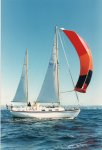
Seadog 30 ketch - usually triple keel but there is a single encapsulated single keel 'Deep Seadog' version. Built like a brick-you-know-what. Essentially a motor-sailer that sails well F4 and above. Old now, though many will have been 'spruced up' and updated but quite reasonable £s nowadays. I'd have another.

Mine that was.

Luna Spinnaker small.jpg
 
Seadog 30 ketch - usually triple keel but there is a single encapsulated single keel 'Deep Seadog' version. Built like a brick-you-know-what. Essentially a motor-sailer that sails well F4 and above. Old now, though many will have been 'spruced up' and updated but quite reasonable £s nowadays. I'd have another.

Mine that was.

View attachment 121345
I think these older designs have a lot to recommend them as a cruising boat: the displacement to carry stores, even in the smaller sizes, the weight not to be fussed too much about the weather, shallow draft to visit all the places worth seeing, such as the Danish South Sea or the Waddenzee and a thick hull with excellent point of impact resistance to keep you afloat if you do find something on the bottom exploring that distant creek or the uncharted corner in the Swedish skerries.
 
It really depends on how far North you want to go! But I'd echo those who suggest that good heating is essential, along with ensuring that water cannot get below except in controlled manners. Somewhere to leave wet outer garments without making the living area wet is a good idea. A sheltered watch-keeping position is useful; if you have wind-vane and autopilot, the need for a sheltered helm is less necessary, though a means of controlling the autopilot from a sheltered location would be a "nice to have"; it's unlikely you'll achieve that with a wind-vane, but it's something to consider.

The Scandinavians all say "There's no such thing as bad weather, only bad clothes". Make sure your clothing will a) keep you dry and b) keep you warm. But if you're expecting to encounter freezing conditions, it's ALSO important that you don't sweat inside your clothes; moisture can be wicked out through your clothing until it reaches a layer where it freezes, destroying the efficiency of the clothing. So multiple, readily adjusted layers are strongly recommended, and if you do get hot, make sure you cool down again.

Ensuring you can make hot drinks (at least) underway is important. If you anticipate weather where operating a stove would be hazardous, fill thermos flasks.

It doesn't sound like you're considering the real Arctic regions, but if you are, be aware that ice is dangerous. Even small lumps are much larger below the water, and they are unstable and liable to overturn without warning. Obviously, avoid hitting ice, but less obviously, give any that you see a wide berth.

Again, if you're heading into the true Arctic, be aware that there is, for practical purposes, no SAR facility. Self-sufficiency is essential, and in some regions, you may be required to carry a gun for defence against Polar Bears (Svalbard has this requirement).

A well-known saying amongst polar people is "Any fool can be uncomfortable in a tent". It isn't about roughing it - it's about ensuring that you maintain good living conditions, despite the challenge of the environment. Roger Taylor and Ming Ming embodied that par excellence!
I will definitely be reading that
Seadog 30 ketch - usually triple keel but there is a single encapsulated single keel 'Deep Seadog' version. Built like a brick-you-know-what. Essentially a motor-sailer that sails well F4 and above. Old now, though many will have been 'spruced up' and updated but quite reasonable £s nowadays. I'd have another.

Mine that was.

View attachment 121345
lovely looking capable yacht that I didn’t know about - I will take a look, thanks ?
 
I have both sailed the Baltic in fall & spring (with ice on the water and frost onshore) and lived full time afloat in Northern climes (Canada).
The most important piece of equipment is some form of heating to keep the boat dry and pleasant to live on. I have tried solid fuel, gas (vented), diesel as in Reflex/Dickinson, electric and now Webasto diesel/forced air.

Solid is messy and requires constant attention.

The Reflex/Dickinson can backdraft in high winds, filling your cabin with black soot and your decks will eventually turn black, no matter how high your flue or sophisticated the cap.

Gas is expensive and must be vented to prevent asphyxiation and death by drowning due to condensation.

Electric has obvious short comings for non-marina use.

We currently have a Webasto, we love it and it has given us ten years of reliable service.

I cannot recommend a wheelhouse enough and there is absolutely no comparison to a soft or hard dodger for sheer liveaboard and cruising comfort. I sailed throughout winter in the Pacific North West with a hard-covered steering; yes, it is a significant improvement over anything else, but it pales in comparison to the fully enclosed wheelhouse arrangement we currently enjoy in our 3 - 5 months a year living aboard. It is by far the best part of the boat and we, quite literally, live in it.

The biggest problems with traditional motorsailers are their often ridiculously low SA/Displ. ratios and it is completely beyond me why that has to be.

LM built a number of (motorsailer) designs in the sub 30' category, also with twin keels and a reputation for decent sailing ability. Then there are such like the Degero which have a semi-closed hard dodger and more of a sailing hull.

I would also recommend a Colvic Watson for their exceptional wheelhouse, available in 25.6', 27.5' and 31.5" (ours), with the caveat that to have much of a pretense as to sailing ability you need to do two things:

a) Fair in the deadwood and profile the rudder(pretty much critical for any of the above, IMHO).

b) Add as much sail area as you can. We more than doubled ours over the standard model (214%, SA/Disp 17.8). In 10kts apparent we now easily approach 6kts. She can happily support this SA up to a F6 on a reach/close reach. Windward ability, in cruising terms, is perfectly acceptable (4.8kts in 12kts apparent ( 8.3kts true) at 40 degr, 7 degr leeway is realistic). We frequently average 6kts on passage. Do yourself a favour and choose a sloop. Do not pick one with bilge keels or remove them if you do (They were never intended to have them in the first place and they don't need any help to go any slower).

All these modifications are well within the capabilities of a somewhat functional amateur.

Anything a twin/bilge keel can do involving land, a pair of legs can do as well. We use ours at the drop of the hat in tidal waters, they store out of the way inside the boat and they cause zero drag. I would have no hesitation storing the boat with them ashore.

Get a good autopilot, not just a wind vane, it takes much of the stress out of the single handed business. We switch on ours the moment we reach open water. Its an ancient CPT wheel pilot (they are making them again in USA), it has zero smarts, is absolutely silent and will steer our tub even going downhill in a steep quartering sea while doing well over 7kts.

Best of luck.
Thanks for taking the time to post such a comprehensive reply I really appreciate it. Lots to consider here ! Thanks
 
It really depends on how far North you want to go! But I'd echo those who suggest that good heating is essential, along with ensuring that water cannot get below except in controlled manners. Somewhere to leave wet outer garments without making the living area wet is a good idea. A sheltered watch-keeping position is useful; if you have wind-vane and autopilot, the need for a sheltered helm is less necessary, though a means of controlling the autopilot from a sheltered location would be a "nice to have"; it's unlikely you'll achieve that with a wind-vane, but it's something to consider.

The Scandinavians all say "There's no such thing as bad weather, only bad clothes". Make sure your clothing will a) keep you dry and b) keep you warm. But if you're expecting to encounter freezing conditions, it's ALSO important that you don't sweat inside your clothes; moisture can be wicked out through your clothing until it reaches a layer where it freezes, destroying the efficiency of the clothing. So multiple, readily adjusted layers are strongly recommended, and if you do get hot, make sure you cool down again.

Ensuring you can make hot drinks (at least) underway is important. If you anticipate weather where operating a stove would be hazardous, fill thermos flasks.

It doesn't sound like you're considering the real Arctic regions, but if you are, be aware that ice is dangerous. Even small lumps are much larger below the water, and they are unstable and liable to overturn without warning. Obviously, avoid hitting ice, but less obviously, give any that you see a wide berth.

Again, if you're heading into the true Arctic, be aware that there is, for practical purposes, no SAR facility. Self-sufficiency is essential, and in some regions, you may be required to carry a gun for defence against Polar Bears (Svalbard has this requirement).

A well-known saying amongst polar people is "Any fool can be uncomfortable in a tent". It isn't about roughing it - it's about ensuring that you maintain good living conditions, despite the challenge of the environment. Roger Taylor and Ming Ming embodied that par excellence!
Lots of sound advice to consider and although I had thought about clothing your experience really shows. A transition area for wet gear would definitely be a fantastic addition ! Thanks
 
Top