Have you given up on a through-hull paddle log?

My paddle wheel works fine for the first two months but thereafter needs cleaning every few days. I have an old Stowe trail log for those times - very accurate and has a lovely analogue speed meter!

Interesting ... the Yacht trailed log I sold many years ago was as per Ships trailed log - distance through water - not speed...

That Yacht Log was in a beautiful mahogany box with all the gear .... I should have kept it ... must be wortth something now as antique !
 
So one school says the data is invaluable. Another school says they foul all the time. So let's say, for the sake of discussion, that the data may be off by 5-10% if a bit of algae or fishing line lodges somewhere. I've worked with MANY industrial flow meters.

Data that is off by 5-10%, when what I am correcting for (tide) is only on the order of 10%, is basically useless. I don't KNOW it is right, I just hope it is, and I can probably guess the tide with similar accuracy.

The only racing that ever interested me was strict one design. Too many games and too much or an arms race in any rating-based system. I recall one regatta where we had to swap boats based on a drawing between races. I liked that. You had 15 minutes to tune it to your weather expectations.
I agree that 10% off is useless, but that doesn't mean that paddle logs can't be useful, though I enjoyed the Seamaster electronic log I had around 1980. With care, they can be with a few percent, and as long as the known errors are taken into account I at least found mine invaluable even when cruising. I knew what speed I would be getting with a clean bottom and prop, so it was a relatively simple matter to set the revs after leaving a berth (naturally) and check if the speed shown was what was expected. A calibration early in the season would be sufficient, and I would set it to be about 0.1-0.2 kn overreading at around 6.5 knots, knowing that it would slightly underread below this speed and vice versa.

It is clearly possible to sail without knowing the water speed, and I have done it myself often enough, but I find it an invaluable guide when windward sailing, and also it has been very helpful when motoring in open water when the prop was fouled by weed and the difference in speed of perhaps half a knot or more could not easily be checked by GPS alone.
 
Interesting ... the Yacht trailed log I sold many years ago was as per Ships trailed log - distance through water - not speed...

That Yacht Log was in a beautiful mahogany box with all the gear .... I should have kept it ... must be wortth something now as antique !
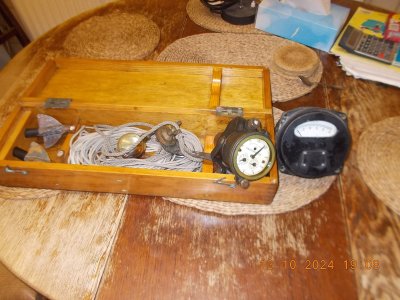
I have a Walker's Knotmaster, too! The boat still has a plate for it on the quarter, but it stays at home, now. I also have a speed meter for it, but it doesn't work unfortunately.
 

Attachments

  • DSCN1559.JPG
    DSCN1559.JPG
    711.5 KB · Views: 6
... also it has been very helpful when motoring in open water when the prop was fouled by weed and the difference in speed of perhaps half a knot or more could not easily be checked by GPS alone.

You could turn 180 degrees for a few minutes, and check the speed in the reverse direction, and average. Would take about 20 seconds but would be more accurate. That is how motoring speed checks are normally done, since this corrects for wind and waves as well. True?

Sailing upwind similar information, plus more, is gleaned by tacking. Also takes only seconds.
 
I've had the nasa electronic log for 2 or 3 years now. It is a very definite step forward from the paddlewheel version. I only had to replace the transducer. As mentioned above slime and hull growth does slow it down as the season progresses but it can be scrubbed from the outside, that's a plus for me as I hate having to remove the transducer while the boat is in the water.
 
I've had the nasa electronic log for 2 or 3 years now. It is a very definite step forward from the paddlewheel version. I only had to replace the transducer. As mentioned above slime and hull growth does slow it down as the season progresses but it can be scrubbed from the outside, that's a plus for me as I hate having to remove the transducer while the boat is in the water.
I’ve got used to the transducer malarkey, not that I enjoy it. I had my baptism of fire with it once. Got invited to sail on an 8M in the British Classics regatta. 1st words from the skipper.., ‘could you just pop the log impeller in for me?’ All went well, but my thoughtfulness of bringing a change of trousers was in my mind.
 
So one school says the data is invaluable. Another school says they foul all the time. So let's say, for the sake of discussion, that the data may be off by 5-10% if a bit of algae or fishing line lodges somewhere. I've worked with MANY industrial flow meters.

Data that is off by 5-10%, when what I am correcting for (tide) is only on the order of 10%, is basically useless. I don't KNOW it is right, I just hope it is, and I can probably guess the tide with similar accuracy.

The only racing that ever interested me was strict one design. Too many games and too much or an arms race in any rating-based system. I recall one regatta where we had to swap boats based on a drawing between races. I liked that. You had 15 minutes to tune it to your weather expectations.
I think depends on how you sail. Tootling around the bay isn't really the same as a 1000nm passage where a number of sail changes, changing conditions, variable currents, etc all make electronics instrumentation more useful. You learn at what true wind speed a reef is needed. It's useful to know why the boat speed has dropped, because you can see a foul tide effect on the boat speed vs SOG.
I wouldn't be with a paddlewheel as we sail to true wind direction on the autopilot. Something we couldn't do without the paddlewheel
 
My old Raymarine paddlewheel works extremely reliably, probably because I remove and replace with the blank whenever I put the boat away on her mooring - it only takes a minute to swap them over, and no more than a teacup's worth of water spurts in - consequently fouling is never an issue.

When very occasionally it doesn't work at first, a sudden stop, then run astern then forward again gets is going.

I recently had a persistent under-reading issue but a slightly more thorough clean with an old toothbrush dislodged a wee bit of crustacean grit from one side. (Trying to calibrate this out at first didn't work, as the slowing effect due to friction was different at different boat speeds!)

Recalibrating is quick and easy to do (I'm currently within a few % of factory standard) and it's certainly more than accurate enough for the coastal and cross-channel type sailing I do. I like comparing boat speed to SOG to see if it tallies with the tidal rate prediction at the time etc - all part of the enjoyment for me!
 
You could turn 180 degrees for a few minutes, and check the speed in the reverse direction, and average. Would take about 20 seconds but would be more accurate. That is how motoring speed checks are normally done, since this corrects for wind and waves as well. True?

Sailing upwind similar information, plus more, is gleaned by tacking. Also takes only seconds.
You could do but I am not psychologically well-attuned to going in the wrong direction halfway through a passage. More importantly, it would not be accurate because the wind and wave conditions could be very different. In this instance it is the relative speed that matters, and even a badly calibrated log will give the correct answer.
 
Just a comment ....

If your PW log stops working ... try this ....

Turn it 180 degrees in the through hull ... it does not care despite some having an arrow showing FWD .. the magnets passing the reed are the important bit and makes no odds which rotation ... CW or CCW. It may just start to work - having the PW now being 'pushed' opposite direction.
 
I still use a Stowe trailled log. You make lots of new friends who helpfully advise that you are trailling a rope. It is accurate and independent of other systems with its own batteries. The in Hull paddle wheel log has not been used for several years now.
 
I still use a Stowe trailled log. You make lots of new friends who helpfully advise that you are trailling a rope. It is accurate and independent of other systems with its own batteries. The in Hull paddle wheel log has not been used for several years now.
The Stowe trailing log was, by far, the best, most accurate log I ever used. I kept mine going for as long as I was able but eventually the supply of spinners dried up. I still miss it and would buy another new one without hesitation if they came back on the market.
 
Is there any reason the trailing log 'spinners' couldn't be 3D printed or otherwise accurately fabricated, in a world where metal and composite parts can be produced to order?

This thread has taught me I want a trailed log. :)
 
I was looking at "trailed logs" on Google. Naturally I found myself back on the forum almost immediately, firstly with a 2005 enquiry from Mr Plum (who mentioned trailed logs here last week...where have 20 years gone? 😯)...

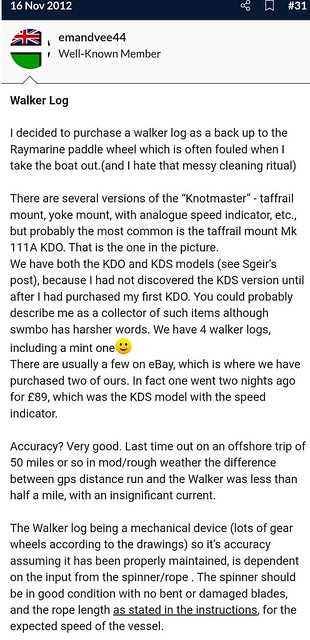
...then this, from 2012, which I find myself entirely persuaded by...

54848285917_caf855cc83_z.jpg
 
I've got a Walker trailing log in the locker but it is a real faff to use it unless you are heading off on a hundred mile trip. The Stowe trailing log was a spinner on the end of an electrical cable which didn't spin. Deployment and retrieval were simple with no possibility of tangles. The display could be mounted anywhere and internal wiring to the transom installed for the plug on the transducer cable.
There was also a Wasp log which was similar to the Walker KDS, displaying speed as well as distance, less well made than the Walker but a lot cheaper.
 
How long did the cables need to be? I can't imagine needing any log in the Solent, where it may sometimes be a bit busy to be pulling something astern.

But going further, I reckon I'd quite enjoy the faff of setting up the Walker log. In the same way there could be easier ways of travelling, than sailing. 😄
 
Top