Hank On Jib Numbering v Size

That makes sense.

In my case I had a failure to furl in 25 -30 knots - we were heading in to wind at about 40 degrees to go in to Dover port in quite big seas. They told us to come in the east entrance and at the last second gave an urgent change as a ferry was leaving through that entrance. This meant an urgent drop of sails as we were getting very flukey high gusts off the walls of the port and at that point the 6 month old largest most expensive Harken furler would not furl , and ended with me lying on the front deck under green water with feet lodged in to the inner stay and hauling like mad until I got a bit away and then trying to tie the rest up with its own sheets. This sail weighs 50 kg and flapping around is no fun! A hank on sail , even if flapping about to get it in the bag would come down straight away with a downhaul and my custom bag incorporates two long pull straps so that if I can't get it in neatly I just need loop them round the big mess and tighten down to have it safe if not neat. Against that background safety always comes first to me and hank on is safer
You do know that it is standard practice on all moderately sized boats and upwards (certainly on a 50 footer) to turn downwind before trying to furl a genoa in anything above a light zephyr? Also often helps to detension backstay if pulled on hard.
We certainly turn downwind in any breeze in a 38 footer.
We also occasionally use VERY CAREFULLY the electric halyard winch to assist with starting furling. But the rule is NEVER use more than two turns on winch and NEVER use self tailer - so if anything jambing the rope slips on the winch and know to sort before proceeding.
 
Have you ever thought about hw many people don't make it to the Caribbean because their furlers broke! Honestly I know to riggers who make very good 6 figure incomes every year and they tell me that a good third of that comes from repairing furling systems - and if they're over 4 or 5 years old they simply won't repair them because they are junk at that point.
You can do whatever you want, that is fine.
But you need to give some better evidence to suggest that genoa furlers are a common source of failure crossing the Atlantic to the Caribbean.

The westbound Atlantic crossing is the one route with the best data on gear strengths and failures- because for over a decade (perhaps two) there is a comprehensive survey of 300+ boats doing just that on the ARC. Have you studied their survey results and can you point to any evidence to support your assertion?
A lot of stuff breaks - from masts to coffee makers. But I have never seen jib furlers listed as a material issue. Not least as, unlike main furling, if there is an issue can point downwind and drop the sail.

I would not have - and indeed did not have - any concerns about a jib furler for crossing the Atlantic westbound, assuming like everything else it has been checked over before departure. 50 other bigger things to worry about before that.

So enjoy your voyage but unless can point to evidence in the ARC surveys perhaps better not to spread misinformation.
 
You do know that it is standard practice on all moderately sized boats and upwards (certainly on a 50 footer) to turn downwind before trying to furl a genoa in anything above a light zephyr? Also often helps to detension backstay if pulled on hard.
We certainly turn downwind in any breeze in a 38 footer.
We also occasionally use VERY CAREFULLY the electric halyard winch to assist with starting furling. But the rule is NEVER use more than two turns on winch and NEVER use self tailer - so if anything jambing the rope slips on the winch and know to sort before proceeding.
Yes I do know that, as I said in an emergency situation not of our making we had to turn in to wind. That situation was extremely dangerous. It may never reoccur but with a hank on it simply won't be a problem.

We don't have any electric winches and I was taught never to use a winch to furl anyway; though I appreciate many do.
 
The additional risk you are subjecting your crew and yourself to is not insignificant.

Do you have anything to support that - have injuries or deaths dropped since furling gear became commonplace ? Millions of miles were done over many years with hank ons without issue.
You have a very biased view of furlers based off a very small sample.
I will agree with this - even two local riggers only see a few hundred boats a year but both advised against furling for long term cruising, despite the prospect of making lots of money selling me stuff, based on their many years in business so I think it would be foolish to ignore such expert advice.
If you have unlimited funds, why are you not simply setting up with twin headsail furlers? Why is £50k a problem to somebody with unlimited funds?
Can I afford £50K to solve a problem I don't believe I have and actually (given my experience and the advice received about furlers) double the problem by having two things to go wrong instead of the one I did have? Yes, yes I can. Would I be stupid enough to do so - I think you can guess the answer.

It has worked for you - I also know lots of others it has worked for. But then everything works until it doesn't and I am trying to eliminate possible problems more that make life convenient - I mean what else is there to do all day when sailing if you're not doing sail changes?

If I see you in the Caribbean I'll let you know how its all gone - if I decide to change back one day to furling I'll be sure to say so here but for now I have no intention of doing so . I hate to cite YouTube but if you take a look there are a lot of people who have done the same as me for very similar reasons
 
Do you have anything to support that - have injuries or deaths dropped since furling gear became commonplace ? Millions of miles were done over many years with hank ons without issue.

I will agree with this - even two local riggers only see a few hundred boats a year but both advised against furling for long term cruising, despite the prospect of making lots of money selling me stuff, based on their many years in business so I think it would be foolish to ignore such expert advice.

Can I afford £50K to solve a problem I don't believe I have and actually (given my experience and the advice received about furlers) double the problem by having two things to go wrong instead of the one I did have? Yes, yes I can. Would I be stupid enough to do so - I think you can guess the answer.

It has worked for you - I also know lots of others it has worked for. But then everything works until it doesn't and I am trying to eliminate possible problems more that make life convenient - I mean what else is there to do all day when sailing if you're not doing sail changes?

If I see you in the Caribbean I'll let you know how its all gone - if I decide to change back one day to furling I'll be sure to say so here but for now I have no intention of doing so . I hate to cite YouTube but if you take a look there are a lot of people who have done the same as me for very similar reasons
The problem with your argument is that you are suggesting everybody else has got it wrong. We don't think so. There is no chance I would ever swap to hank on sails under any circumstances. I don't think you have ocean sailed before so from an experience perspective I and others on here making comments have that experience. You are doing it with just two people. You don't get much sleep with just two. A third person as crew gives you each twice as much off watch time. Off watch time equals sleep. Hank on sails mean potentially a lot less sleep as they are more effort and more risk in my view. Clearly you won't take advice but that entirely you choice. You may have a perfect light wind crossing and tell us you were right and we were all wrong. Or you could have a rough crossing with multiple +40kt squalls as friends did this winter. They were super happy they set up their yacht with twin headsails and twin poles. Something I recommended before they left. They never needed to leave the cockpit at night and venture on to the foredeck in 4 metre seas. Quite a bonus I think.
 
The beauty and simplicity of a detachable Solent stay is it can attach right up by the forestay (12 to 18 inches aft) which may allow use of pre existing reinforcements on mast and deck. Not an inconsiderable issue on a catamaran I would think. Mine uses the same large attachment fitting as the forestay with a Highfield lever to tension. You can hank on the next sail before dropping or in my case rolling away the genoa. It is more work than a furler, especially singlehanded and I understand the psychology of "let's wait and see if it drops" leading to delaying sail changes. Dropping it in 30knts+ is exciting but then so is furling. And not something I would entertain if the bow kept slicing through waves. But in the real world without infinite resources to experiment and equip, it provides a simple solution for multiple headsails.

View attachment 154882
As others have said, I much prefer a furler for my genoa which is 150%. And my mast is only 11m.
I reckon that rig is the way to go. We used that on our Moody 33 on two Carib cruises. Don't need second pole, used boom prevented out on opposite side to pole., fantastic.

On other ocean crossings where I've been delivering yachts, the old enemy chafe has been an issue. Especially on jib furling lines. Quite interesting when one breaks and gives you more sail than you actually need.....

Regarding big headsails with hanks, I sailed a lot on Nicholson 55's. All hanked on.for a sail change....twin foils...hoisted the new in the Lee of the old. Flaked changed sail on foredeck the lashed it high on guardrail. No bags on foredeck except in harbour... Helps if you are fully crewed!
 
You can do whatever you want, that is fine.
But you need to give some better evidence to suggest that genoa furlers are a common source of failure crossing the Atlantic to the Caribbean.

The westbound Atlantic crossing is the one route with the best data on gear strengths and failures- because for over a decade (perhaps two) there is a comprehensive survey of 300+ boats doing just that on the ARC. Have you studied their survey results and can you point to any evidence to support your assertion?
A lot of stuff breaks - from masts to coffee makers. But I have never seen jib furlers listed as a material issue. Not least as, unlike main furling, if there is an issue can point downwind and drop the sail.

I would not have - and indeed did not have - any concerns about a jib furler for crossing the Atlantic westbound, assuming like everything else it has been checked over before departure. 50 other bigger things to worry about before that.

So enjoy your voyage but unless can point to evidence in the ARC surveys perhaps better not to spread misinformation.
I got my own survey from 12 crossings. :cool:
 
The problem with your argument is that you are suggesting everybody else has got it wrong. We don't think so. There is no chance I would ever swap to hank on sails under any circumstances. I don't think you have ocean sailed before so from an experience perspective I and others on here making comments have that experience. You are doing it with just two people. You don't get much sleep with just two. A third person as crew gives you each twice as much off watch time. Off watch time equals sleep. Hank on sails mean potentially a lot less sleep as they are more effort and more risk in my view. Clearly you won't take advice but that entirely you choice. You may have a perfect light wind crossing and tell us you were right and we were all wrong. Or you could have a rough crossing with multiple +40kt squalls as friends did this winter. They were super happy they set up their yacht with twin headsails and twin poles. Something I recommended before they left. They never needed to leave the cockpit at night and venture on to the foredeck in 4 metre seas. Quite a bonus I think.
The voice of experience.
And from my much more limited trans Atlantic experience, it is very likely that there will be short sharp squalls at times in the crossing - some can be predicted by watching the clouds (esp in daytime) or running radar regularly, but it is difficult to predict whether they will actually hit and how windy. Being able to furl, or part furl, a genoa without touching the pole is a huge safety feature which makes for much more relaxed night sailing.
There are lots on here who have done Atlantic crossings, many such as the Capn lots of times - and suspect few would be raising concerns about a properly serviced/inspected jib furler system. That includes careful check for chafe on any rope, and removing the source of chafe if there is any before replacing the rope
 
I many ways I miss my old hank on sails. They set so much better and as I only have a small boat the sizes are quite manageable. The hank on No1 genoa was half the weight of an equivalent furling genoa and dropping it to the deck and lashing it under elastics and guardrail netting took only seconds. Getting even my small furling genoa up or down the foil is something I only do once a season and would not contemplate doing at sea. The simplicity and redundancy of having 5 sails to choose from has a certain appeal but advancing years has made a furler and Solent stay a more sensible option for me.
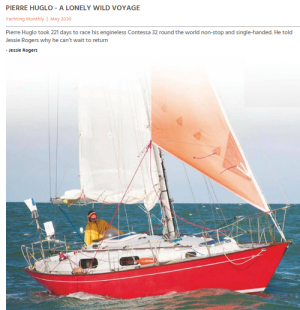
Pierre Huglo knows a bit about long distance sailing and used hank on sails but no engine or sprayhood is a step too far for me.
1681478333540.png
 
Last edited:
When quite a few decades younger and even more foolish I used to sail a 42ft monohull sloop, 10 ton displacement. She came with twin forestays, side by side. Many said they were anathema and for ultimate performance they probably did reduce the luff tension a bit. The only time I experienced a sail hank catching both stays was when crewing on someone else's boat that also had twin forestays.

Not ocean crossing but quite a few passages of a few hundred miles north of 60 N and one above the arctic circle so some open ocean experience.

My normal sail handling procedure was to have two sails hanked on to its stay, the ready to use one being stowed along the top guard rail. If changing down and the wind looked like increasing further the larger was bagged and sent below and the next smaller hanked on ready for use. Rather than hopefully hanging on to too much sail the rule was "if it looks as if a sail reduction might be needed do it now". Sail changes were usually made close hauled, tack and heave to, then drop the sail across the narrow foredeck.

This process worked fine both with sailing school/charter crews and when single handed, though my sail area would usually be a bit more conservative when single handed.
 
Trident,

You are the skipper, its ALL your responsibility.

Do let us know how the adventure pans out. I note that others who have made the crossing continue to support YBW with their experiences after they arrive safely - I look forward to reading your future posts.

I am a little bit sceptical of the advice to buy racing yachts sails. Such sails are not built for longevity (which is one reason you may find many available). They tend to be built very lightweight from delicate cloth, commonly exotic laminates, which do not enjoy being stuffed into sail bags nor dragged unceremoniously across the deck. I hope you get lucky.
Neptune sets plenty of trials for us to endure out on the rolling deep. :)

Which is why the skipper tries to reduce the opportunity of failure. Watching for chafe being one simple chore you will need put into practice every day (along with checking shackles etc etc).

You have not mentioned what is the master plan after you cross the Atlantic - or if you have mentioned it - I missed it.

I'm sorry that your thread did not quite answer your original question, but a sailmaker will give you chapter and verse. However the drift of this thread is not lost - it did give you opportunity to articulate your views and decide your original conclusions and plan are correct. I, and others, might not agree with you - but we are not the skipper of your yacht - you are aware of what we think.

I admire your courage, and anyone who crosses oceans.

Fair winds, live the dream

Jonathan
 
Trident,

You are the skipper, its ALL your responsibility.

Do let us know how the adventure pans out. I note that others who have made the crossing continue to support YBW with their experiences after they arrive safely - I look forward to reading your future posts.

I am a little bit sceptical of the advice to buy racing yachts sails. Such sails are not built for longevity (which is one reason you may find many available). They tend to be built very lightweight from delicate cloth, commonly exotic laminates, which do not enjoy being stuffed into sail bags nor dragged unceremoniously across the deck. I hope you get lucky.


Which is why the skipper tries to reduce the opportunity of failure. Watching for chafe being one simple chore you will need put into practice every day (along with checking shackles etc etc).

You have not mentioned what is the master plan after you cross the Atlantic - or if you have mentioned it - I missed it.

I'm sorry that your thread did not quite answer your original question, but a sailmaker will give you chapter and verse. However the drift of this thread is not lost - it did give you opportunity to articulate your views and decide your original conclusions and plan are correct. I, and others, might not agree with you - but we are not the skipper of your yacht - you are aware of what we think.

I admire your courage, and anyone who crosses oceans.

Fair winds, live the dream

Jonathan
I think you have to read the context of advice to buy racing sails - they're cheap and plentiful so play with a few and when you find the size and shape that suits use that as a basic pattern to get something made that will last.

I went across to the Sailing Anarchy forum where there was an 8 page discussion on this subject with the OP giving a long list of why he used hank on sails (all sensible and all I agree with) but a far more balanced set of responses, many like here think it a retrograde move but an equal number support it. I did note those who had done many ocean crossings, like 75000 NM were firmly in the ok with hank camp - and there was certainly a more pro hank contingent from Australia and NZ - citing sail shape for utility as the main reason - perhaps less downwind sailing there?

Our plans are to go everywhere we want over the next 6 years or so. I'm not much of a fan of the Caribbean from my previous times there; lovely local people, pretty scenery , spoiled by ex-pats who sit there year after year for the cheap rum and tourists who treat the locals poorly. (After being helped out by two local brothers in the BVI for example, I paid for the parts they had run around to find for me and gave them some cash for their time - which the older handed back - its was Valentine's Day so eventually persuaded him to take something to buy his GF a meal - but his younger brother , about 17, just said "just remember my name, if you see me in the street say hello" - apparently no matter how nice these guys were most visitors, white folks, would forget them and ignore them immediately they had what they wanted...

So Panama, South Pacific , visit friends in NZ for 6 months or a year, then Australia , then undecided on SA or Suez for the return. However , we may also do the Med, Suez, Indian Ocean, South Africa , St Helena, Caribbean rather than the traditional route from the Canaries - we'll make that decision in about August when we are in the middle of the Med - much like Lynn and Larry Pardey describe in one of their books; they could go left or right to get home to the US and only decided at the last minute. Fortunately the winds works both ways at roughly the same time :)
 
Well we went a long way with only hank on sails when we were younger. It was a classic CCA / early IOR design with a short boom and large overlapping headsails which on paper (or on the internet) ahould have been the least workable option. But it also had a deep keel, a lot of lead and narrow-ish beam, so it would put it's rail in and stay there.

Our inventory included a good, rugged No2 genoa of about 135% overlap. It had a fairly high clew so you could not only see under it, but it didn't scoop green bow waves and most importantly, it could be poled out with a level spinnaker pole that had equal tension on the foot and leach and didn't roll into the water running downwind in the trades. A tight leach to the genoa and main when running is the best way to counter rolling on these boats. Rather counter intuitively, when we became over pressed, the boat settled by putting a reef in the much smaller main and even dropping it completely in squalls , rather than reducing the size of the headsail. Up wind this took us from F2 to F5 and downwind up to F6+. A raised clew also allows it to remained powered up reaching without too much twist.

We then had a very rugged No3 (or full hoist 100% Solent jib but with a hollow leach) again with a fairly high clew (but not as high as in Pierre Huglos) and this not only had a deep reef parallel to the foot, but another line from the full hoist tack to the reefed clew. A second sheet rigged on here would allow a very easy shedding of 10% of its area without the need to touch the halyard. This took us upwind in F5 - F7 and off wind pretty much until bare poles. We did carry a ISAF sized storm jib, but apart from getting it out before every passage to grease the hanks and check it hadn't been attacked by insects / rats / old age, it never saw the light of day.

If we had the means, then a removable stay just aft of the forestay would have allowed us to pre-rig the No3 and swap without having to un-hank the No2. Also we could have run with the poled out No2 and used the No3 instead of the main and saved wear on the gooseneck / mainsail.

The 'gear change' that did worry us was if we were running in the trades in F5 with the poled out No2 and had to head back upwind for a man overboard. Realistically with only one left on board, this was way too complicated to be realistic especially with only a 9hp engine that would only push the boat in flat water. We accepted that we would never recover the other person if detached from the boat, so our 'clipping on' regime reflected this reality. When visiting the US Naval Academy we did watch the early trials of the 'crash stop' MOB drill being developed but never had the courage to try it in a blow on our own boat as our budget could have been overwhelmed by damaging a sail.

The tiny engine and 10 gallon fuel tank also influenced our light wind inventory. We carried a (quite tired) Ratsey & Lapthorn, small panelled, No1 which was about 155% overlap. This was completely deck sweeping and made of quite light cloth. It did however get us moving upwind in any discernable air movement, although it takes a lot of patience to be happy with 50 mile days. But better than nothing but probably only used less than 5% of the time if that. Downwind we had a .5oz radial head that would inflate with a fart and a 1.5oz flat cut spinnaker that would run / reach in anything we had the nerve / energy to fly it. This was swapped in Annapolis for a cruising chute we found secondhand in Bacons. Both started in generic snuffers but ended up being flown conventionally until we met Étienne at ATN who let us have a snuffer that worked.

I think these days, the No1 would be replaced with a Code 0 on a short prodder and that together with inner forestay would make it all quite workable. Although multiple rollers are obviously well proven solutions, it's worth bearing in mind that when coding a boat, consideration has to be given to the stability implications of increased 'top hamper'. I have seen shallow draught mid thirty foot cruising boats with two rollers, in mast furling, goal posts covered in solar panels, wind generator, radar, outboard on the push pit, old Aries on the transom, RIB on the cabin roof, etc. It's got to have some effect.
 
I think you have to read the context of advice to buy racing sails - they're cheap and plentiful so play with a few and when you find the size and shape that suits use that as a basic pattern to get something made that will last.

I went across to the Sailing Anarchy forum where there was an 8 page discussion on this subject with the OP giving a long list of why he used hank on sails (all sensible and all I agree with) but a far more balanced set of responses, many like here think it a retrograde move but an equal number support it. I did note those who had done many ocean crossings, like 75000 NM were firmly in the ok with hank camp - and there was certainly a more pro hank contingent from Australia and NZ - citing sail shape for utility as the main reason - perhaps less downwind sailing there?

Our plans are to go everywhere we want over the next 6 years or so. I'm not much of a fan of the Caribbean from my previous times there; lovely local people, pretty scenery , spoiled by ex-pats who sit there year after year for the cheap rum and tourists who treat the locals poorly. (After being helped out by two local brothers in the BVI for example, I paid for the parts they had run around to find for me and gave them some cash for their time - which the older handed back - its was Valentine's Day so eventually persuaded him to take something to buy his GF a meal - but his younger brother , about 17, just said "just remember my name, if you see me in the street say hello" - apparently no matter how nice these guys were most visitors, white folks, would forget them and ignore them immediately they had what they wanted...

So Panama, South Pacific , visit friends in NZ for 6 months or a year, then Australia , then undecided on SA or Suez for the return. However , we may also do the Med, Suez, Indian Ocean, South Africa , St Helena, Caribbean rather than the traditional route from the Canaries - we'll make that decision in about August when we are in the middle of the Med - much like Lynn and Larry Pardey describe in one of their books; they could go left or right to get home to the US and only decided at the last minute. Fortunately the winds works both ways at roughly the same time :)
The problem with picking up second hand sails is you need to get the sheeting angle right for your particular boat such that the lead for the sheets actually arrived at the genoa tracks in the correct position. When we installed an inner roller furler a furling jib, we sat down with sailmaker and the rig dimension and track positions in a CAD package. He produced a perfect drawing of our rig and we superimposed the sail options on the rig. We could see which sail sizes and cut had the desired area and sheeting angle to place the sheets on the tracks in the position we wanted. The result was a perfect sail first time. Its now done many thousands of miles reliably. Trial and error is far less satisfactory in my eyes. You buy some second hand sails then eventually have one made thats right? Why not just straight to the sailmaker and avoid the cost of a number of second hand sails?
 
Last edited:
The problem with picking up second hand sails is you need to get the sheeting angle right for your particular boat such that the lead for the sheets actually arrived at the genoa tracks in the correct position. When we installed an inner roller furler a furling jib, we sat down with sailmaker and the rig dimension and track positions in a CAD package. He produced a perfect drawing of our rig and we superimposed the sail options on the rig. We could see which sail sizes and cut had the desired area and sheeting angle to place the sheets on the tracks in the position we wanted. The result was a perfect sail first time. Its now done many thousands of miles reliably. Trial and error is far less satisfactory in my eyes. You buy some second hand sails then eventually have one made thats right? Why not just straight to the sailmaker and avoid the cost of a number of second hand sails?
Adding a second sheet (with a snatch block) closer to the forestay (I have forgotten its proper name.) to control the sheeting angle should cover most sail shapes without vast expense.
 
Adding a second sheet (with a snatch block) closer to the forestay (I have forgotten its proper name.) to control the sheeting angle should cover most sail shapes without vast expense.
Barber hauling?

Cheap as chips - and a use for an LFR if you need to do it frequently and set up for the need. Our sheeting angles are quite narrow and we use 2 sheets when off the wind, one on the track and one to a transom block - balancing the 2 to get a wider sheeting angle (and I've forgotten if the concept has a name. :)). It is more complicated (but what else are you doing when on long passages) and needs a spare winch (or a block and appropriate clutch).

Jonathan
 
Barber hauling?

Cheap as chips - and a use for an LFR if you need to do it frequently and set up for the need. Our sheeting angles are quite narrow and we use 2 sheets when off the wind, one on the track and one to a transom block - balancing the 2 to get a wider sheeting angle (and I've forgotten if the concept has a name. :)). It is more complicated (but what else are you doing when on long passages) and needs a spare winch (or a block and appropriate clutch).

Jonathan
We have long genoa tracks with a car for each furler. Swapping from one sail to the other is super simple. No barber hauler blocks banging on the deck. If we are beam reaching here between the islands we have the cars already set so we can furl one sail away and the other one out with minimal hassle and good sail shape once the sail is out and winched in.
 
The problem with picking up second hand sails is you need to get the sheeting angle right for your particular boat such that the lead for the sheets actually arrived at the genoa tracks in the correct position. When we installed an inner roller furler a furling jib, we sat down with sailmaker and the rig dimension and track positions in a CAD package. He produced a perfect drawing of our rig and we superimposed the sail options on the rig. We could see which sail sizes and cut had the desired area and sheeting angle to place the sheets on the tracks in the position we wanted. The result was a perfect sail first time. Its now done many thousands of miles reliably. Trial and error is far less satisfactory in my eyes. You buy some second hand sails then eventually have one made thats right? Why not just straight to the sailmaker and avoid the cost of a number of second hand sails?
Exactly the approach we are taking with the plan to fit 2 furlers. Like your boat we have long tracks (actually 2 tracks) and the plan once the second inner furler is fitted to transfer all the measurements to the CAD programme and design the new sail plus recutting the existing genoa for use on the outer stay to suit. Only unresolved issue will be that there is only one pair of winches and no good place to fit another pair.
 
Top