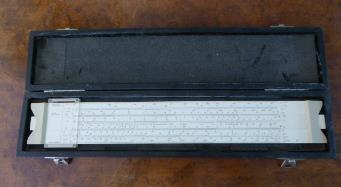
GPS is sooo yesterday.

Reminds me of my maths teacher: " You won't walk around with a calculator in your pocket when you're in work".
Mine said

"Neeves, I've been waiting for you to come and buy a slide rule."

And I still have that same slide rule - my grandchildren think its a joke, but then I have some George III pennies - they think they are a joke too.

Jonathan
 
We started with charts, DIviders. Compass, Watch, and Sextant. They got us there. (mostly,).
Calculators and programs were WOW. Then my first sat Nav. Thought I was an Astronaut (almost).
THEN GPS. and mine still puts my car in fields in middle of nowhere. BUT. Will put my bow up to most channel markers at sea.
Dead flat water. NO hills and clear sky's. Help a lot.
Anybody old enuff will remember the US Military used to regularly put navigational "diversions/offsets" into the system to stop OTHER Military etc using it to direct Missiles etc.
When they took it off. It was they had another more effective/accurate system. Still do.
But we don't get near it yet? as far as I know..
Me. I still practice with my Sextant and Aero Tables. They simpler than Marine ones.
My Citizen Solar watch has run for over 23 yrs. with around 7 seconds variation in that time. NEVER touched.
I use it as my chronograph comfortably.. Never needs winding NOR a battery. Just keeps plodding along.
Old school is still the safest. Most reliable in most things.
 
We started with charts, DIviders. Compass, Watch, and Sextant. They got us there. (mostly,).
Calculators and programs were WOW. Then my first sat Nav. Thought I was an Astronaut (almost).
THEN GPS. and mine still puts my car in fields in middle of nowhere. BUT. Will put my bow up to most channel markers at sea.
Dead flat water. NO hills and clear sky's. Help a lot.
Anybody old enuff will remember the US Military used to regularly put navigational "diversions/offsets" into the system to stop OTHER Military etc using it to direct Missiles etc.
When they took it off. It was they had another more effective/accurate system. Still do.
But we don't get near it yet? as far as I know..
Me. I still practice with my Sextant and Aero Tables. They simpler than Marine ones.
My Citizen Solar watch has run for over 23 yrs. with around 7 seconds variation in that time. NEVER touched.
I use it as my chronograph comfortably.. Never needs winding NOR a battery. Just keeps plodding along.
Old school is still the safest. Most reliable in most things.

I think you may have an out of date understanding on how accurate leisure market Global Satellite Navigation Systems (GNSS) systems are. Selective Availability (SA) has been discontinued by the USA Government who control GPS. Indeed, SA is not even a feature on other GNSS service provider systems. It is just not an issue anymore. Some leisure system plotters now use Satellite Based Augmentation System (SBAS) which is used to improve positional accuracy. SBAS basically is the satellite interrogating multiple, accurate, known position places on the earths surface, comparing the calculated position, then applying correction data to the signals from the satellite.

Compass and sextant based fixes are simply inaccurate, time consuming, inconvenient and increase the probability of an incident caused by positional error. That is not to say they don't have a role as a back up, but as a primary method of navigation, they are inferior in every way to GNSS derived positions displayed on modern plotter systems.

GPS.gov: Selective Availability
 
I think you may have an out of date understanding on how accurate leisure market Global Satellite Navigation Systems (GNSS) systems are. Selective Availability (SA) has been discontinued by the USA Government who control GPS. Indeed, SA is not even a feature on other GNSS service provider systems. It is just not an issue anymore. Some leisure system plotters now use Satellite Based Augmentation System (SBAS) which is used to improve positional accuracy. SBAS basically is the satellite interrogating multiple, accurate, known position places on the earths surface, comparing the calculated position, then applying correction data to the signals from the satellite.

Compass and sextant based fixes are simply inaccurate, time consuming, inconvenient and increase the probability of an incident caused by positional error. That is not to say they don't have a role as a back up, but as a primary method of navigation, they are inferior in every way to GNSS derived positions displayed on modern plotter systems.

GPS.gov: Selective Availability
Of course. But anyone can take a moment to look at a screen.

It takes skill, dedication, mental adjustment, practice, skill and flair to determine ones position from the heavens. Only a talented few have been enlightened.

Plus what else are you gonna do to fill a bit of time on an ocean passage? You can't sleep 23 hours a day...although I've had crew who gave it a good shot......
 
Mine said

"Neeves, I've been waiting for you to come and buy a slide rule."

And I still have that same slide rule - my grandchildren think its a joke, but then I have some George III pennies - they think they are a joke too.

Jonathan
In 1969 I got a college maths prize of a beautiful Thornton Slide rule. A few years later I got my first Sinclair calculator and the slide rule never left its case.
1684924087301.png
I am amazed by what my Garmin watch can do and it will be considered old technology very soon.
 
In 1969 I got a college maths prize of a beautiful Thornton Slide rule. A few years later I got my first Sinclair calculator and the slide rule never left its case.
View attachment 157024
I am amazed by what my Garmin watch can do and it will be considered old technology very soon.

Still got my father’s slide rule and just for the mental exercise, it occasionally comes out of the box but I have never used it in marine navigation.

If I know where I am and weather permitting, I don’t need any high faulting navvy things to get safely where I am going.

If I don’t know where I am, I am lost and an accurate fixing aid should tell me where I am. Then, as above in line one.

I like the simple life and navigating at 6 knots ain’t too difficult.👍🏻
 
Last edited:
And quite frankly their advice has rung true for me. The ability to do mental and hand written arithmetic has served me well in my career. Often quicker than reaching for a calculator.
When paying in several cheques in the bank several years ago I was amused that I could add them up (which I had not done in advance) in my head faster reading the clerk's handwritten list upside-down than she could...
 
And quite frankly their advice has rung true for me. The ability to do mental and hand written arithmetic has served me well in my career. Often quicker than reaching for a calculator.
One of the things learned from my Dad is that when using a slide rule, doing a ballpark mental calculation is a useful exercise to get the power of 10 about right. I find I still use that technique today, refining with a calculator/spreadsheet as necessary.
 
When paying in several cheques in the bank several years ago I was amused that I could add them up (which I had not done in advance) in my head faster reading the clerk's handwritten list upside-down than she could...
My Father was a chartered accountant who started out long before calculators. He could have used an adding machine, but he could add a sheet of figures going down then check himself by going back up quicker than most people could do it once with the machine.

By the time I had a job that required that sort of thing, Excel had come along.
 
GPS on the hr. Neat and tidy. Booooring.
I use both. The sights are for one thing mainly. It's called SELF Satisfaction.
I can still do it Reasonably well.
We live on coast. I practice on my front deck and see how close I can get. It's surprising on a stable platform. "Interesting" at sea.
And I think of the old skipper that donated it to me in the '60's. Even the old plastic Davis aren't bad it you tune them b4 using.
And the day you lose your electricity at sea. You will be Soooo glad you practiced.I
I used to sail Adelaide th Strahan (Tassie) regularly (girl friend) yrs ago. ALways used Sextant.
 
And the day you lose your electricity at sea. You will be Soooo glad you practiced
More likely kicking yourself for not having up to date tables on board, making the thing a useless ornament.
Very few of us would be in trouble if the electronics went off. Sailing mostly in the channel I can either go north or south to get to land then east or west to find the bit of land I need. Exact position isn’t all that important to most sailors.
 
It is interesting that within living memory we have gone from navigating by stars, through Decca, GPS, single channel, multi channel, DGPS, switching off SA, and SBAS and yet many of the charts we use are relying on surveys that predate much of this technology. Here we see the next step forward in accurate navigation. But just how accurate do we really need? No doubt in the coming years we will see the electronics suppliers pedalling the latest greatest accurate to within 1mm or whatever when quite frankly we don’t need anything more accurate than what we had 10 years ago. This forum will no doubt progress from the current “GPS rocks and sextants are for Capt Birdseye” to “laser AHRS rocks and GPS is so inaccurate” feeding the drive to buy more kit we don’t need. Fine if you are trying to navigate some subsea vehicle large distances for which gps is unavailable. But adopting super duper electronic gadgetry for an application which doesn’t need it is a waste of resources.

Sailing is supposed to be fun and fulfil some inherent need. Navigating is part of the challenge as far as see it and can be more fulfilling than sailing itself. Who’s to say we should give up sextants or gps because they are inaccurate/rely on electricity? surely we chose to navigate the way we do because it gives us enjoyment, either from navigating or being able to focus on something else while the black box navigates
 
More likely kicking yourself for not having up to date tables on board, making the thing a useless ornament.
Very few of us would be in trouble if the electronics went off. Sailing mostly in the channel I can either go north or south to get to land then east or west to find the bit of land I need. Exact position isn’t all that important to most sailors.
Mmm I think you may be surprised by just how many yachts dont sail off south UK and go well offshore.

Once you are in a position where self reliance becomes the priority, back ups take a different part of sailing. Including having an up to date almanac.

It's handy to have a spare alternator on long distance. But as well as we can equip our own yachts, such items are not always available on those who trust engines to re charge ships batteries. In my experience a huge amount.

But as you say, no problem if you sail in local waters and you have a steering compass, hand bearing compass, echo sounder, charts, tide stream atlas and tide tables. I generally find mobile phones drop off around ten miles or so offshore depending on where you are do the signal can also be a useful nav back up if you got an app.

Main cause I've had of no engine in the middle of vast expanse has been exhaust blow out.

Jb weld, empty and cleaned food cans jubilee clips and attitude got me through one of these. :) :cool:
 
Knowing my LAT and Long has never really contributed to my sailing enjoyment. Conversely, not knowing has caused a good day to turn bad.

Personally, if folks want to wear hair shirts and scourge themselves for enjoyment, that’s okay. I can think of easier ways to avail myself of pleasure.

Before I sailed Ocean’s I used sextants for VSA and HSA. The HBC, charts, walker logs, tidal atlas. Later I used my Sextant for SRS running fixed and star fix. All was interesting.

The convenience of a modern plotter is exceptional and the productivity improvements regarding position knowledge, has freed up time for me to enjoy sailing even more.

BoomerangBen, bathymetry has changed significantly with user supplied sonar data overlaying digital charts that may have ancient source data. While the data may not comply with recognised standards for quality assurance, with that in mind, it is incredible how contour density and even images are now easily available on plotter devices. The leisure community, divers and fisherman, are using all this new data to improve their enjoyment.
 
Knowing my LAT and Long has never really contributed to my sailing enjoyment. Conversely, not knowing has caused a good day to turn bad.

Personally, if folks want to wear hair shirts and scourge themselves for enjoyment, that’s okay. I can think of easier ways to avail myself of pleasure.

Before I sailed Ocean’s I used sextants for VSA and HSA. The HBC, charts, walker logs, tidal atlas. Later I used my Sextant for SRS running fixed and star fix. All was interesting.

The convenience of a modern plotter is exceptional and the productivity improvements regarding position knowledge, has freed up time for me to enjoy sailing even more.

BoomerangBen, bathymetry has changed significantly with user supplied sonar data overlaying digital charts that may have ancient source data. While the data may not comply with recognised standards for quality assurance, with that in mind, it is incredible how contour density and even images are now easily available on plotter devices. The leisure community, divers and fisherman, are using all this new data to improve their enjoyment.
I started a thread a couple of months ago regarding user defined bathymetry. Specifically how they account for tide and barometric pressure variations. Educated replies suggested that much of what you see is not derived from users but a clever app that interpolates bathymetry data to form what are essentially best guess contours. To test this I took a look at the Flannan Isles off the Outer Hebrides. There is incredible detail on C-Map that I find difficult to comprehend given their remoteness and lack of attraction. Maybe they are frequented by fishermen and divers who also happen to share their data. But I think looking at various remote areas and the detail in the depth contours, I find it hard to believe that it is anything other than interpolation. Perhaps you can provide details on how much of what we see on plotters is derived from users and how much is just pretty infill from existing data?

And I am not a complete Luddite. I just recognise we are free to make our own choices on how we navigate. I just wonder how much of this fancy new tech is necessary, how much is just nice to have and how much is simply to part us from our cash. Of course we are free to choose what we use and don’t have to justify to anyone but ourselves.
 
I always check my dead reckoning, sextant sights and transits with GPS.
Guess which position I trust the most.
 
Mmm I think you may be surprised by just how many yachts dont sail off south UK and go well offshore.

Once you are in a position where self reliance becomes the priority, back ups take a different part of sailing. Including having an up to date almanac.
As a percentage of boats though, those are essentially zero, and as a percentage of those going far offshore I think that’ll be a tiny percentage of that tiny percentage actually carrying up to date almanacs and all the other items needed. Perhaps they’re foolish but I do think that’s the reality these days. I suspect a lot of people think they have up to date almanacs and will realise slightly too late they were from several years ago, I know I’m always surprised how out of date things are when I open them!
 
... Perhaps you can provide details on how much of what we see on plotters is derived from users and how much is just pretty infill from existing data? ... I just wonder how much of this fancy new tech is necessary, ...

I don't feel a need to justify or prove my point. Some of the bathy data on Navionics and Lighthouse charts is clearly user derived as stated in their operating manuals and from various articles over the last few years. I have read the post you mentioned about the extrapolation of data outside the trend, or interpolation between known points and accept that the forum members who offered opinions that QA does not meet a recognised quality standard or process are likely correct.

Example
Recently there have been amateur sonar surveys using Raymarine equipment of various Clyde wrecks. Such imagery, if user allows, is shared through the premium subscription service.

Improved Scanning Capability

The above scans are using Raymarine Axiom RV9 system, that allows the user to share data to Raymarine and onwards to others. Your doubt on the intensity of data from such systems I think is misplaced.

Take the Flannan Isles in your example. If you look at an Admiralty chart there is a depth in the cut between the two islands, stated as rep 1985, dotted line around the depth, 16m, IIRC, a long time now. That was reported by me using a lead line, after we found the shallower spot during my first transit of the cut. I don't know if the data you mention, out at the Flannan Isles is user derived or not, but it would not surprise me if some of it is. It is not such an isolated place that people with modern MFD systems don't visit a few times a year; the user derived data could be sparse and the algorithms filling in the gaps maybe way out. The point is, even at the Flannel Isles, people visit in RIBs, fishing boats and likely some of them, will be storing and uploading the bathy data. The explosion in RIB ownership is massive, they are everywhere, breading like rabbits.

For me it is not about old or new. It is what it is, old stuff tends to be less productive and have greater probability of error, compared to new tech. As always it is the competency of the user that counts e.g. blind faith in auto routing, 1' out on Sextant fix with a subsequent EP approaching an island with a 60 NM shallow reef nearby.
 
Last edited:
Top