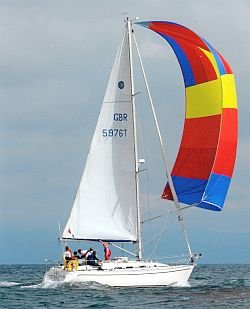
Going downwind.

Allan

Well-Known Member
Joined
17 Mar 2004
Messages
4,695
Location
Lymington
Visit site
We are definitely cruising sailing but would like some advice from racers. Going downwind we normally goose wing with genoa or gennaker and main. I believe most of you racers gybe across the wind as that's faster overall. I'd like to try gybing downwind this year to see which I prefer. What sort of angle off the wind would most people start at?
Boat is a Starlight 35 (standard keel) recent fully battened main and very good 150% Genoa.
Allan
 
I think this is boat and conditions dependant. Pure displacement boats are likely to be better sailing deeper or straight downwind. Planing or semi displacement hulls will probably be able to sail a better VMG downwind by gybing. Windspeed, water state, sail plan and hull shape all play a role into determining which option is best.
 
We are definitely cruising sailing but would like some advice from racers. Going downwind we normally goose wing with genoa or gennaker and main. I believe most of you racers gybe across the wind as that's faster overall. I'd like to try gybing downwind this year to see which I prefer. What sort of angle off the wind would most people start at?
Boat is a Starlight 35 (standard keel) recent fully battened main and very good 150% Genoa.
Allan
Depends on wind speed.

The stronger the wind, the narrower the gybe angle. Flying kites I'm doing 140TWA in 6 knots, 160 in 9 knots, 170 in 14 knots, as low as I dare in 18, then come back to 155-160 over 20 knots as I'm on the plane at that point.

However, with a genoa on a Starlight, I'd be pointing almost DDW with the Genoa poled out from about 8 knots. Simply because a roller furler genoa, which will have a much heavier cloth weight than my J1, will not be very efficient sailing deep angles in light breezes, but will be ok when supported by the pole. With your Gennaker, you should be sailing roughly the same angles as me in the light, but over about 14 knots you'll probably be better DDW with the poled out Genoa.
 
A jib to leeward - even poled out to leeward - will not have better downwind vmg than wing on wing

Angles will be quite bad and progress downwind will be frustratingly slow

Without a spinnaker, what you are doing is the fastest way to get downwind

One thing you could try when wing on wing , and maybe you are already doing it, is to head up a bit and put the jib by the lee. This will probably be faster than straight down wind. You will need to adjust the pole fore and aft as well as up and down to get the most out of this

Boat speed and vmg will both be better, but if your destination is ddw you will have to gybe and that takes time
 
Last edited:
On a strictly displacement Rassy 310, with the choice of a fractional 105% genny or an asymmetric (which amounts to a masthead 150% genny), both of which I can pole; the rhumb line, shortest route, always seems to win out. Certainly over a day’s passage. It worked for Jean Le Cam, in the 2020 Vendée, and I’ve been sticking to the strategy ever since! With faster passage times, but lower peak speeds……
 
We are definitely cruising sailing but would like some advice from racers. Going downwind we normally goose wing with genoa or gennaker and main. I believe most of you racers gybe across the wind as that's faster overall. I'd like to try gybing downwind this year to see which I prefer. What sort of angle off the wind would most people start at?
Boat is a Starlight 35 (standard keel) recent fully battened main and very good 150% Genoa.
Allan
My last boat as a Starlight 35 and I raced it on a similar basis to you. It was definitely faster to sail downwind rather than tack - the boat was to heavy and too cruisey to gain enough speed off the wind to make up for the extra distance sailed.

sailing_1_005.jpg
Lovely boat - wish I had kept it but it was getting too heavy for my old body. Bought another Steven Jones to replace it - a Sadler 290. Excellent performance for a 29ft bilgie
 
If you have a chart plotter it likely has a display for VMG to wind along with VMG to Waypoint. In this case you would see a negative value here but it makes these decisions much easier.
I would bet the 135 degree angle would be your fastest point of downwind with main and jib but I certainly could be wrong for your boat.
 
If you have a chart plotter it likely has a display for VMG to wind along with VMG to Waypoint. In this case you would see a negative value here but it makes these decisions much easier.
I would bet the 135 degree angle would be your fastest point of downwind with main and jib but I certainly could be wrong for your boat.
That may be the highest speed, but I doubt it has the best VMG. Proper displacement boats hardly ever benefit from tacking downwind ti that extent, that’s a multihull angle. And even we’d sail deeper than that with the kite up.
 
a set of Polar diagrams for you boat will give the answer and also show that it's slightly different for different wind speeds
that said, its unlikely to be anything other than dead down wind given the displacement and rig dimensions. The main reason for sailing less than 180deg is to avoid a Chinese gybe
if you look at the polars for a high performance asymmetric sailed yacht compared to your Starlight (or similar) you'll get a better understanding of of why they sail the higher angles and the relationship between speed through the water and velocity made good dead down wind
you'll be more comfortable on the Starlight and can laugh at their exertions hiking out and gybing, as you make another cuppa or warm up your lunch.....
 
a set of Polar diagrams for you boat will give the answer

any easily available polars are unlikely to be for jib and main alone, or to include wing-on-wing. For some boats you might find polars for both symmetric and asymmetric configurations.

the 135 TWA mentioned above is undoubtedly too hot for jib and main. Plenty of performance-oriented asym boats will have a target TWA in that 135 range for light winds, but with a huge spinnaker. I suspect that for many cruising boats any time the target angle is 135 with a spinnaker, wing on wing will provide better VMG.

For pretty much any boat without a spinnaker, wing-on-wing will provide the highest VMG.

Even some boats with asymmetric spinnakers, like the J/70, find that running wing-on-wing - with the asym, not the jib - has better VMG than sailing the asym normally in winds under about 15kts.
 
Last edited:
While going downwind with white sails (main+genoa) I d give some thoughts to the sailing ''comfort'' too, in particular during longer runs. Personally I am more than happy to avoid dead downwind and give up some VMG in favour of a boat which is rolling a lot less, it heels on a predominant side rather than playing the metronome and throwing people and stuff all over the place, needs less constant attention to the wind angle (risk of accidental gybes, banging sails etc), also when the wind is light the increase in apparent wind immediately benefits the wind steering and -despite hardly ever using it- I see the electric autopilot working a lot less when 20-30 degrees off the wind than DDW, the boat seems happier overall. When DDW was almost unavoidable, say specific coastlines etc, I usually have memories of rather miserable sailing, if at all possible I d always prefer broad reaching and jibing, happier sail for a longer time what s not to like :)
 
I agree with a lot of what you say - DDW in big seas can be awful. The wing on wing configuration can be very rolly, and with no feeling on the helm it can be difficult to steer - for man or machine.

I will say that modern boats with width carried aft are more comfortable in this configuration than more traditional designs.

on the other hand, many modern designs have trouble DDW because of spreaders being swept so far aft

when 20-30 degrees off the wind than DDW, the boat seems happier overall.

The problem is you need to come up a fair bit to get the genoa to work - i think usually more than 20 to 30deg,

But it depends on the boat i guess.

Sure - for short trips reaching and gybing is fine.

But for say an E to W tradewind atlantic crossing, you will add a lot of time to an already long voyage.
 
It should be said that tacking downw8nd for max VMG is literally that, you need to gybe on the shifts just as you do tacking on the shifts upwind. If you don’t tack on the shifts upwind, then sailing the angles downwind is probably not for you.
 
you need to come up a fair bit to get the genoa to work - i think usually more than 20 to 30deg,
I usually bring the boat to the first notch in the analogue wind display, ie 30deg :) On my boat -I reckon similar to the OP's- less than that is useless. 30deg deviation means 15% increase in distance, slight increase in speed so maybe 5-10% time increase overall? It goes into the balance with quite different sailing conditions.
A particular case is when wave direction is slightly different from wind direction, there are glorious sailings to be had with waves perfectly astern and wind from say polar 150deg, it gets a little bumpier on the other tack, IMHO preferable to DDW with waves always on the quarter from the same side.
Anyway, I think it s worth testing to find what one feels better with; the general approach is maximising speed, there may be other aspects worth considering.
 
FWIW Allan, we came round Lands End one season heading up the bristol channel in my Starlight. We were Goose winged with the main held by a jibe preventer and the genoa fully unrolled and poled out. The boat is so controllable that we were on autopilot ( below deck Simrad hydraulic) and busily doing anything but paying notice to what was happening. The wind steadily built, the boat trundled on, until suddenly the bow have was above the guard rails and the log briefly flashed up to 14kn. Panic stations and the fastest reef down I have ever seen! Not an approach ever to be tried deliberately but the really surprising thing was that the autopilot held the course as it always did.
They are fabulous all round boats.
 
I agree with a lot of what you say - DDW in big seas can be awful. The wing on wing configuration can be very rolly, and with no feeling on the helm it can be difficult to steer - for man or machine.

I will say that modern boats with width carried aft are more comfortable in this configuration than more traditional designs.

on the other hand, many modern designs have trouble DDW because of spreaders being swept so far aft


The problem is you need to come up a fair bit to get the genoa to work - i think usually more than 20 to 30deg,

But it depends on the boat i guess.

Sure - for short trips reaching and gybing is fine.

But for say an E to W tradewind atlantic crossing, you will add a lot of time to an already long voyage.
For long DDW passages we set a 130% genoa on a pole. The main goes out as far as possible on the other side and we also set the jib on the same side as the main, sheeted tight. We ideally sail slightly by the lee as low as 160 degrees for better speed and less rolling. The jib set tight acts as a roll damper and provides more sail area. This configuration punches above its weight for us and works well upto about 20kts true. After this we would be looking to reef. Below 13kts true on an Atlantic passage we would set the big spinnaker during daylight hours and back to the above configuration at night for easy reefing
 
Cant say I ever experienced a significant rolling issue going DDW wing and wing. Did get very near trouble with main and spinnaker DDW at 25kn true but not with the genoa. That said the Starlight had an excellent grip on the water and never once rounded up pushing hard in races when the likes of the Benny First were doing so.
 
Cant say I ever experienced a significant rolling issue going DDW wing and wing. Did get very near trouble with main and spinnaker DDW at 25kn true but not with the genoa. That said the Starlight had an excellent grip on the water and never once rounded up pushing hard in races when the likes of the Benny First were doing so.
We only experience rolking when in significant waves and wind. It's not going to be an issue in lake Solent
 
For long DDW passages we set a 130% genoa on a pole. The main goes out as far as possible on the other side and we also set the jib on the same side as the main, sheeted tight. We ideally sail slightly by the lee as low as 160 degrees for better speed and less rolling. The jib set tight acts as a roll damper and provides more sail area. This configuration punches above its weight for us and works well upto about 20kts true. After this we would be looking to reef. Below 13kts true on an Atlantic passage we would set the big spinnaker during daylight hours and back to the above configuration at night for easy reefing
Surprised that you need to reef going downwind in 20knots true - which should be a boat speed of circa 7 knots so just a benign 13knots apparent.
We pop a reef in upwind in about 17-20 knots true upwind (20-25 knots apparent) as we have a biggish rig, but quite happy deep downwind in 25-30 knots true.
(Sudden 55 knot squall off the hills with full sail was more “interesting”.)
 
Surprised that you need to reef going downwind in 20knots true - which should be a boat speed of circa 7 knots so just a benign 13knots apparent.
We pop a reef in upwind in about 17-20 knots true upwind (20-25 knots apparent) as we have a biggish rig, but quite happy deep downwind in 25-30 knots true.
(Sudden 55 knot squall off the hills with full sail was more “interesting”.)
We have a tall mast and plenty of sail area. We don't need more boat speed. When we are cruising long distance we sail conservatively as there is just the two of us onboard.
Upwind we reef at 20/21kts apparent. Our toerail will be dipping in the water at this point. Rolling the genoa away and unroling the blade jib gives us more comfort, more upright, pointing higher and less pitching.
I find the reefing is heavily dependant on seastate. In flat water, we can carry the 165m2 spinnaker in 18kts True but in 5m seas we probably set a different sail plan with no spinnaker. Also, it depends if we are sailing in daylight or at night. We would always have a more conservative sail plan at night
 
Top